## Diagram: Spatial Reasoning Test
### Overview
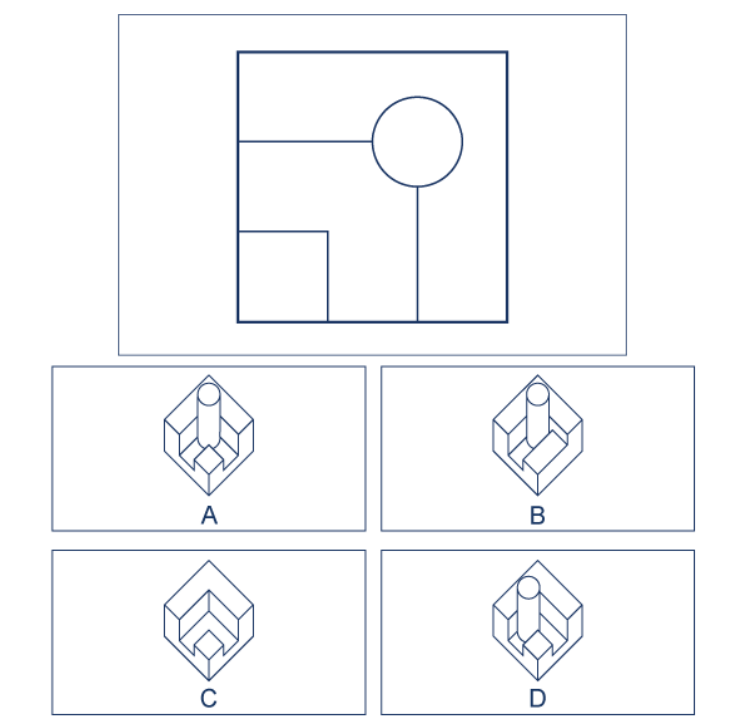
The image presents a spatial reasoning problem, commonly found in psychometric or engineering aptitude tests. The top panel displays a 2D orthographic top-down view of a 3D object. The bottom panel provides four isometric perspective options (labeled A, B, C, and D) to identify the correct 3D representation of the top-down view.
### Components
* **Top View (Reference):** A square outline representing the base of the object.
* **Bottom-left:** A square cutout.
* **Top-right:** A circle.
* **Isometric Views (Options):** Four distinct 3D renderings of a square block.
* **A:** Isometric block with a square cutout at the front corner and a cylinder on the back corner.
* **B:** Isometric block with a square cutout at the front corner and a cylinder inside the cutout.
* **C:** Isometric block with a square cutout at the front corner, with no cylinder.
* **D:** Isometric block with a square cutout at the front corner and a cylinder on the back corner.
### Detailed Analysis
The task requires mapping the 2D top-down view to the correct 3D isometric projection.
* **Top View Analysis:**
* The square boundary defines the footprint.
* The square cutout is located in the bottom-left corner of the 2D view.
* The circle is located in the top-right corner of the 2D view.
* **Isometric Orientation:**
* In the provided isometric views, the "front" corner of the block corresponds to the "bottom" of the top-down view.
* The "back" corner of the block corresponds to the "top" of the top-down view.
* Therefore, the cylinder must be positioned on the back corner of the block, and the cutout must be at the front corner.
* **Option Comparison:**
* **Option A:** Shows the cylinder on the back corner.
* **Option B:** Shows the cylinder inside the front cutout. This contradicts the top-down view where the circle is in the opposite corner from the cutout.
* **Option C:** Shows no cylinder, which contradicts the presence of the circle in the top-down view.
* **Option D:** Shows the cylinder on the back corner.
### Key Observations
* **Ambiguity:** Options A and D appear to be identical in their geometric representation. Both depict a square block with a front-facing square cutout and a cylinder positioned on the back corner.
* **Spatial Logic:** The correct answer must be either A or D, as they are the only options that correctly place the cylinder in the corner opposite the cutout (the back corner), matching the top-down reference.
### Interpretation
This diagram is designed to test **spatial visualization ability**, specifically the capacity to mentally rotate a 2D orthographic projection into a 3D isometric view.
* **The Logic:** By identifying that the "bottom-left" of the 2D view corresponds to the "front" of the 3D view, one can eliminate options B and C immediately.
* **The Anomaly:** The presence of two identical options (A and D) suggests either a printing error in the source material or a test of the observer's ability to identify that multiple options might satisfy the geometric constraints provided. If this were a strict test, the observer would look for minute differences in line weight, perspective, or cylinder height, though none are visually apparent here.