\n
## Diagram: Spatial Reasoning Puzzle
### Overview
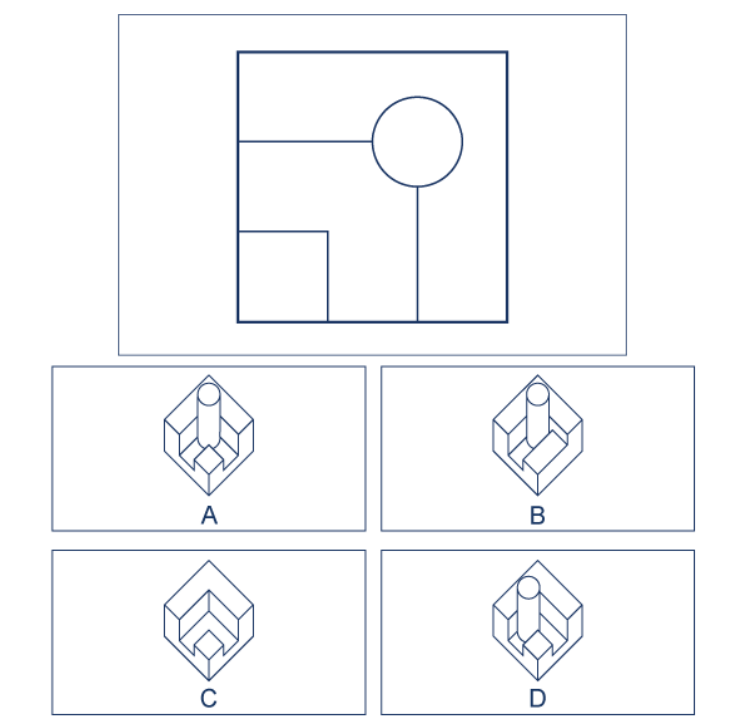
The image presents a spatial reasoning puzzle. It consists of a 2D geometric arrangement at the top and four 3D isometric cube arrangements (labeled A, B, C, and D) at the bottom. The task appears to be identifying which of the 3D cubes could be formed by folding the 2D arrangement.
### Components/Axes
The image contains the following components:
* **Top Section:** A 2D geometric arrangement composed of rectangles and a circle.
* **Bottom Section:** Four isometric cube arrangements labeled A, B, C, and D.
* **Labels:** A, B, C, and D are labels for the four cube arrangements.
There are no axes or scales present in this image.
### Detailed Analysis or Content Details
The top section shows a large rectangle with a smaller rectangle attached to its bottom edge. A further, smaller rectangle is attached to the bottom edge of the second rectangle. A circle is connected to the top of the large rectangle via a line.
The four cube arrangements (A, B, C, and D) are isometric projections of cubes with internal cutouts or extensions. Each cube has a different arrangement of these features.
* **Cube A:** Shows a cylindrical cutout on the top face and a rectangular extension on the front face.
* **Cube B:** Shows a cylindrical cutout on the top face and a rectangular extension on the right face.
* **Cube C:** Shows a cylindrical cutout on the top face and a rectangular extension on the left face.
* **Cube D:** Shows a cylindrical cutout on the top face and a rectangular extension on the back face.
### Key Observations
The key element to consider is how the 2D arrangement would fold into a 3D cube. The circle likely represents a cylindrical cutout, and the rectangles represent extensions or indentations on the cube's faces. The orientation of the rectangles relative to the circle is crucial.
### Interpretation
This image is a test of spatial visualization skills. The puzzle requires the viewer to mentally manipulate the 2D shape to determine which 3D cube it can be folded into. The correct answer would be the cube where the rectangular extension aligns with the position of the rectangles in the 2D arrangement relative to the circle. Without further context or instructions, it's impossible to determine the "correct" answer. The puzzle is designed to assess the ability to understand and reason about 3D shapes from 2D representations. The puzzle is a classic example of a non-verbal reasoning test.