## Image Analysis: Human Pose Decomposition and Representation
### Overview
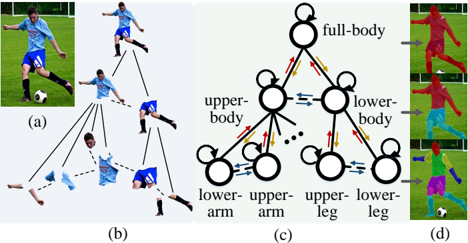
The image presents a visual representation of human pose decomposition and modeling, likely related to computer vision or machine learning. It shows a soccer player's image broken down into hierarchical components and represented as a state diagram.
### Components/Axes
* **(a):** Original image of a soccer player kicking a ball.
* **(b):** Hierarchical decomposition of the soccer player's image into body parts. The full body is at the top, branching down to upper and lower body, and further down to individual limbs. Dashed lines indicate less certain connections.
* **(c):** State diagram representing the relationships between body parts. Nodes represent body parts (full-body, upper-body, lower-body, lower-arm, upper-arm, upper-leg, lower-leg). Arrows indicate transitions or relationships between states. The arrows are colored blue, red, and yellow.
* **(d):** Visualization of the body part segmentation. The original image is overlaid with different colors representing different body parts.
### Detailed Analysis
**Section (a):**
* Shows a soccer player in action, kicking a soccer ball.
**Section (b):**
* The full image is at the top.
* It branches into the upper and lower body.
* The upper body branches into the upper arms.
* The lower body branches into the upper and lower legs.
* The arms and legs are further broken down into their respective parts.
**Section (c):**
* **Nodes:**
* full-body (at the top)
* upper-body (left side, below full-body)
* lower-body (right side, below full-body)
* lower-arm (bottom-left)
* upper-arm (left-center, below upper-body)
* upper-leg (right-center, below lower-body)
* lower-leg (bottom-right)
* **Arrows:**
* Self-loops on each node.
* Bi-directional arrows between upper-body and lower-body (blue).
* Arrows from upper-body to upper-arm (red/orange).
* Arrows from lower-body to upper-leg (red/orange).
* Bi-directional arrows between upper-arm and lower-arm (blue).
* Bi-directional arrows between upper-leg and lower-leg (blue).
* Arrows from full-body to upper-body and lower-body (red/orange).
**Section (d):**
* The original image is segmented into different body parts, each colored differently.
* The colors appear to correspond to the body parts identified in the state diagram.
* The segmentation is not perfect, but it provides a visual representation of the body part decomposition.
### Key Observations
* The image demonstrates a hierarchical approach to representing human pose.
* The state diagram captures the relationships between different body parts.
* The segmentation provides a visual representation of the body part decomposition.
### Interpretation
The image illustrates a method for representing human pose using a hierarchical decomposition and a state diagram. This approach could be used in computer vision applications such as pose estimation, action recognition, and human-computer interaction. The hierarchical decomposition allows for a coarse-to-fine representation of the human body, while the state diagram captures the relationships between different body parts. The segmentation provides a visual representation of the body part decomposition, which can be used for training and evaluation. The use of different colored arrows in the state diagram likely indicates different types of relationships or probabilities of transitions between states. The dashed lines in the hierarchical decomposition might indicate weaker or less certain relationships between body parts.