## Diagram: Human Motion Analysis Framework
### Overview
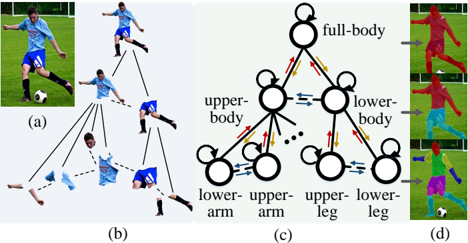
The image depicts a hierarchical motion analysis system for human movement tracking, visualized through three interconnected components:
1. **(a)** A static image of a soccer player kicking a ball.
2. **(b)** A pose sequence diagram showing multiple body positions connected by dashed lines.
3. **(c)** A flow diagram with labeled body parts and color-coded arrows.
4. **(d)** Color-coded body part visualizations aligned with the flow diagram.
### Components/Axes
#### (a) Static Image
- **Label**: (a)
- **Content**: Soccer player in mid-kick pose.
#### (b) Pose Sequence Diagram
- **Label**: (b)
- **Structure**:
- **Nodes**: 6 sequential poses of the soccer player.
- **Connections**: Dashed lines linking poses, suggesting motion trajectory.
- **Spatial Layout**: Poses arranged vertically, with the initial pose at the top and subsequent poses branching downward.
#### (c) Flow Diagram
- **Label**: (c)
- **Components**:
- **Nodes**: 7 labeled body parts:
- Full-body (top)
- Upper-body (left)
- Lower-body (right)
- Upper-arm (left)
- Lower-arm (left)
- Upper-leg (right)
- Lower-leg (right)
- **Arrows**:
- **Colors**: Red, blue, green (mapped to body parts via legend).
- **Directions**:
- Red: Full-body → Upper-body/Lower-body.
- Blue: Upper-body → Upper-arm/Lower-arm.
- Green: Lower-body → Upper-leg/Lower-leg.
- **Legend**:
- **Colors**:
- Red = Upper-body
- Blue = Lower-body
- Green = Upper-arm/Lower-arm
- Purple = Upper-leg/Lower-leg
#### (d) Color-Coded Body Part Visualizations
- **Label**: (d)
- **Content**:
- Three figures with color-coded body parts:
- **Red**: Upper-body (torso/arms).
- **Blue**: Lower-body (legs).
- **Purple**: Upper-leg/Lower-leg (detailed leg segmentation).
- **Arrows**: Point from the flow diagram (c) to the figures, indicating mapping of abstract labels to visual representations.
### Detailed Analysis
1. **Hierarchical Breakdown**:
- The flow diagram (c) decomposes the full-body motion into progressively granular components (e.g., full-body → upper/lower-body → limbs).
- Arrows indicate directional relationships (e.g., full-body motion influences upper/lower-body, which further influence limbs).
2. **Color Coding**:
- Red, blue, and green arrows in (c) correspond to body regions, with purple used for leg-specific segmentation in (d).
- Spatial grounding: Red (upper-body) and blue (lower-body) nodes are centrally positioned, while green (arms) and purple (legs) nodes are peripheral.
3. **Pose-to-Component Mapping**:
- The static image (a) and pose sequence (b) feed into the flow diagram (c), which abstracts motion into labeled body parts.
- Color-coded figures in (d) validate the flow diagram’s segmentation.
### Key Observations
- **Hierarchical Flow**: Motion is analyzed from macro (full-body) to micro (individual limbs) levels.
- **Color Consistency**: Arrows in (c) and figures in (d) use identical color coding (e.g., red for upper-body).
- **Dashed Lines in (b)**: Suggest uncertainty or variability in pose transitions.
### Interpretation
This framework demonstrates a **motion capture and analysis pipeline**:
1. **Data Input**: Captured poses (a, b) are processed to identify key body joints.
2. **Hierarchical Segmentation**: The flow diagram (c) abstracts motion into labeled body parts, enabling targeted analysis (e.g., tracking leg movement independently).
3. **Validation**: Color-coded figures (d) confirm the accuracy of the segmentation.
**Notable Insight**: The use of color coding and hierarchical arrows suggests a system designed for real-time motion tracking, where upper/lower-body and limb movements are analyzed separately for applications like sports analytics or rehabilitation.