## Heatmap: Syllogism Format vs. Predicted Validity
### Overview
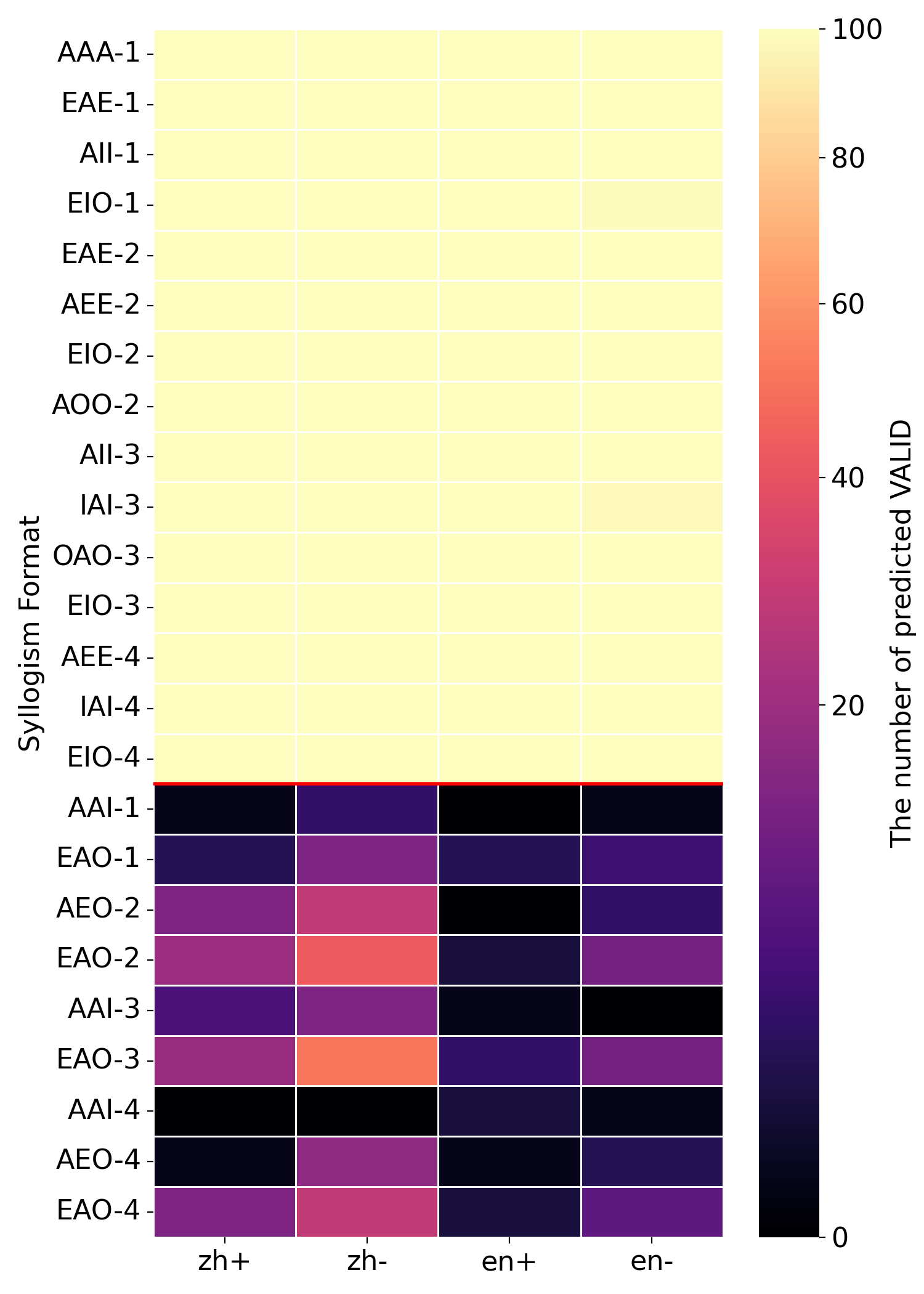
The image is a heatmap visualizing the number of predicted valid syllogisms for different syllogism formats across four conditions: zh+, zh-, en+, and en-. The color intensity represents the number of predicted valid syllogisms, ranging from 0 (dark purple) to 100 (light yellow). The heatmap is divided into two distinct regions separated by a red line. The top region shows high validity across all conditions, while the bottom region shows varying degrees of validity depending on the syllogism format and condition.
### Components/Axes
* **Y-axis:** Syllogism Format. The syllogism formats are listed vertically, with the first 12 formats (AAA-1 to EIO-4) in the top region and the remaining 8 formats (AAI-1 to EAO-4) in the bottom region.
* **X-axis:** Conditions. The conditions are zh+, zh-, en+, and en-.
* **Color Scale:** The color scale represents the number of predicted valid syllogisms, ranging from 0 (dark purple) to 100 (light yellow).
* **Legend:** Located on the right side of the heatmap, showing the color gradient and corresponding numerical values (0, 20, 40, 60, 80, 100). The label for the legend is "The number of predicted VALID".
### Detailed Analysis
**Syllogism Formats (Y-axis):**
* AAA-1
* EAE-1
* AII-1
* EIO-1
* EAE-2
* AEE-2
* EIO-2
* AOO-2
* AII-3
* IAI-3
* OAO-3
* EIO-3
* AEE-4
* IAI-4
* EIO-4
* AAI-1
* EAO-1
* AEO-2
* EAO-2
* AAI-3
* EAO-3
* AAI-4
* AEO-4
* EAO-4
**Conditions (X-axis):**
* zh+
* zh-
* en+
* en-
**Data Points:**
* **Top Region (AAA-1 to EIO-4):** All cells in this region are light yellow, indicating a value close to 100 for all syllogism formats and conditions.
* **AAI-1:** zh+ (dark purple, ~0), zh- (dark purple, ~0), en+ (dark purple, ~0), en- (dark purple, ~0)
* **EAO-1:** zh+ (dark purple, ~0), zh- (dark purple, ~0), en+ (dark purple, ~0), en- (dark purple, ~0)
* **AEO-2:** zh+ (dark purple, ~0), zh- (red-purple, ~30), en+ (dark purple, ~0), en- (dark purple, ~0)
* **EAO-2:** zh+ (red-purple, ~30), zh- (orange, ~70), en+ (dark purple, ~0), en- (dark purple, ~0)
* **AAI-3:** zh+ (dark purple, ~0), zh- (dark purple, ~0), en+ (dark purple, ~0), en- (dark purple, ~0)
* **EAO-3:** zh+ (red-purple, ~30), zh- (orange, ~70), en+ (red-purple, ~30), en- (dark purple, ~0)
* **AAI-4:** zh+ (dark purple, ~0), zh- (dark purple, ~0), en+ (dark purple, ~0), en- (dark purple, ~0)
* **AEO-4:** zh+ (dark purple, ~0), zh- (red-purple, ~30), en+ (dark purple, ~0), en- (dark purple, ~0)
* **EAO-4:** zh+ (red-purple, ~30), zh- (red-purple, ~30), en+ (dark purple, ~0), en- (dark purple, ~0)
### Key Observations
* The top 15 syllogism formats (AAA-1 to EIO-4) consistently show high predicted validity across all conditions (zh+, zh-, en+, en-).
* The bottom 9 syllogism formats (AAI-1 to EAO-4) show significantly lower predicted validity, with some formats showing higher validity in the zh- condition.
* The 'en+' and 'en-' conditions generally show very low predicted validity for the bottom syllogism formats.
* A red line separates the two regions of the heatmap, visually highlighting the difference in predicted validity between the two groups of syllogism formats.
### Interpretation
The heatmap suggests that certain syllogism formats (AAA-1 to EIO-4) are consistently predicted as valid, regardless of the condition (zh+, zh-, en+, en-). In contrast, other syllogism formats (AAI-1 to EAO-4) are generally predicted as invalid, with some exceptions in the zh- condition. The 'en+' and 'en-' conditions appear to have a negative impact on the predicted validity of these syllogism formats.
The separation of the heatmap into two distinct regions indicates a clear difference in the predicted validity of different syllogism formats. This could be due to the inherent logical structure of the syllogisms or the way they are processed under different conditions. The higher validity observed in the zh- condition for some syllogism formats suggests that this condition may be more conducive to valid reasoning for those specific formats. The consistently low validity in the 'en+' and 'en-' conditions warrants further investigation to understand the factors contributing to this effect.