## Line Chart: Proportion of Flips in Llama-3.1-8B Across Iterations
### Overview
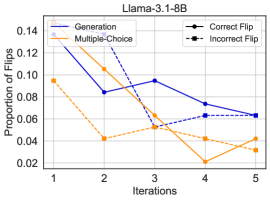
The chart illustrates the proportion of correct and incorrect flips for two prompting strategies ("Generation" and "Multiple-Choice") across five iterations. The y-axis represents the proportion of flips (0.02–0.14), and the x-axis represents iterations (1–5). Two lines are plotted: a blue line for "Generation" and an orange dashed line for "Multiple-Choice," each annotated with markers for correct (filled circles) and incorrect (open squares) flips.
### Components/Axes
- **X-axis (Iterations)**: Labeled "Iterations," with discrete values 1, 2, 3, 4, 5.
- **Y-axis (Proportion of Flips)**: Labeled "Proportion of Flips," scaled from 0.02 to 0.14 in increments of 0.02.
- **Legend**: Located in the top-right corner.
- **Correct Flip**: Black filled circles.
- **Incorrect Flip**: Black open squares.
- **Lines**:
- **Blue Solid Line**: Represents "Generation" strategy.
- **Orange Dashed Line**: Represents "Multiple-Choice" strategy.
### Detailed Analysis
#### Generation (Blue Line)
- **Iteration 1**: Correct flip = ~0.14 (circle), Incorrect flip = ~0.14 (square).
- **Iteration 2**: Correct flip = ~0.08 (circle), Incorrect flip = ~0.12 (square).
- **Iteration 3**: Correct flip = ~0.10 (circle), Incorrect flip = ~0.08 (square).
- **Iteration 4**: Correct flip = ~0.06 (circle), Incorrect flip = ~0.08 (square).
- **Iteration 5**: Correct flip = ~0.06 (circle), Incorrect flip = ~0.06 (square).
#### Multiple-Choice (Orange Dashed Line)
- **Iteration 1**: Correct flip = ~0.09 (circle), Incorrect flip = ~0.11 (square).
- **Iteration 2**: Correct flip = ~0.04 (circle), Incorrect flip = ~0.08 (square).
- **Iteration 3**: Correct flip = ~0.06 (circle), Incorrect flip = ~0.06 (square).
- **Iteration 4**: Correct flip = ~0.02 (circle), Incorrect flip = ~0.04 (square).
- **Iteration 5**: Correct flip = ~0.04 (circle), Incorrect flip = ~0.04 (square).
### Key Observations
1. **Trend for Generation**:
- Correct flips start high (~0.14) in Iteration 1, drop to ~0.08 in Iteration 2, then stabilize around ~0.06–0.10 in later iterations.
- Incorrect flips peak at ~0.12 in Iteration 2, then decline to ~0.06 by Iteration 5.
2. **Trend for Multiple-Choice**:
- Correct flips start at ~0.09 in Iteration 1, drop to ~0.02 in Iteration 4, then rebound to ~0.04 in Iteration 5.
- Incorrect flips decrease from ~0.11 in Iteration 1 to ~0.04 in Iteration 4, then stabilize at ~0.04 in Iteration 5.
### Interpretation
- **Performance Degradation**: Both strategies show a general decline in correct flips over iterations, suggesting potential overfitting or adaptation to specific prompts. However, "Multiple-Choice" exhibits sharper declines, indicating less robustness compared to "Generation."
- **Incorrect Flip Patterns**: The "Generation" strategy’s incorrect flips decrease steadily after Iteration 2, while "Multiple-Choice" shows a more erratic decline. This could imply that "Generation" better manages error reduction over time.
- **Outliers**: The sharp drop in "Multiple-Choice" correct flips at Iteration 4 (~0.02) is notable, possibly reflecting a critical failure or misalignment in prompting strategy during that iteration.
- **Implications**: The data highlights trade-offs between prompting methods. While "Generation" maintains more stable performance, "Multiple-Choice" may struggle with consistency, raising questions about its suitability for iterative refinement tasks.