## Diagram: Process Flow with Mathematical Transformations
### Overview
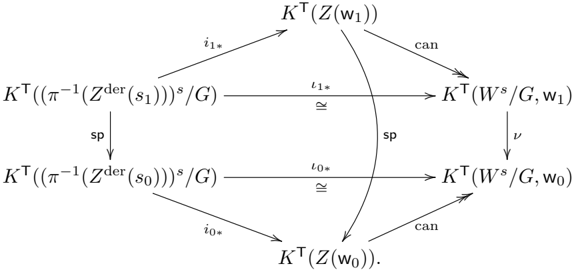
The diagram illustrates a complex process flow involving mathematical transformations and operations. It features interconnected components labeled with algebraic expressions, arrows with symbolic labels, and hierarchical relationships. The structure suggests a computational or theoretical framework, possibly related to category theory, functional programming, or formal verification.
### Components/Axes
- **Top Section**:
- **K^T(Z(w₁))**: Central node with outgoing arrows labeled "can" and "τ₁*".
- **K^T(W^s / G, w₁)**: Connected to K^T(Z(w₁)) via "can" and "ν" arrows.
- **Middle Section**:
- **K^T((π⁻¹(Z^der(s₁)))^s / G)**: Connected to K^T(Z(w₁)) via "i₁*" and "τ₁*" arrows.
- **K^T((π⁻¹(Z^der(s₀)))^s / G)**: Connected to K^T(Z(w₀)) via "i₀*" and "τ₀*" arrows.
- **Bottom Section**:
- **K^T(Z(w₀))**: Central node with outgoing arrows labeled "can" and "sp".
- **K^T(W^s / G, w₀)**: Connected to K^T(Z(w₀)) via "can" and "sp" arrows.
- **Arrows**:
- **Labels**: "can", "sp", "ν", "τ₁*", "τ₀*", "i₁*", "i₀*".
- **Flow Direction**: Arrows indicate dependencies or transformations between components.
### Detailed Analysis
- **Mathematical Expressions**:
- **K^T(...)**: Likely denotes a type constructor or kernel function.
- **π⁻¹(Z^der(s))**: Inverse of a derivative operation applied to a function Z.
- **W^s / G**: A quotient structure, possibly a module or algebraic structure.
- **s₁, s₀, w₁, w₀**: Subscripts suggesting indexed states or variables.
- **Symbolic Labels**:
- **"can"**: May represent "canonical" or "computable" transitions.
- **"sp"**: Could denote "step" or "specification".
- **"ν"**: Likely a transformation or substitution.
- **"τ₁*", "τ₀*": Subscripted τ with asterisks, possibly time steps or indices.
### Key Observations
1. **Hierarchical Structure**: The diagram is organized into three tiers (top, middle, bottom), with vertical connections between components.
2. **Bidirectional Flow**: Arrows indicate both forward and backward dependencies (e.g., "can" and "sp" arrows).
3. **Mathematical Abstraction**: The use of π⁻¹, Z^der, and quotient structures suggests a focus on formal systems or computational models.
4. **Indexed States**: Subscripts (s₁, s₀, w₁, w₀) imply discrete steps or configurations.
### Interpretation
The diagram represents a formal process where:
- **Transformations** (e.g., π⁻¹, Z^der) are applied to inputs (s₁, s₀) to produce intermediate states.
- **Operations** ("can", "sp", "ν") govern transitions between states (w₁, w₀).
- **Indexed Components** (τ₁*, τ₀*) suggest temporal or sequential dependencies.
- **Quotient Structures** (W^s / G) imply modular or algebraic relationships.
This could model a computational workflow, such as:
- **Type Inference**: Where K^T represents type constructors and Z^der denotes derivative types.
- **Formal Verification**: Where "can" and "sp" enforce constraints or specifications.
- **Category Theory**: With objects as mathematical structures and arrows as morphisms.
The absence of numerical data emphasizes symbolic relationships, prioritizing logical or structural integrity over quantitative analysis.