## Diagram: Commutative Diagram of K-Theory
### Overview
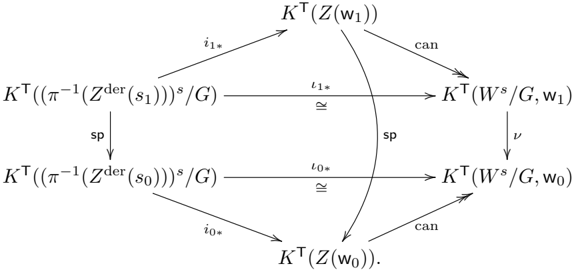
The image is a commutative diagram in the context of K-theory. It illustrates relationships between various K-theory groups associated with spaces and their quotients. The diagram consists of nodes representing K-theory groups and arrows representing maps between them.
### Components/Axes
* **Nodes:** The nodes represent K-theory groups, denoted by expressions like `K^T(Z(w_1))`, `K^T((π^{-1}(Z^{der}(s_1)))^s/G)`, `K^T(W^s/G, w_1)`, `K^T((π^{-1}(Z^{der}(s_0)))^s/G)`, `K^T(W^s/G, w_0)`, and `K^T(Z(w_0))`.
* **Arrows:** The arrows represent maps between the K-theory groups. They are labeled with symbols like `i_{1*}`, `can`, `sp`, `l_{1*}`, `l_{0*}`, `ν`, and `i_{0*}`. The symbol "≅" appears near the arrows labeled `l_{1*}` and `l_{0*}`, indicating an isomorphism.
* **Labels:** The labels on the arrows indicate the type of map or morphism between the K-theory groups.
### Detailed Analysis
The diagram can be broken down into the following relationships:
1. **Top Row:**
* `K^T(Z(w_1))` maps to `K^T((π^{-1}(Z^{der}(s_1)))^s/G)` via `i_{1*}`.
* `K^T(Z(w_1))` maps to `K^T(W^s/G, w_1)` via `can`.
* `K^T((π^{-1}(Z^{der}(s_1)))^s/G)` maps to `K^T(W^s/G, w_1)` via `l_{1*}`, which is an isomorphism (indicated by "≅").
2. **Middle Vertical Arrows:**
* `K^T((π^{-1}(Z^{der}(s_1)))^s/G)` maps to `K^T((π^{-1}(Z^{der}(s_0)))^s/G)` via `sp`.
* `K^T(W^s/G, w_1)` maps to `K^T(W^s/G, w_0)` via `ν`.
3. **Bottom Row:**
* `K^T((π^{-1}(Z^{der}(s_0)))^s/G)` maps to `K^T(W^s/G, w_0)` via `l_{0*}`, which is an isomorphism (indicated by "≅").
* `K^T((π^{-1}(Z^{der}(s_0)))^s/G)` maps to `K^T(Z(w_0))` via `i_{0*}`.
* `K^T(W^s/G, w_0)` maps to `K^T(Z(w_0))` via `can`.
4. **Curved Arrow:**
* `K^T(Z(w_1))` maps to `K^T(W^s/G, w_0)` via `sp`.
### Key Observations
* The diagram illustrates the relationships between K-theory groups associated with different spaces and their quotients under group actions.
* The presence of isomorphisms (indicated by "≅") suggests that certain maps preserve the structure of the K-theory groups.
* The curved arrow indicates a direct map from `K^T(Z(w_1))` to `K^T(W^s/G, w_0)`, bypassing the intermediate nodes.
### Interpretation
The diagram likely represents a step in a larger proof or argument in algebraic topology or K-theory. It shows how different K-theory groups are related through various maps, including canonical maps (`can`), specialization maps (`sp`), and maps induced by inclusions (`i_{1*}`, `i_{0*}`). The isomorphisms `l_{1*}` and `l_{0*}` are crucial, as they indicate that certain constructions are equivalent in K-theory. The commutativity of the diagram implies that different paths between the same starting and ending nodes yield the same result, which is essential for consistency in the theory. The diagram suggests a relationship between the K-theory of a space, its derived space, and quotients by a group action.