\n
## Diagram: Directed Acyclic Graph
### Overview
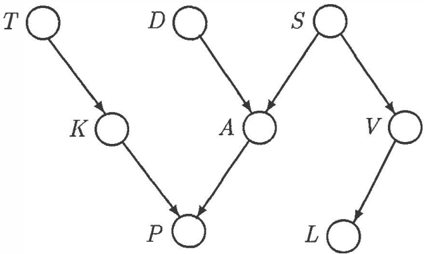
The image depicts a directed acyclic graph (DAG) consisting of nodes represented by circles and directed edges represented by arrows. The graph illustrates relationships between several elements labeled with single letters. There are no axes, scales, or legends present.
### Components/Axes
The diagram consists of the following nodes: T, D, S, K, A, P, V, and L.
The following directed edges are present:
- T -> K
- D -> A
- S -> V
- S -> A
- K -> P
- A -> P
- V -> L
### Detailed Analysis or Content Details
The graph can be described as follows:
* **Node T** has one outgoing edge to node K.
* **Node D** has one outgoing edge to node A.
* **Node S** has two outgoing edges, one to node V and one to node A.
* **Node K** has one outgoing edge to node P.
* **Node A** has one outgoing edge to node P.
* **Node P** has no outgoing edges.
* **Node V** has one outgoing edge to node L.
* **Node L** has no outgoing edges.
The graph is acyclic, meaning there are no closed loops or cycles. The direction of the edges indicates a one-way relationship between the connected nodes.
### Key Observations
The nodes P and L are terminal nodes, meaning they have no outgoing edges. Nodes T, D, and S are source nodes, meaning they have no incoming edges. Node A has two incoming edges (from D and S) and one outgoing edge (to P).
### Interpretation
This diagram likely represents a workflow, dependency graph, or a hierarchical structure. The nodes could represent tasks, events, or entities, and the edges represent the order in which they must occur or the relationships between them. For example:
* T and D must occur before A and K.
* S must occur before V and A.
* K and A must occur before P.
* V must occur before L.
The graph suggests a process where multiple inputs (T, D, S) converge to a common point (A, P) and then diverge again (V, L). The absence of numerical data or further context limits a more precise interpretation. It is a structural representation of relationships, not a quantitative measurement.