\n
## Grid-Based Task Progression
### Overview
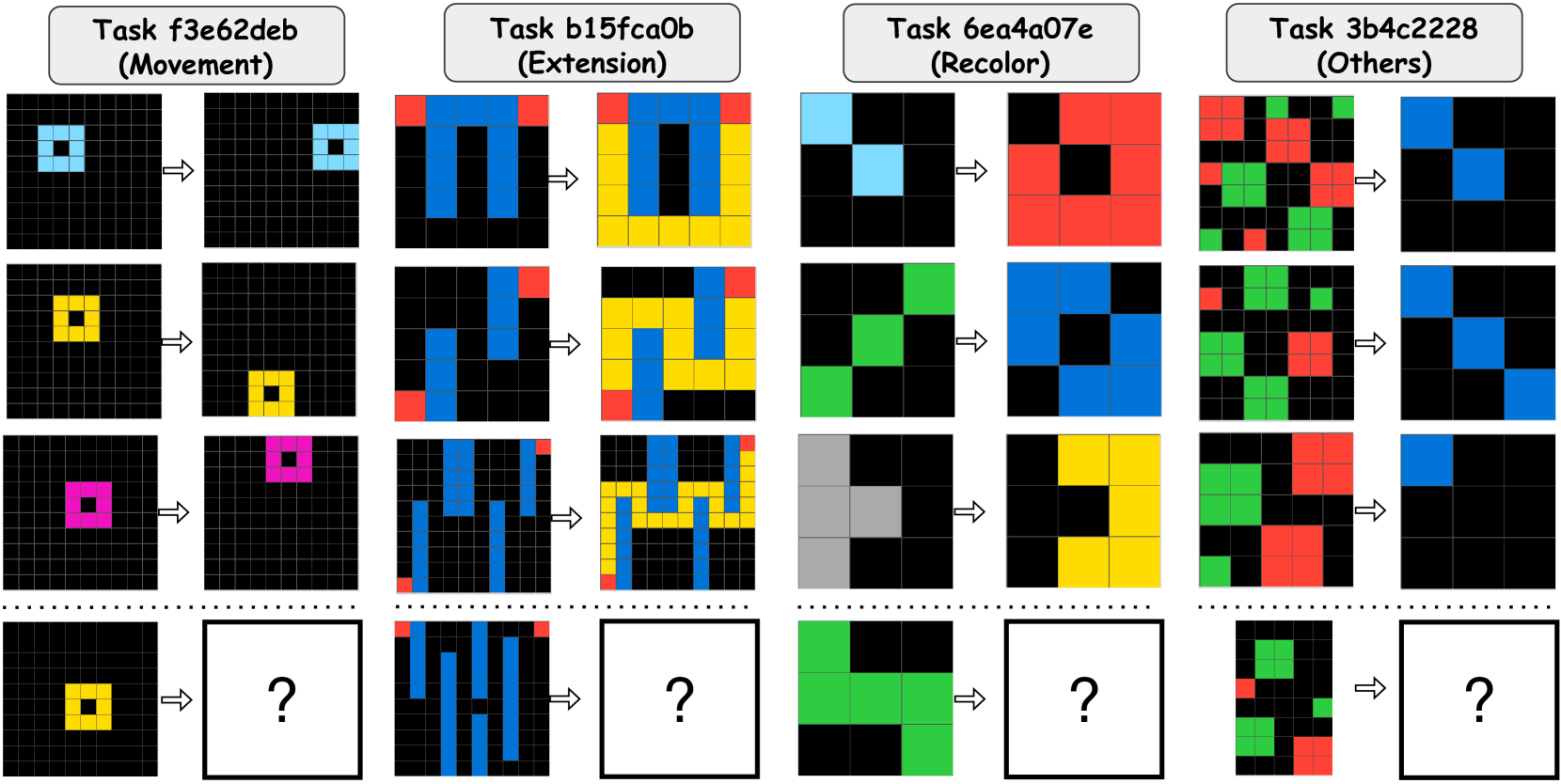
The image presents a series of grid-based visual tasks, categorized into four types: "Movement", "Extension", "Recolor", and "Others". Each task type displays three examples of an input grid and its corresponding output grid, followed by a fourth input grid with a question mark indicating the expected output is unknown. The grids are 8x8, composed of black, white, cyan, yellow, green, and magenta cells. Arrows visually connect the input and output grids, suggesting a transformation process.
### Components/Axes
The image is structured into four columns, each representing a task type. Each column contains four rows: three example transformations and one incomplete transformation. The column headers are:
* **Task f3e62deb (Movement)**
* **Task b15fca0b (Extension)**
* **Task 6ea4a07e (Recolor)**
* **Task 3b4c228 (Others)**
Each grid is composed of 64 cells. The cells are colored black, white, cyan, yellow, green, or magenta.
### Detailed Analysis or Content Details
**Task f3e62deb (Movement)**
* **Example 1:** A cyan square moves one cell to the right. Input: Cyan square in top-left corner. Output: Cyan square one cell to the right.
* **Example 2:** A yellow square moves two cells down. Input: Yellow square in top-left corner. Output: Yellow square two cells down.
* **Example 3:** A magenta square moves one cell down and one cell to the right. Input: Magenta square in top-left corner. Output: Magenta square one cell down and one cell to the right.
* **Incomplete:** A yellow square in the top-left corner. Expected output is unknown.
**Task b15fca0b (Extension)**
* **Example 1:** A cyan vertical line extends to fill the grid. Input: Cyan vertical line. Output: Cyan filled grid.
* **Example 2:** A yellow and cyan vertical line extends to fill the grid. Input: Yellow and cyan vertical line. Output: Yellow and cyan filled grid.
* **Example 3:** A yellow and magenta vertical line extends to fill the grid. Input: Yellow and magenta vertical line. Output: Yellow and magenta filled grid.
* **Incomplete:** A cyan and yellow vertical line. Expected output is unknown.
**Task 6ea4a07e (Recolor)**
* **Example 1:** A cyan square is recolored to green. Input: Cyan square. Output: Green square.
* **Example 2:** A yellow square is recolored to blue. Input: Yellow square. Output: Blue square.
* **Example 3:** A magenta square is recolored to yellow. Input: Magenta square. Output: Yellow square.
* **Incomplete:** A green square. Expected output is unknown.
**Task 3b4c228 (Others)**
* **Example 1:** A cyan square expands into a pattern of cyan, green, magenta, and red. Input: Cyan square. Output: Complex pattern.
* **Example 2:** A yellow square expands into a pattern of yellow, green, magenta, and red. Input: Yellow square. Output: Complex pattern.
* **Example 3:** A magenta square expands into a pattern of cyan, green, magenta, and red. Input: Magenta square. Output: Complex pattern.
* **Incomplete:** A green square. Expected output is unknown.
### Key Observations
* The "Movement" task involves shifting the position of a single colored square.
* The "Extension" task involves filling the entire grid based on an initial vertical line pattern.
* The "Recolor" task involves changing the color of a single square.
* The "Others" task involves a more complex transformation of a single square into a patterned grid.
* The incomplete tasks require predicting the output based on the observed patterns in the examples.
### Interpretation
The image demonstrates a series of visual reasoning tasks. The tasks are designed to assess an agent's ability to identify patterns and apply them to new inputs. The four task types represent different types of transformations: simple movement, grid filling, color replacement, and complex pattern generation. The presence of the question marks suggests that the image is part of a test or challenge, where the goal is to predict the correct output for the incomplete tasks. The tasks progressively increase in complexity, from simple movement to complex pattern generation. The "Others" task is particularly challenging, as it requires understanding a more abstract transformation rule. The consistent use of a grid format and limited color palette simplifies the visual complexity, allowing for a focus on the underlying transformation logic. The tasks could be used to evaluate the performance of machine learning models on visual reasoning tasks.