TECHNICAL ASSET FINGERPRINT
a54b576d4caa734288692811
Click to view fullscreen
Press ESC or click to close
FOUND IN PAPERS
EXPERT: healer-alpha-free VERSION 1
RUNTIME: free/openrouter/healer-alpha
INTEL_VERIFIED
## Visual Pattern Recognition Tasks: Four Transformation Categories
### Overview
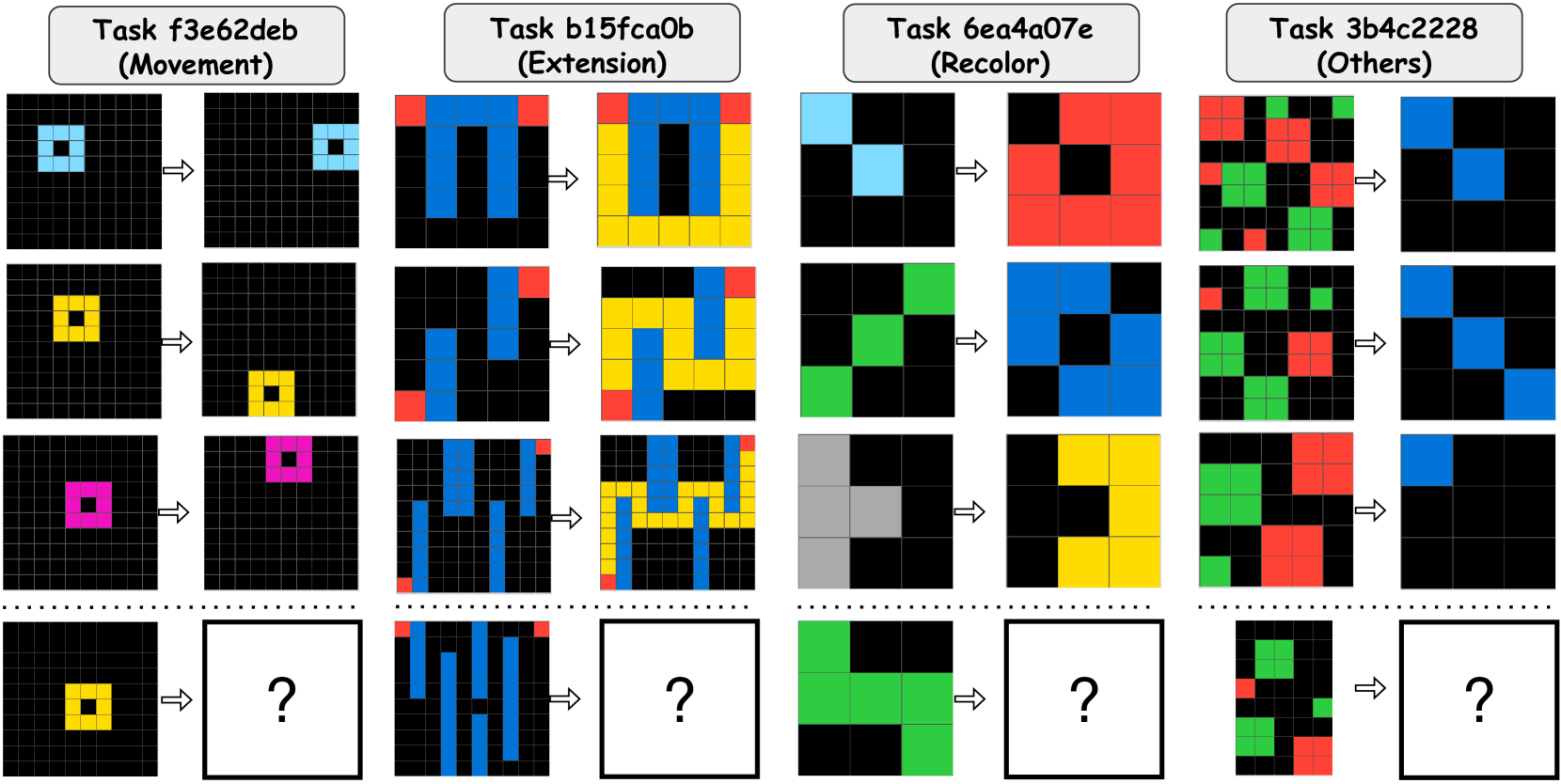
The image displays a structured set of visual reasoning tasks, organized into four columns. Each column represents a distinct category of transformation applied to grid-based pixel art. The image serves as a demonstration or test set for an AI or human to infer the underlying rule for each category and apply it to a final, unsolved example (marked with a "?").
### Components/Axes
The image is divided into four vertical columns, each with a header and four rows of examples.
**Headers (Top of each column):**
1. **Task f3e62deb (Movement)**
2. **Task b15fca0b (Extension)**
3. **Task 6ea4a07e (Recolor)**
4. **Task 3b4c2228 (Others)**
**Structure per Column:**
* **Rows 1-3:** Three complete "input → output" example pairs.
* **Row 4:** A final "input → ?" test case, separated from the examples by a horizontal dotted line.
* **Grid Format:** Each input and output is presented as a square grid of pixels (approximately 8x8 or 10x10 cells). A right-pointing arrow (`→`) separates the input grid from the output grid in each pair.
### Detailed Analysis
#### **Column 1: Task f3e62deb (Movement)**
* **Rule Inference:** The transformation involves moving a single, solid-colored square shape within the grid.
* **Examples:**
1. **Input:** A light blue square outline (3x3 with a hollow center) in the top-left quadrant. **Output:** The same shape moved to the top-right quadrant.
2. **Input:** A solid yellow square (3x3) in the center-left. **Output:** The square moved to the bottom-center.
3. **Input:** A solid magenta square (3x3) in the center. **Output:** The square moved to the top-right.
* **Test Case (Row 4):**
* **Input:** A solid yellow square (3x3) in the center-left (identical to Example 2's input).
* **Expected Output:** Based on the pattern, the square should move to a new position. The rule is not a simple translation (e.g., "move right 3 cells") as the direction varies. It may involve moving to a specific quadrant or following a sequence.
#### **Column 2: Task b15fca0b (Extension)**
* **Rule Inference:** The transformation involves "extending" or "filling" areas adjacent to existing blue and red shapes with yellow pixels.
* **Examples:**
1. **Input:** Blue vertical bars and red corner pixels on a black background. **Output:** Yellow pixels fill the spaces between and around the blue bars, creating a connected yellow region.
2. **Input:** A different arrangement of blue bars and red pixels. **Output:** Yellow fills the negative space, connecting the blue elements.
3. **Input:** A more complex pattern of blue and red. **Output:** Yellow fills the cavities and gaps, forming a continuous yellow background around the blue structures.
* **Test Case (Row 4):**
* **Input:** A pattern of blue vertical bars and red pixels.
* **Expected Output:** The black background areas adjacent to the blue and red shapes should be filled with yellow, following the "fill the connected negative space" rule observed in the examples.
#### **Column 3: Task 6ea4a07e (Recolor)**
* **Rule Inference:** The transformation is a direct color substitution rule applied to all pixels of a specific color.
* **Examples:**
1. **Input:** Light blue pixels on black. **Output:** All light blue pixels become red.
2. **Input:** Green pixels on black. **Output:** All green pixels become blue.
3. **Input:** Gray pixels on black. **Output:** All gray pixels become yellow.
* **Test Case (Row 4):**
* **Input:** Green pixels on black (identical in color to Example 2's input).
* **Expected Output:** Based on the rule from Example 2, all green pixels should become **blue**.
#### **Column 4: Task 3b4c2228 (Others)**
* **Rule Inference:** This is the most complex category. The transformation appears to isolate or extract a specific subset of pixels based on their color and/or spatial relationship, discarding the rest.
* **Examples:**
1. **Input:** A mix of green and red pixels. **Output:** Only a specific pattern of **blue** pixels remains on a black background. The blue pattern does not directly correspond to the input colors, suggesting a rule like "output the connected component of a certain color" or "apply a cellular automaton rule."
2. **Input:** A different mix of green and red. **Output:** A different pattern of blue pixels.
3. **Input:** Another green/red pattern. **Output:** Yet another blue pixel pattern.
* **Test Case (Row 4):**
* **Input:** A specific arrangement of green and red pixels.
* **Expected Output:** A new pattern of blue pixels on a black background, derived by applying the same unknown complex rule from the examples.
### Key Observations
1. **Task Segmentation:** The image clearly segments problems by transformation type (Movement, Extension, Recolor, Others), which is a common structure in few-shot learning or abstract reasoning tests (like ARC - Abstraction and Reasoning Corpus).
2. **Color Palette:** The tasks use a limited, consistent palette: black (background), light blue, blue, green, yellow, red, magenta, gray.
3. **Rule Complexity Gradient:** The tasks progress from simple geometric translation (Movement) to area filling (Extension), to direct property mapping (Recolor), to an opaque, complex rule (Others).
4. **Test Case Design:** The test cases for "Movement" and "Extension" reuse input patterns from earlier examples, testing if the solver can generalize the rule. The "Recolor" test case uses the exact input color from a previous example, testing direct rule application. The "Others" test case presents a novel input pattern.
### Interpretation
This image is a benchmark or demonstration set for **visual program synthesis** or **abstract reasoning**. It challenges a system to:
1. **Perceive** the visual input accurately (pixel colors and positions).
2. **Induce** a generalizable rule from a small set of examples (few-shot learning).
3. **Deduce** the correct output for a novel input by applying the inferred rule.
The "Others" category is particularly significant as it represents a **black-box function**—the relationship between input and output is not easily describable in simple geometric or color terms, implying the rule might be based on connectivity, symmetry, or a computational process. Successfully solving all four test cases would demonstrate a robust capability for cross-domain visual abstraction, moving from concrete transformations to opaque algorithmic ones. The structure suggests this is from a research context evaluating AI's ability to perform human-like conceptual reasoning on visual data.
DECODING INTELLIGENCE...