# Technical Document Extraction: Mathematical Set and Path Diagram
## 1. Overview
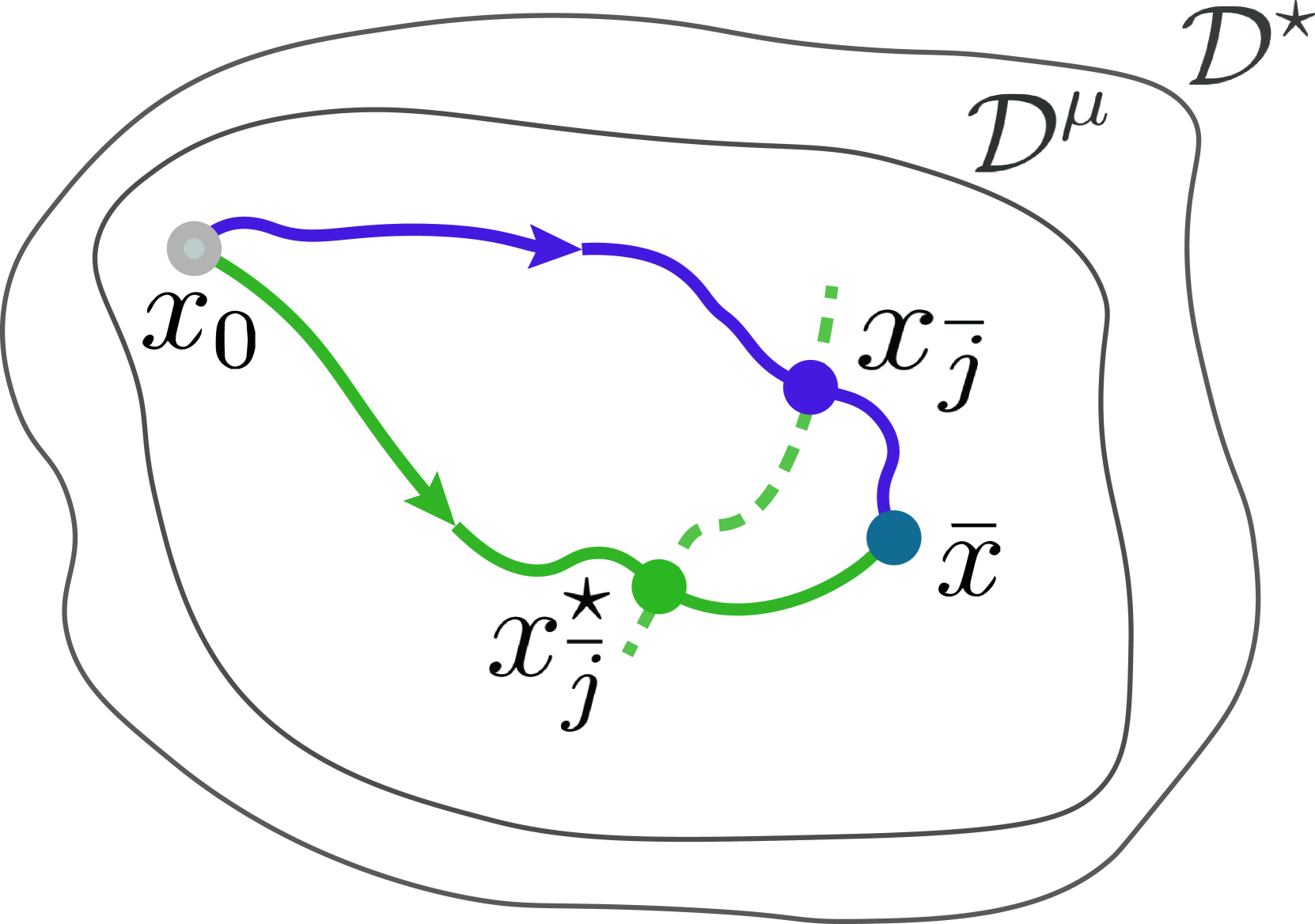
This image is a mathematical diagram illustrating trajectories or paths within nested domains. It likely represents a concept in optimization, control theory, or dynamical systems, showing how different paths originate from a common starting point and terminate or pass through specific states within defined boundaries.
## 2. Component Isolation
### A. Domains (Nested Sets)
The diagram features two nested, irregularly shaped closed curves representing mathematical sets or domains.
* **Outer Domain ($\mathcal{D}^\star$):** Labeled at the top right. This is the largest boundary shown.
* **Inner Domain ($\mathcal{D}^\mu$):** Labeled inside the top right of the outer boundary. This set is strictly contained within $\mathcal{D}^\star$.
### B. Points and States
There are five distinct points/nodes identified in the diagram:
1. **$x_0$ (Initial State):** Located on the far left. It is represented by a grey circular node with a lighter grey center. This is the origin for both paths.
2. **$x_{\bar{j}}^-$ (Intermediate/Upper State):** A solid blue node located on the upper path.
3. **$x_{\bar{j}}^\star$ (Intermediate/Lower State):** A solid green node located on the lower path.
4. **$\bar{x}$ (Terminal State):** A teal/dark blue node located on the far right where the paths appear to converge or terminate.
5. **Dashed Boundary Intersection:** A dashed light-green line passes through $x_{\bar{j}}^\star$ and $x_{\bar{j}}^-$, suggesting a specific manifold or constraint boundary within the domains.
### C. Paths and Trajectories
Two primary directed paths originate from $x_0$:
* **Upper Path (Blue):**
* **Trend:** Slopes upward and to the right from $x_0$, levels off, then curves downward through $x_{\bar{j}}^-$ toward $\bar{x}$.
* **Features:** Contains an arrowhead pointing right in the first segment. It passes through the blue node $x_{\bar{j}}^-$ before reaching the terminal node $\bar{x}$.
* **Lower Path (Green):**
* **Trend:** Slopes downward and to the right from $x_0$, exhibits a slight "wave" or oscillation, passes through $x_{\bar{j}}^\star$, and then curves upward to meet $\bar{x}$.
* **Features:** Contains an arrowhead pointing down-right in the first segment. It passes through the green node $x_{\bar{j}}^\star$ before reaching the terminal node $\bar{x}$.
## 3. Textual Information and Labels
| Label | Type | Description |
| :--- | :--- | :--- |
| $\mathcal{D}^\star$ | Set/Domain | The outermost boundary/feasible region. |
| $\mathcal{D}^\mu$ | Set/Domain | An inner subset or restricted domain. |
| $x_0$ | Variable | The starting point (initial condition). |
| $x_{\bar{j}}^-$ | Variable | A specific state on the upper (blue) trajectory. |
| $x_{\bar{j}}^\star$ | Variable | A specific state on the lower (green) trajectory, likely an optimal or reference state. |
| $\bar{x}$ | Variable | The target or terminal state. |
## 4. Logical Flow and Interpretation
1. **Initialization:** The process begins at $x_0$ within the domain $\mathcal{D}^\mu$.
2. **Divergence:** Two different strategies or trajectories (Blue and Green) are taken.
3. **Constraint/Manifold:** Both trajectories cross a specific internal boundary (represented by the dashed green line). The points of crossing are marked as $x_{\bar{j}}^-$ and $x_{\bar{j}}^\star$.
4. **Convergence:** Both trajectories eventually terminate at the state $\bar{x}$.
5. **Containment:** All actions and states occur within the inner domain $\mathcal{D}^\mu$, which itself is a subset of $\mathcal{D}^\star$.