## Diagram: Single LLM vs. Multi-Agent LLM System
### Overview
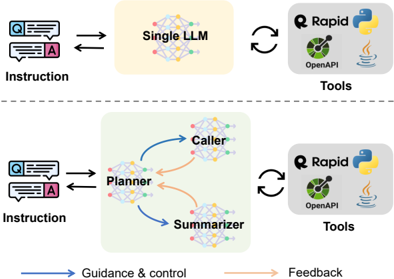
The image presents a comparative diagram illustrating two different approaches to utilizing Large Language Models (LLMs): a single LLM and a multi-agent LLM system. The diagram highlights the flow of information and control in each approach, emphasizing the interaction between instructions, the LLM(s), and external tools.
### Components/Axes
* **Top Section:** Represents the single LLM approach.
* **Instruction:** Depicted as a speech bubble containing "Q" and "A," indicating a question-and-answer interaction.
* **Single LLM:** A neural network icon labeled "Single LLM" with a light yellow background.
* **Tools:** A box containing icons for RapidAPI, Python, OpenAI, and Java, labeled "Tools."
* **Arrows:** Double-headed arrows indicate bidirectional communication between the instruction and the LLM, and between the LLM and the tools.
* **Bottom Section:** Represents the multi-agent LLM system approach.
* **Instruction:** Similar to the top section, depicting a question-and-answer interaction.
* **Planner:** A neural network icon labeled "Planner" with a light green background.
* **Caller:** A neural network icon labeled "Caller."
* **Summarizer:** A neural network icon labeled "Summarizer."
* **Tools:** Similar to the top section, containing icons for RapidAPI, Python, OpenAI, and Java, labeled "Tools."
* **Arrows:** Double-headed arrows indicate bidirectional communication between the instruction and the Planner, and between the Planner and the tools. Blue arrows indicate "Guidance & control" from the Planner to the Caller and Summarizer. An orange arrow indicates "Feedback" from the Caller and Summarizer to the Planner.
* **Legend:** Located at the bottom of the image.
* Blue Arrow: "Guidance & control"
* Orange Arrow: "Feedback"
### Detailed Analysis
* **Single LLM Approach:**
* An instruction is directly fed into a single LLM.
* The single LLM interacts with external tools.
* The interaction between the LLM and the tools is bidirectional.
* **Multi-Agent LLM System Approach:**
* An instruction is fed into a "Planner" LLM.
* The "Planner" LLM coordinates the "Caller" and "Summarizer" LLMs.
* The "Planner" LLM interacts with external tools.
* The "Planner" provides guidance and control to the "Caller" and "Summarizer" (blue arrows).
* The "Caller" and "Summarizer" provide feedback to the "Planner" (orange arrows).
### Key Observations
* The single LLM approach is a direct interaction between the instruction, the LLM, and the tools.
* The multi-agent LLM system approach introduces a "Planner" LLM to coordinate other LLMs ("Caller" and "Summarizer").
* The multi-agent system incorporates feedback loops between the "Planner" and the other LLMs.
### Interpretation
The diagram illustrates two distinct architectures for utilizing LLMs. The single LLM approach represents a simpler, more direct method, where a single model handles both understanding the instruction and interacting with external tools. The multi-agent system, on the other hand, introduces a layer of orchestration with the "Planner," allowing for more complex task decomposition and coordination between specialized LLMs. The feedback loop in the multi-agent system suggests a mechanism for iterative refinement and improved performance. The choice between these architectures depends on the complexity of the task and the desired level of control and specialization.