## [System Architecture Diagram]: Comparison of Single LLM vs. Multi-Agent LLM System with Tool Integration
### Overview
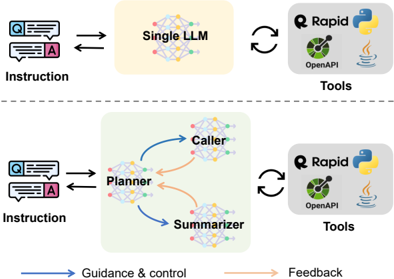
The image is a technical diagram comparing two architectural approaches for integrating Large Language Models (LLMs) with external tools. The top section illustrates a direct, single-LLM approach, while the bottom section depicts a more complex, multi-agent system. Both systems are shown processing an "Instruction" and interacting with a common set of "Tools."
### Components/Axes
The diagram is divided into two main horizontal sections separated by a dashed line.
**Top Section (Single LLM Approach):**
* **Left:** An icon labeled **"Instruction"** depicting a document with a magnifying glass and a red "A".
* **Center:** A yellow box containing a neural network icon labeled **"Single LLM"**.
* **Right:** A gray box labeled **"Tools"** containing three icons:
* **RapidAPI** (logo with a stylized 'R')
* **OpenAI** (logo with a green knot-like symbol)
* **Java** (logo of a coffee cup)
* **Connections:** Double-headed arrows connect the "Instruction" to the "Single LLM," and the "Single LLM" to the "Tools" box.
**Bottom Section (Multi-Agent System):**
* **Left:** An identical **"Instruction"** icon as in the top section.
* **Center:** A light green box containing three interconnected neural network icons representing agents:
* **Planner** (central node)
* **Caller** (top-right node)
* **Summarizer** (bottom-right node)
* **Right:** An identical **"Tools"** box as in the top section.
* **Connections:**
* Double-headed arrows connect the "Instruction" to the "Planner."
* Curved arrows connect the agents within the green box:
* A **blue arrow** labeled **"Guidance & control"** (per legend) points from the "Planner" to the "Caller."
* An **orange arrow** labeled **"Feedback"** (per legend) points from the "Caller" back to the "Planner."
* A **blue arrow** ("Guidance & control") points from the "Planner" to the "Summarizer."
* An **orange arrow** ("Feedback") points from the "Summarizer" back to the "Planner."
* Double-headed arrows connect the "Caller" agent to the "Tools" box.
**Legend (Bottom of Image):**
* A **blue arrow** is labeled **"Guidance & control"**.
* An **orange arrow** is labeled **"Feedback"**.
### Detailed Analysis
The diagram explicitly contrasts two workflows:
1. **Single LLM Workflow:** A monolithic model ("Single LLM") receives an instruction, directly interfaces with external tools (RapidAPI, OpenAI, Java), and presumably returns a result. The flow is linear and bidirectional.
2. **Multi-Agent System Workflow:** A coordinated system of specialized agents handles the task.
* The **Planner** is the central coordinator, receiving the initial instruction.
* The Planner provides **"Guidance & control"** (blue arrows) to the **Caller** and **Summarizer** agents.
* The **Caller** is the component that directly interacts with the external **Tools**.
* The **Summarizer** likely processes or formats the final output.
* Both the Caller and Summarizer provide **"Feedback"** (orange arrows) back to the Planner, creating a closed-loop, iterative process.
### Key Observations
* **Architectural Complexity:** The bottom system introduces significant structural complexity by decomposing the task among three specialized agents (Planner, Caller, Summarizer) instead of relying on one generalist model.
* **Communication Protocol:** The multi-agent system uses a defined protocol of "Guidance & control" (top-down direction) and "Feedback" (bottom-up reporting), suggesting a hierarchical and iterative operation.
* **Tool Interface Point:** In the single-LLM model, the LLM itself manages tool interaction. In the multi-agent model, this responsibility is isolated to the dedicated "Caller" agent.
* **Shared Components:** The "Instruction" input and the "Tools" (RapidAPI, OpenAI, Java) are identical in both architectures, highlighting that the comparison is about the internal processing structure, not the inputs or available tools.
### Interpretation
This diagram illustrates a shift in AI system design from monolithic models to modular, multi-agent collaborations.
* **What it demonstrates:** It argues for the benefits of a **specialized, orchestrated approach** over a **single, general-purpose approach**. The multi-agent system introduces checks and balances (via feedback loops) and clear role separation (planning vs. execution vs. summarization), which could lead to more reliable, transparent, and controllable outcomes when using external tools.
* **Relationships:** The Planner acts as the "brain," delegating tasks. The Caller is the "hands" that execute tool calls. The Summarizer is the "mouth" that formulates the final response. The feedback loops allow for error correction and refinement.
* **Notable Implications:** The architecture suggests that complex tasks requiring tool use may be more effectively handled by a team of simpler, specialized agents than by a single, highly capable LLM. This could improve debuggability (isolating failures to a specific agent) and allow for more sophisticated planning and recovery strategies. The presence of commercial tool logos (RapidAPI, OpenAI) grounds the diagram in practical, real-world application development.