## Diagram: Comparison of Single LLM vs. Multi-Agent System Architecture
### Overview
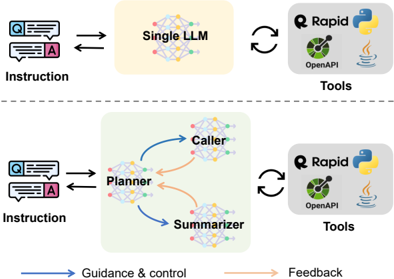
The diagram contrasts two approaches to handling instructions with tools:
1. **Top Section**: A single Large Language Model (LLM) directly interacting with tools.
2. **Bottom Section**: A multi-agent system comprising a Planner, Caller, and Summarizer, also interacting with tools.
Arrows indicate guidance/control (blue) and feedback (orange) flows.
---
### Components/Axes
- **Labels**:
- **Top Section**:
- "Single LLM" (central node with interconnected edges).
- "Instruction" (input text bubble with "Q" icon).
- "Tools" (box with icons: Rapid, Python, OpenAPI, Java).
- **Bottom Section**:
- "Planner," "Caller," "Summarizer" (three interconnected nodes).
- "Instruction" (input text bubble with "Q" icon).
- "Tools" (same box as top section).
- **Arrows**:
- **Blue**: Guidance & control (e.g., Planner → Caller, Planner → Summarizer).
- **Orange**: Feedback (e.g., Caller → Planner, Summarizer → Planner).
- **Spatial Grounding**:
- Top section: Single LLM centered, tools on the right.
- Bottom section: Planner, Caller, and Summarizer arranged in a triangular flow, tools on the right.
---
### Detailed Analysis
- **Single LLM Approach**:
- Direct bidirectional interaction between the LLM and tools.
- No intermediate components; instruction → LLM → tools.
- **Multi-Agent System**:
- **Planner**: Coordinates tasks, sends guidance to Caller and Summarizer.
- **Caller**: Executes tool calls based on Planner’s instructions.
- **Summarizer**: Processes outputs and provides feedback to the Planner.
- Feedback loops enable iterative refinement.
---
### Key Observations
1. **Complexity**: The multi-agent system introduces additional components (Planner, Caller, Summarizer) compared to the single LLM.
2. **Feedback Mechanisms**: Orange arrows highlight iterative refinement in the multi-agent system, absent in the single LLM.
3. **Tool Integration**: Both approaches share the same tools (Rapid, Python, OpenAPI, Java), suggesting modularity.
4. **Control Flow**: Blue arrows in the multi-agent system emphasize structured task delegation.
---
### Interpretation
- **Purpose**: The diagram illustrates a trade-off between simplicity (single LLM) and adaptability (multi-agent system).
- **Implications**:
- The single LLM may struggle with complex, multi-step tasks requiring coordination.
- The multi-agent system’s feedback loops suggest improved error handling and dynamic adjustment.
- **Anomalies**: No explicit data points or numerical values are provided, limiting quantitative analysis.
- **Design Philosophy**: The multi-agent system aligns with modular AI architectures, emphasizing specialization and collaboration.
This diagram underscores the potential benefits of distributed intelligence in handling structured workflows, though it lacks empirical validation (e.g., performance metrics).