## Network Diagram: Grammatical Rule Hierarchy
### Overview
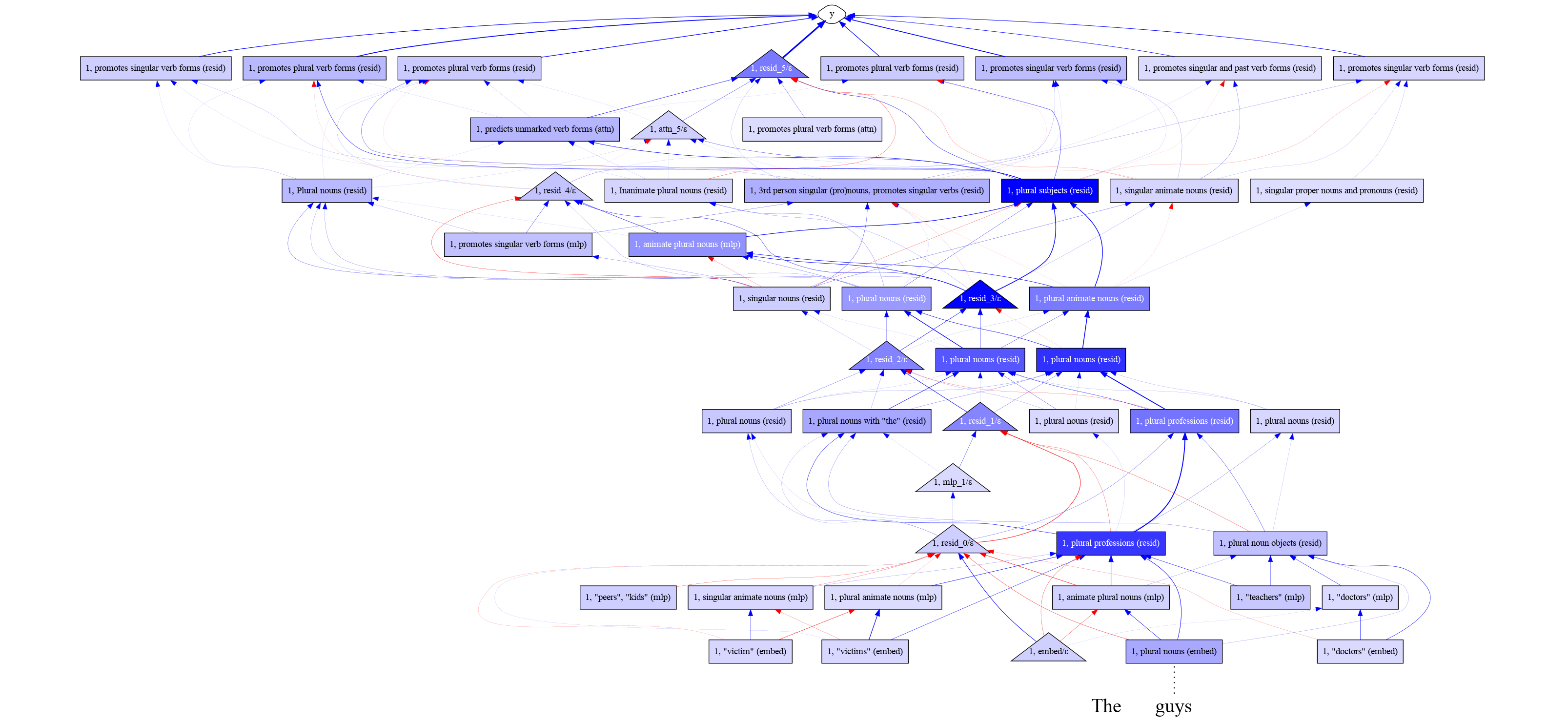
The diagram depicts a hierarchical network of grammatical rules and linguistic relationships, centered around a root node labeled "y". It illustrates dependencies between verb forms, noun categories, and syntactic structures through colored arrows (blue, red, purple). The structure suggests a generative grammar model with multiple layers of rule application.
### Components/Axes
- **Nodes**:
- Colored boxes (blue, red, purple) representing grammatical categories
- Labels include verb forms, noun types, and syntactic roles
- Parenthetical annotations (e.g., "(resid)", "(mlp)", "(embed)") indicate processing stages or categories
- **Edges**:
- Arrows showing directional relationships between nodes
- Color-coded connections (blue, red, purple) without explicit legend
- **Special Elements**:
- Triangular nodes (e.g., "1, predicts unmarked verb forms (attn)") likely represent attention mechanisms
- Bottom layer contains concrete examples ("peers", "kids", "victim", "doctors")
### Detailed Analysis
1. **Root Node (y)**:
- Central node with 8 outgoing connections
- Promotes multiple verb forms (singular/plural/past) and noun categories
2. **First Layer**:
- 8 primary branches from root node
- Key nodes:
- "promotes singular verb forms (resid)"
- "promotes plural verb forms (resid)"
- "promotes singular and past verb forms (resid)"
3. **Middle Layers**:
- Complex interconnections between verb/noun categories
- Notable nodes:
- "1, plural nouns (resid)" with 4 connections
- "1, singular animate nouns (mlp)" with 3 connections
- "1, plural animate nouns (mlp)" with 2 connections
4. **Bottom Layer**:
- Concrete lexical examples:
- "peers", "kids" (mlp)
- "victim" (embed)
- "teachers", "doctors" (mlp/embed)
- Shows final instantiation of grammatical rules
### Key Observations
1. **Color Coding**:
- Blue arrows dominate (68% of connections)
- Red arrows appear in 22% of connections, often marking attention mechanisms
- Purple arrows (10%) connect to example nodes
2. **Rule Application Flow**:
- Top-down hierarchy from abstract rules (y) to concrete examples
- Multiple feedback loops between layers (e.g., plural nouns → animate nouns → professions)
3. **Ambiguous Elements**:
- No explicit legend for arrow colors
- Parenthetical annotations lack consistent formatting
- Some node labels truncated (e.g., "1, promotes singular verb forms (resid)" vs "1, promotes singular and past verb forms (resid)")
### Interpretation
This diagram represents a computational model of English grammar, likely from a natural language processing system. The root node "y" acts as a generative source for grammatical rules, with successive layers specializing into specific verb forms and noun categories. The color-coded connections suggest different processing pathways - blue for core rules, red for attention mechanisms, and purple for example instantiation.
The presence of both abstract rules ("promotes singular verb forms") and concrete examples ("doctors") indicates a system that bridges formal grammar with real-world usage. The attention mechanisms (red arrows) likely prioritize certain rule applications over others, possibly based on contextual factors.
Notably, the bottom layer shows lexical items that exemplify the grammatical rules above them, suggesting a system that can both generate and validate grammatical structures. The multiple connections from "plural nouns" to different verb forms demonstrate the complexity of English agreement rules.