## Line Chart: Score vs. Generation
### Overview
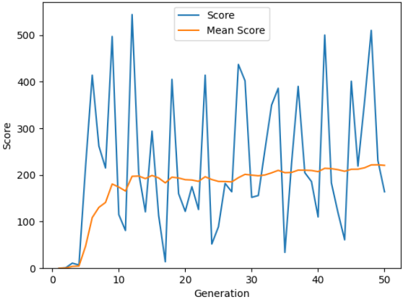
The image is a line chart displaying the "Score" and "Mean Score" over 50 generations. The "Score" line fluctuates significantly, while the "Mean Score" line shows a gradual increase and then stabilizes.
### Components/Axes
* **X-axis:** Generation, labeled from 0 to 50 in increments of 10.
* **Y-axis:** Score, labeled from 0 to 500 in increments of 100.
* **Legend (top-center):**
* Blue line: "Score"
* Orange line: "Mean Score"
### Detailed Analysis
* **Score (Blue Line):**
* Trend: Highly volatile, with large fluctuations between generations.
* Initial Values: Starts near 0 at generation 0.
* Peak Values: Reaches peaks around 400-500 at various generations (e.g., around generations 10, 25, 40, and 50).
* Low Values: Drops to near 0 at several points (e.g., around generations 15, 20, 30, and 45).
* **Mean Score (Orange Line):**
* Trend: Initially increases rapidly, then stabilizes around a value between 180 and 220.
* Initial Values: Starts near 0 at generation 0.
* Stabilized Value: Reaches a plateau around 200 after approximately 10 generations.
* Final Value: Ends around 220 at generation 50.
### Key Observations
* The "Score" exhibits high variance, indicating significant performance differences between individual generations.
* The "Mean Score" provides a smoother representation of the overall performance trend, showing an initial learning phase followed by stabilization.
* The "Score" line frequently dips to very low values, suggesting occasional poor-performing generations despite the overall increasing trend in the "Mean Score."
### Interpretation
The chart likely represents the performance of an algorithm or model over multiple generations. The volatile "Score" indicates that individual iterations can vary widely in their effectiveness. However, the "Mean Score" suggests that, on average, the algorithm improves over time, eventually reaching a stable level of performance. The large fluctuations in the "Score" could be due to factors such as randomness in the algorithm, sensitivity to initial conditions, or exploration of different solution spaces. The stabilization of the "Mean Score" implies that the algorithm has converged to a relatively consistent level of performance.