## Physics Concept Network: "K" Domain
### Overview
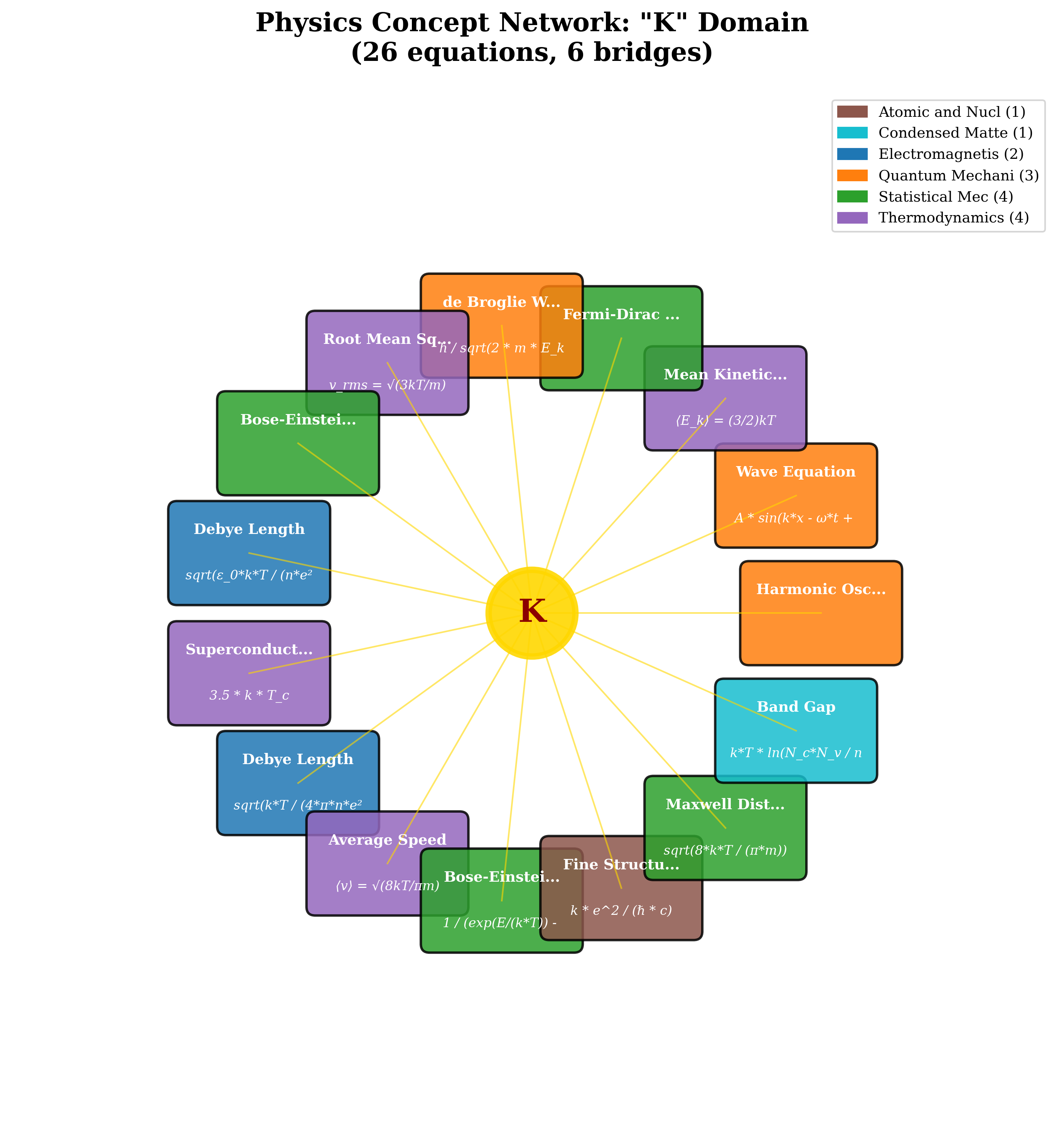
The image is a concept network diagram centered around the variable "K", likely representing Boltzmann constant. It illustrates the relationships between various physics concepts and equations within different domains of physics. The diagram consists of labeled rectangular nodes representing physics concepts, connected to a central node "K" with lines. The concepts are grouped by color, indicating their respective physics domain, as defined in the legend. The diagram indicates 26 equations and 6 bridges.
### Components/Axes
* **Central Node:** A yellow circle labeled "K" at the center of the diagram.
* **Concept Nodes:** Rectangular nodes surrounding the central node, each labeled with a physics concept and an associated equation.
* **Connecting Lines:** Yellow lines connecting the central node "K" to each of the concept nodes.
* **Legend (Top-Right):**
* Atomic and Nucl (1) - Brown
* Condensed Matte (1) - Cyan
* Electromagnetis (2) - Blue
* Quantum Mechani (3) - Orange
* Statistical Mec (4) - Green
* Thermodynamics (4) - Purple
### Detailed Analysis or ### Content Details
Here's a breakdown of each concept node, its associated equation, and its corresponding physics domain based on color:
1. **Atomic and Nucl (Brown):**
* Concept: Fine Structu...
* Equation: k * e^2 / (ħ * c)
* Position: Bottom-Right
2. **Condensed Matte (Cyan):**
* Concept: Band Gap
* Equation: k*T * ln(N\_c*N\_v/n)
* Position: Right
3. **Electromagnetis (Blue):**
* Concept: Debye Length
* Equation: sqrt(k*T / (4*π*n*e^2))
* Position: Bottom-Left
4. **Electromagnetis (Blue):**
* Concept: Debye Length
* Equation: sqrt(ε\_0*k*T / (n*e^2))
* Position: Left
5. **Quantum Mechani (Orange):**
* Concept: Wave Equation
* Equation: A * sin(k*x - w*t +
* Position: Top-Right
6. **Quantum Mechani (Orange):**
* Concept: Harmonic Osc...
* Equation: (No equation visible)
* Position: Right
7. **Quantum Mechani (Orange):**
* Concept: de Broglie W...
* Equation: h/sqrt(2 * m * E\_k)
* Position: Top
8. **Statistical Mec (Green):**
* Concept: Fermi-Dirac ...
* Equation: (No equation visible)
* Position: Top-Right
9. **Statistical Mec (Green):**
* Concept: Maxwell Dist...
* Equation: sqrt(8*k*T / (π*m))
* Position: Bottom-Right
10. **Statistical Mec (Green):**
* Concept: Bose-Einstei...
* Equation: 1 / (exp(E/(k*T)) -
* Position: Bottom
11. **Statistical Mec (Green):**
* Concept: Bose-Einstei...
* Equation: (No equation visible)
* Position: Left
12. **Thermodynamics (Purple):**
* Concept: Mean Kinetic...
* Equation: (E\_k) = (3/2)kT
* Position: Top-Right
13. **Thermodynamics (Purple):**
* Concept: Root Mean Sq...
* Equation: v\_rms = √(3kT/m)
* Position: Top-Left
14. **Thermodynamics (Purple):**
* Concept: Average Speed
* Equation: (v) = √(8kT/πm)
* Position: Bottom-Left
15. **Thermodynamics (Purple):**
* Concept: Superconduct...
* Equation: 3.5 * k * T\_c
* Position: Left
### Key Observations
* The central node "K" represents a key concept (Boltzmann constant) that links various physics domains.
* The diagram visually represents the interconnectedness of different physics concepts through the common variable "K".
* The number of concepts from each domain varies, with Statistical Mechanics and Thermodynamics having the most representations.
* The equations associated with each concept demonstrate how "K" is used in different contexts.
### Interpretation
The concept network illustrates how the Boltzmann constant "K" is a fundamental constant that appears in various equations across different domains of physics. The diagram emphasizes the unifying role of "K" in connecting seemingly disparate concepts such as electromagnetism, quantum mechanics, statistical mechanics, and thermodynamics. The number of equations associated with each domain suggests the relative importance or frequency of use of "K" within those fields. The diagram serves as a visual aid for understanding the relationships between these concepts and the central role of the Boltzmann constant in physics.