## Physics Concept Network: "K" Domain (26 equations, 6 bridges)
### Overview
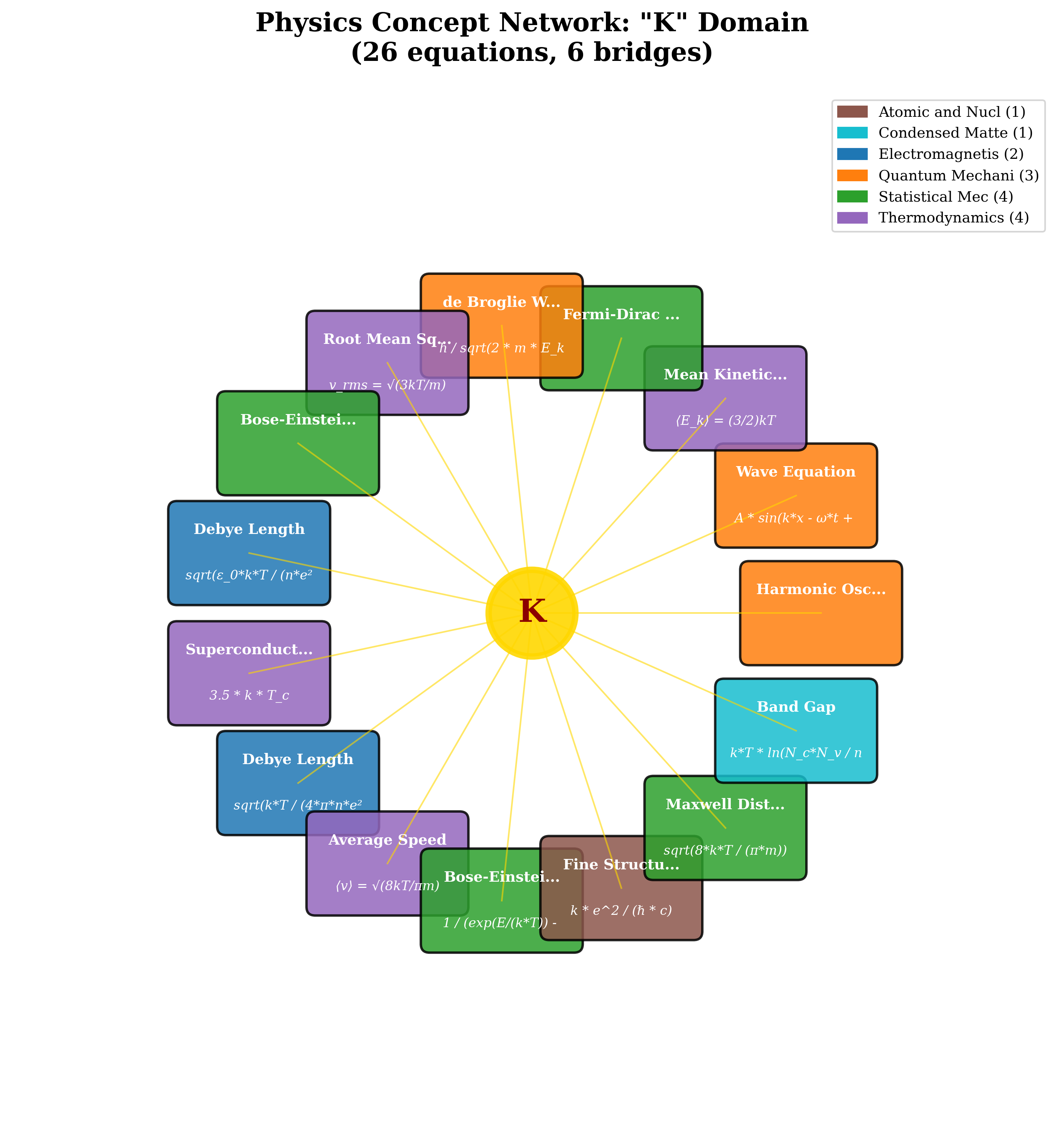
This is a radial concept network diagram centered on the symbol **K** (Boltzmann constant, the unifying element), connecting to 16 labeled physics concepts (each paired with an equation) across 6 distinct physics subfields. The diagram is designed to show the cross-domain relevance of the Boltzmann constant, with yellow lines linking all concepts to the central "K" node.
### Components/Axes
1. **Legend (Top-Right):** Defines 6 physics domains with color coding and count of concepts per domain:
- Brown: Atomic and Nucl (1)
- Cyan: Condensed Matte (1)
- Blue: Electromagnetis (2)
- Orange: Quantum Mechani (3)
- Green: Statistical Mec (4)
- Purple: Thermodynamics (4)
2. **Central Node:** A yellow circle with red text "K", positioned at the exact center of the diagram, acting as the hub for all connections.
3. **Concept Boxes:** 16 rectangular boxes (truncated labels in some cases) radiate outward from the central node, each containing a physics concept name and its associated equation (where visible).
### Detailed Analysis
Each concept, its domain, equation, and relative position:
1. **de Broglie W...** (Quantum Mechani, orange, top-center): Equation: $\lambda = \hbar / sqrt(2 * m * E_k)$ (truncated label, full: de Broglie Wavelength)
2. **Fermi-Dirac ...** (Statistical Mec, green, top-right): Truncated label, no visible equation (Fermi-Dirac distribution, quantum statistical mechanics)
3. **Mean Kinetic...** (Thermodynamics, purple, top-right): Equation: $\langle E_k \rangle = (3/2)kT$ (Mean Kinetic Energy of gas molecules)
4. **Wave Equation** (Quantum Mechani, orange, right-center): Equation: $A * sin(k*x - \omega*t + \phi)$ (truncated, full quantum wave equation form)
5. **Harmonic Osc...** (Quantum Mechani, orange, right): Truncated label, no visible equation (Quantum Harmonic Oscillator)
6. **Band Gap** (Condensed Matte, cyan, bottom-right): Equation: $k*T * ln(N_c*N_v / n_i)$ (Semiconductor band gap relation)
7. **Maxwell Dist...** (Statistical Mec, green, bottom-right): Equation: $sqrt(8*k*T / (\pi*m))$ (Maxwell-Boltzmann mean speed)
8. **Fine Structu...** (Atomic and Nucl, brown, bottom-center): Equation: $k * e^2 / (\hbar * c)$ (Fine Structure Constant, related to K)
9. **Bose-Einstei...** (Statistical Mec, green, bottom-center): Equation: $1 / (exp(E/(k*T)) - 1)$ (Bose-Einstein distribution)
10. **Average Speed** (Thermodynamics, purple, bottom-left): Equation: $\langle v \rangle = sqrt(8kT/(\pi m))$ (Average molecular speed)
11. **Debye Length** (Electromagnetis, blue, bottom-left): Equation: $sqrt(k*T / (4\pi n e^2))$ (Electrostatic screening length)
12. **Superconduct...** (Thermodynamics, purple, left-center): Equation: $3.5 * k * T_c$ (Superconducting critical temperature relation)
13. **Debye Length** (Electromagnetis, blue, left): Equation: $sqrt(\epsilon_0*k*T / (n*e^2))$ (Alternate Debye length form, with permittivity)
14. **Bose-Einstei...** (Statistical Mec, green, left): Truncated label, no visible equation (Bose-Einstein condensate related)
15. **Root Mean Sq...** (Thermodynamics, purple, top-left): Equation: $v_{rms} = sqrt(3kT/m)$ (Root Mean Square molecular speed)
### Key Observations
- The Boltzmann constant (K) is explicitly present in every visible equation, confirming its role as a unifying constant across physics subfields.
- Thermodynamics and Statistical Mechanics have the highest number of concepts (4 each), followed by Quantum Mechanics (3), Electromagnetism (2), and 1 concept each for Atomic/Nuclear and Condensed Matter physics.
- Some concepts have multiple representations (two distinct Debye Length equations, two Bose-Einstein related boxes), showing variations of K-dependent formulas.
- Truncated labels indicate the full network contains more equations/concepts than are visible in this view.
### Interpretation
This diagram illustrates the foundational, cross-disciplinary importance of the Boltzmann constant (K) in physics. It acts as a bridge between macroscopic thermodynamic properties (like molecular speed and kinetic energy) and microscopic quantum/statistical mechanical behavior (wave equations, particle distributions), as well as electromagnetic, condensed matter, and atomic phenomena. The network structure emphasizes that K is not limited to thermodynamics, but is a critical constant that links observable macroscopic properties to the underlying quantum and statistical behavior of matter. The "bridges" (connections) highlight how K enables the translation between different scales and subfields of physics, making it a core unifying concept in the field.