## Physics ConceptNetwork: "K" Domain
### Overview
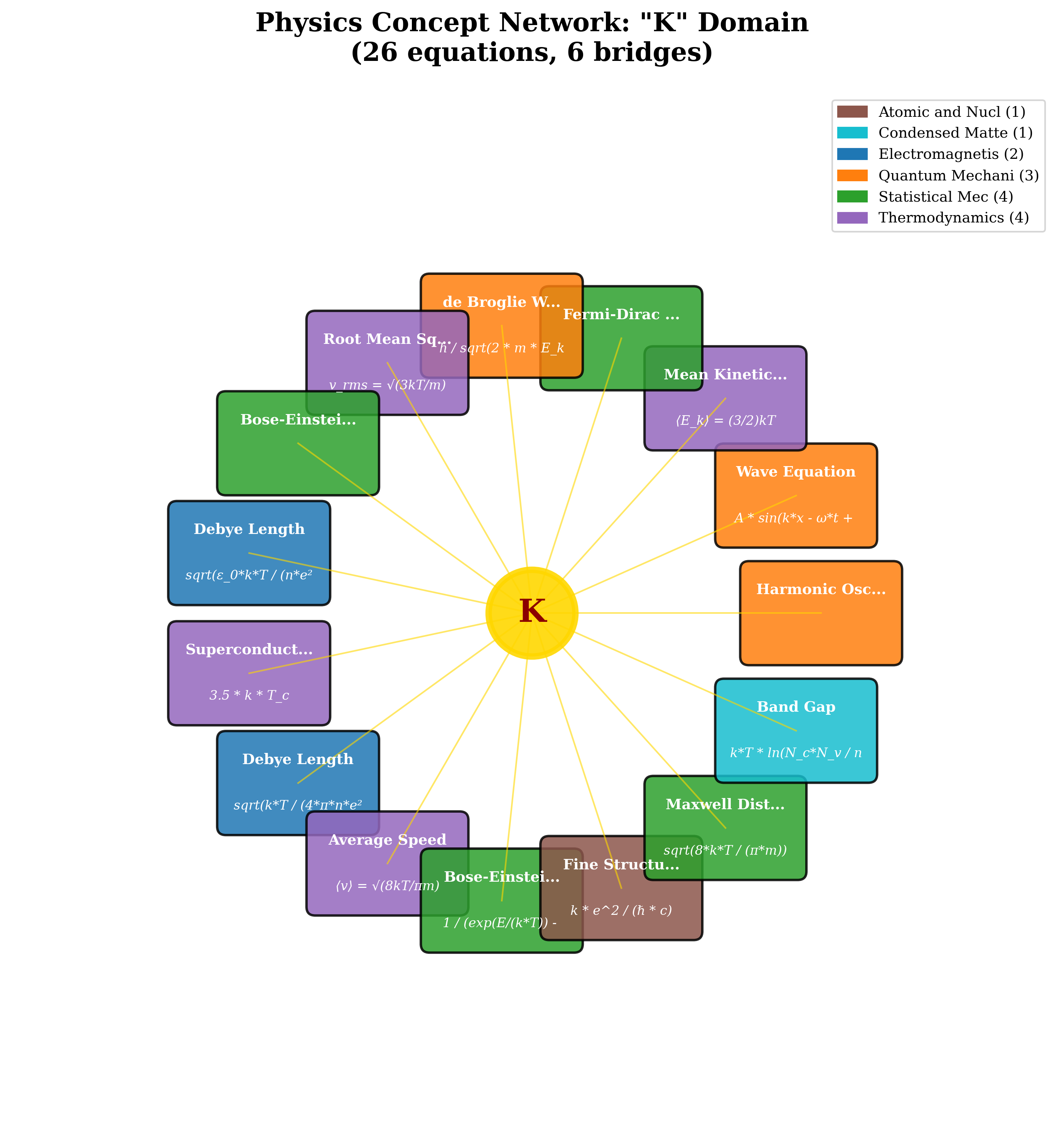
The image depicts a radial network centered on the Boltzmann constant "K" (represented as a yellow circle), with 26 equations radiating outward. These equations are grouped into six physics domains (color-coded) and connected to "K" via yellow lines. The network emphasizes the interdisciplinary role of "K" in thermodynamics, quantum mechanics, statistical mechanics, and other fields.
### Components/Axes
- **Central Node**: "K" (Boltzmann constant)
- **Branches**: 26 equations, each labeled with a physics concept and its mathematical expression.
- **Legend**: Located in the top-right corner, mapping six physics domains to colors:
- **Atomic and Nuclear** (1 equation, brown)
- **Condensed Matter** (1 equation, teal)
- **Electromagnetism** (2 equations, blue)
- **Quantum Mechanics** (3 equations, orange)
- **Statistical Mechanics** (4 equations, green)
- **Thermodynamics** (4 equations, purple)
### Detailed Analysis
#### Equations and Their Categories
1. **Thermodynamics (Purple)**
- Mean Kinetic Energy: \( \langle E_k \rangle = \frac{3}{2}kT \)
- Average Speed: \( \langle v \rangle = \sqrt{\frac{8kT}{\pi m}} \)
- Root Mean Square Velocity: \( v_{rms} = \sqrt{\frac{3kT}{m}} \)
- Superconducting Transition: \( 3.5 \cdot k \cdot T_c \)
- Debye Length (Condensed Matter): \( \sqrt{\frac{kT}{4\pi n e^2}} \)
2. **Quantum Mechanics (Orange)**
- de Broglie Wavelength: \( \lambda = \frac{h}{\sqrt{2mE_k}} \)
- Wave Equation: \( A \sin(kx - \omega t + \phi) \)
- Harmonic Oscillator: \( E_n = \hbar \omega \left(n + \frac{1}{2}\right) \)
3. **Statistical Mechanics (Green)**
- Bose-Einstein Distribution: \( \frac{1}{e^{(E - kT)/k} - 1} \)
- Maxwell-Boltzmann Distribution: \( \sqrt{\frac{8kT}{\pi m}} \)
- Fermi-Dirac Distribution: \( \frac{1}{e^{(E - \mu)/kT} + 1} \)
- Bose-Einstein Condensation: \( \lambda = \sqrt{\frac{h^2}{2\pi m kT}} \)
4. **Electromagnetism (Blue)**
- Debye Length (Plasma): \( \sqrt{\frac{\epsilon_0 kT}{n e^2}} \)
- Fine Structure Constant: \( \alpha = \frac{e^2}{\hbar c} \)
5. **Atomic and Nuclear (Brown)**
- Fine Structure Constant: \( \alpha = \frac{e^2}{\hbar c} \)
- Bohr Radius: \( a_0 = \frac{4\pi \epsilon_0 \hbar^2}{m_e e^2} \)
6. **Condensed Matter (Teal)**
- Band Gap: \( E_g = kT \ln\left(\frac{N_c}{N_v}\right) \)
- Mean Square Displacement: \( \langle x^2 \rangle = \frac{kT}{\eta} \)
#### Spatial Grounding
- The legend is positioned in the **top-right corner**, with color-coded labels.
- Equations are arranged radially around "K", with no overlapping text.
- All equations are written in LaTeX, with variables like \( k \), \( T \), \( m \), and \( e \) consistently used.
### Key Observations
- **Interdisciplinary Connections**: "K" links thermodynamics (e.g., \( \langle E_k \rangle \)) to quantum mechanics (e.g., de Broglie wavelength) and statistical mechanics (e.g., Bose-Einstein distribution).
- **Dominance of Thermodynamics/Statistical Mechanics**: These domains account for 8/26 equations (31%), highlighting "K"’s centrality in energy-temperature relationships.
- **Quantum Mechanics Focus**: Three equations (11.5%) emphasize wave-particle duality and quantization.
- **Condensed Matter and Electromagnetism**: Two equations each (7.7%) focus on material properties and plasma behavior.
### Interpretation
The network illustrates how the Boltzmann constant "K" acts as a **universal bridge** between macroscopic thermodynamics and microscopic quantum/statistical phenomena. For example:
- In thermodynamics, "K" connects temperature (\( T \)) to energy (\( E_k \)).
- In quantum mechanics, it appears in the de Broglie wavelength and harmonic oscillator equations.
- Statistical mechanics uses "K" to describe particle distributions (Bose-Einstein, Fermi-Dirac).
Notably, the **fine structure constant** (\( \alpha \)) appears in both atomic/nuclear and condensed matter contexts, suggesting its role in unifying quantum electrodynamics and material science. The absence of equations from fluid dynamics or relativity implies a focus on condensed-phase and quantum systems.
This network underscores "K" as a foundational constant that transcends disciplinary boundaries, enabling the description of phenomena from atomic scales (e.g., \( a_0 \)) to macroscopic material behavior (e.g., Debye length).