## Diagram: State Transition Diagram
### Overview
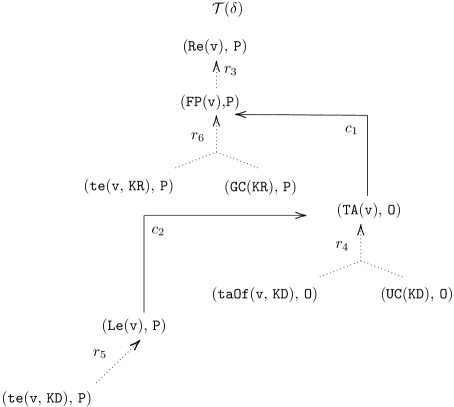
The image is a state transition diagram representing a process or system. It shows various states, labeled with expressions involving 'v', 'P', 'O', 'KR', and 'KD', and transitions between these states, labeled with 'c1' and 'c2'. The diagram also includes labels 'r3', 'r4', 'r5', and 'r6' associated with some transitions or states. The diagram is titled "T(δ)".
### Components/Axes
* **Nodes (States):**
* (Re(v), P): Located at the top-center of the diagram.
* (FP(v), P): Located below (Re(v), P).
* (te(v, KR), P): Located to the left and below (FP(v), P).
* (GC(KR), P): Located to the right and below (FP(v), P).
* (TA(v), O): Located to the right of (GC(KR), P) and (te(v, KR), P).
* (Le(v), P): Located below (te(v, KR), P) and to the left of (TA(v), O).
* (te(v, KD), P): Located below and to the left of (Le(v), P).
* (taOf(v, KD), O): Located below and to the left of (TA(v), O).
* (UC(KD), O): Located below and to the right of (TA(v), O).
* **Edges (Transitions):**
* c1: A directed edge from (TA(v), O) to (FP(v), P).
* c2: A directed edge from (GC(KR), P) to (Le(v), P).
* **Labels:**
* T(δ): Title of the diagram, located at the top.
* r3: Located above the dotted line connecting (Re(v), P) and (FP(v), P).
* r6: Located below the dotted line connecting (FP(v), P) to (te(v, KR), P) and (GC(KR), P).
* r4: Located above the dotted line connecting (TA(v), O) to (taOf(v, KD), O) and (UC(KD), O).
* r5: Located above the dotted line connecting (Le(v), P) to (te(v, KD), P).
### Detailed Analysis or ### Content Details
* **State Descriptions:**
* (Re(v), P): Represents a state with 'Re(v)' and 'P'.
* (FP(v), P): Represents a state with 'FP(v)' and 'P'.
* (te(v, KR), P): Represents a state with 'te(v, KR)' and 'P'.
* (GC(KR), P): Represents a state with 'GC(KR)' and 'P'.
* (TA(v), O): Represents a state with 'TA(v)' and 'O'.
* (Le(v), P): Represents a state with 'Le(v)' and 'P'.
* (te(v, KD), P): Represents a state with 'te(v, KD)' and 'P'.
* (taOf(v, KD), O): Represents a state with 'taOf(v, KD)' and 'O'.
* (UC(KD), O): Represents a state with 'UC(KD)' and 'O'.
* **Transition Descriptions:**
* c1: Transition from (TA(v), O) to (FP(v), P).
* c2: Transition from (GC(KR), P) to (Le(v), P).
* **Connectivity:**
* (Re(v), P) is connected to (FP(v), P) via a dotted line, labeled 'r3'.
* (FP(v), P) is connected to (te(v, KR), P) and (GC(KR), P) via dotted lines, labeled 'r6'.
* (TA(v), O) is connected to (taOf(v, KD), O) and (UC(KD), O) via dotted lines, labeled 'r4'.
* (Le(v), P) is connected to (te(v, KD), P) via a dotted line, labeled 'r5'.
### Key Observations
* The diagram shows a flow of states and transitions.
* 'P' and 'O' appear to be parameters or properties associated with the states.
* 'KR' and 'KD' appear to be identifiers or categories.
* The dotted lines with labels 'r3', 'r4', 'r5', and 'r6' might represent relationships or dependencies between states.
### Interpretation
The diagram likely represents a state machine or a process flow in a system. The states represent different stages or conditions, and the transitions represent the movement between these states based on certain events or conditions. The labels 'P', 'O', 'KR', and 'KD' likely represent parameters or properties that define the state. The transitions 'c1' and 'c2' represent specific actions or events that trigger the change from one state to another. The dotted lines and 'r' labels may represent relationships or dependencies between states that are not direct transitions. The diagram provides a visual representation of the system's behavior and can be used to analyze and understand its dynamics.