\n
## Diagram: Tree Structure - T(δ)
### Overview
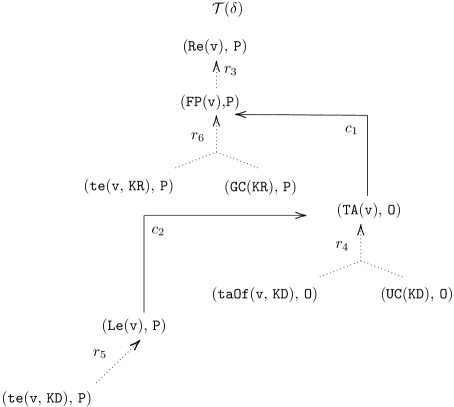
The image depicts a tree-like diagram labeled "T(δ)" at the top-center. The diagram represents a hierarchical structure with nodes connected by branches. Each node contains a textual label enclosed in parentheses, and branches are labeled with variables (r₁, c₁, c₂, etc.). The diagram appears to represent a logical or computational process, potentially a derivation or transformation.
### Components/Axes
The diagram consists of nodes and branches. There are no explicit axes in the traditional sense. The structure is organized from top to bottom, with a root node at the top and branching paths leading to terminal nodes at the bottom. The labels within the nodes are the primary components. The branches are labeled as follows:
* r₃
* r₄
* r₅
* r₆
* c₁
* c₂
### Detailed Analysis or Content Details
The diagram can be described as follows, starting from the root and traversing down the branches:
1. **Root Node:** (Re(v), P)
2. **Branching from Root:**
* A dotted line labeled 'r₃' leads to (FP(v), P)
* A line labeled 'c₁' leads to (GC(KR), P)
3. **From (FP(v), P):**
* A line labeled 'r₆' leads to (te(v, KR), P)
4. **From (GC(KR), P):**
* A line labeled 'c₂' leads to (TA(v), 0)
5. **From (TA(v), 0):**
* A dotted line labeled 'r₄' leads to (taOf(v, KD), 0)
* A dotted line labeled 'r₄' leads to (UC(KD), 0)
6. **From (te(v, KR), P):**
* A line labeled 'c₂' leads to (Le(v), P)
7. **From (Le(v), P):**
* A line labeled 'r₅' leads to (te(v, KD), P)
### Key Observations
The diagram shows a branching structure with a clear hierarchy. The labels within the nodes suggest a series of transformations or operations applied to variables 'v', 'KR', and 'KD'. The presence of 'P' and '0' as second elements in the node labels might indicate different states or types of values. The dotted lines (r₃, r₄) and solid lines (c₁, c₂, r₅, r₆) may represent different types of relationships or transitions.
### Interpretation
The diagram likely represents a derivation or a computational process. The nodes represent intermediate states, and the branches represent transformations or operations. The variables 'v', 'KR', and 'KD' likely represent inputs or parameters to the process. The 'P' and '0' values could indicate boolean flags or numerical values associated with each state. The diagram could be a simplified representation of a formal system, a program execution flow, or a logical proof. The use of 'te', 'GC', 'TA', 'Le', 'FP', 'taOf', and 'UC' suggests specific functions or operators within the system. Without further context, it's difficult to determine the exact meaning of the diagram, but it clearly illustrates a structured process with defined steps and transformations. The diagram is a visual representation of a logical or computational process, potentially a derivation or transformation. The labels within the nodes suggest a series of transformations or operations applied to variables 'v', 'KR', and 'KD'. The presence of 'P' and '0' as second elements in the node labels might indicate different states or types of values. The dotted lines (r₃, r₄) and solid lines (c₁, c₂, r₅, r₆) may represent different types of relationships or transitions.