## Diagram: Formal Logic/State Transition Diagram
### Overview
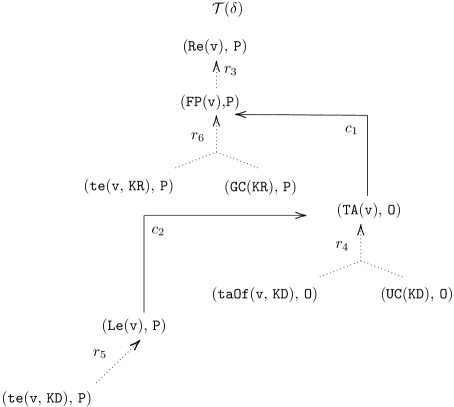
The image displays a directed graph diagram, likely representing a formal logic system, state transition model, or proof structure from computer science or mathematical logic. It consists of nodes containing mathematical expressions (predicates or state tuples) connected by directed edges labeled with identifiers. The diagram is titled "T(δ)".
### Components/Axes
* **Title:** `T(δ)` (located at the top center).
* **Nodes:** The diagram contains 9 distinct nodes, each represented by a tuple in parentheses. The tuples appear to have the form `(Predicate/Function, Parameter)`.
* **Edges:** Directed edges connect the nodes. They are of two types:
* **Solid arrows:** Indicate a primary or direct relationship.
* **Dotted arrows:** Indicate a secondary, conditional, or derived relationship.
* **Edge Labels:** Each edge has an associated label, typically a lowercase letter (`r`, `c`) followed by a subscript number (e.g., `r₃`, `c₁`).
### Detailed Analysis
**Node Inventory (with approximate spatial grounding):**
1. **Top Center:** `(Re(v), P)`
2. **Below Node 1:** `(FP(v), P)`
3. **Left of Node 2:** `(te(v, KR), P)`
4. **Right of Node 2:** `(GC(KR), P)`
5. **Far Right, Middle:** `(TA(v), 0)`
6. **Below Node 5:** `(taOf(v, KD), 0)`
7. **Right of Node 6:** `(UC(KD), 0)`
8. **Bottom Left:** `(Le(v), P)`
9. **Below Node 8:** `(te(v, KD), P)`
**Edge Connections and Flow:**
* **Vertical Chain (Center):**
* `(Re(v), P)` → `(FP(v), P)` via a **dotted arrow** labeled `r₃`.
* `(FP(v), P)` → `(te(v, KR), P)` via a **dotted arrow** labeled `r₆`.
* `(FP(v), P)` → `(GC(KR), P)` via a **dotted arrow** (also associated with `r₆`).
* **Horizontal/Right Flow:**
* `(FP(v), P)` ← `(TA(v), 0)` via a **solid arrow** labeled `c₁` (pointing left).
* `(te(v, KR), P)` → `(TA(v), 0)` via a **solid arrow** labeled `c₂`.
* `(TA(v), 0)` → `(taOf(v, KD), 0)` via a **dotted arrow** labeled `r₄`.
* `(TA(v), 0)` → `(UC(KD), 0)` via a **dotted arrow** (also associated with `r₄`).
* **Bottom Left Flow:**
* `(te(v, KD), P)` → `(Le(v), P)` via a **dotted arrow** labeled `r₅`.
**Transcription of All Text:**
* `T(δ)`
* `(Re(v), P)`
* `r₃`
* `(FP(v), P)`
* `c₁`
* `r₆`
* `(te(v, KR), P)`
* `(GC(KR), P)`
* `c₂`
* `(TA(v), 0)`
* `r₄`
* `(taOf(v, KD), 0)`
* `(UC(KD), 0)`
* `r₅`
* `(Le(v), P)`
* `(te(v, KD), P)`
### Key Observations
1. **Dual Parameter States:** Nodes are characterized by a second parameter being either `P` (likely representing "True," "Proven," or a positive state) or `0` (likely representing "False," "Unproven," or a neutral/initial state).
2. **Central Hub:** The node `(FP(v), P)` acts as a central hub, receiving input from `(Re(v), P)` and `(TA(v), 0)`, and distributing to `(te(v, KR), P)` and `(GC(KR), P)`.
3. **Rule Types:** The edge labels suggest different classes of rules or transitions: `r`-rules (e.g., `r₃`, `r₄`, `r₅`, `r₆`) and `c`-rules (e.g., `c₁`, `c₂`). The `c`-rules involve solid arrows and connect nodes with different second parameters (`P` to `0` or vice-versa).
4. **Symmetry in Derivation:** The structure around `(TA(v), 0)` mirrors that around `(FP(v), P)`. Both have two dotted arrows (`r₄` and `r₆`) leading to two child nodes, suggesting a similar logical operation is applied in different contexts.
### Interpretation
This diagram models a formal system, possibly a **proof calculus, a state machine for program verification, or a semantic network**. The tuples likely represent **states or propositions**, where `v`, `KR`, and `KD` are variables or constants (e.g., `v` for a value, `KR` and `KD` for knowledge domains or data sets). The predicates (`Re`, `FP`, `te`, `GC`, `TA`, `taOf`, `UC`, `Le`) represent operations, properties, or functions.
* **Flow of Justification/State Change:** The arrows represent transitions or inference rules. The movement from nodes with parameter `0` to nodes with parameter `P` (e.g., via `c₁` and `c₂`) suggests a process of **validation, proof, or state activation**. Conversely, the dotted `r`-rules seem to represent **derivation or decomposition** steps within a proven state (`P`).
* **Purpose:** The diagram `T(δ)` likely illustrates the **transition rules (`T`)** for a specific system or theory defined by `δ`. It shows how complex states (like `FP(v)`) are derived from simpler ones (`Re(v)`) and how they, in turn, enable or relate to other states (`te`, `GC`) and external validations (`TA`).
* **Notable Pattern:** The separation between the `P`-world (left/center) and the `0`-world (right) is bridged by the `c`-rules. This could model the interaction between a **core logical system** (operating on proven facts `P`) and an **external environment or oracle** (operating on unproven or raw data `0`). The node `(TA(v), 0)` appears to be a key interface point.