## Flowchart Diagram: State Transition Process with Parameterized Nodes
### Overview
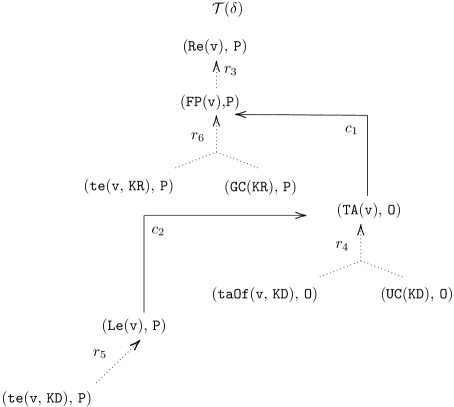
The diagram represents a directed graph illustrating a state transition process with parameterized nodes. It includes 9 nodes connected by 6 labeled edges, with hierarchical branching and parameterized transitions. The structure suggests a computational or algorithmic workflow involving function calls, transformations, and state changes.
### Components/Axes
- **Nodes** (labeled with tuples containing functions/variables and parameters):
1. `T(δ)` (top node, root)
2. `(Re(v), P)`
3. `(FP(v), P)`
4. `(te(v), KR, P)`
5. `(GC(KR), P)`
6. `(TA(v), O)`
7. `(Le(v), P)`
8. `(taOf(v, KD), O)`
9. `(UC(KD), O)`
- **Edges** (labeled with transition identifiers):
- `r3` (↑ arrow from `T(δ)` to `(Re(v), P)`)
- `r6` (→ arrow from `(FP(v), P)` to `(te(v), KR, P)`)
- `c1` (→ arrow from `(FP(v), P)` to `(GC(KR), P)`)
- `c2` (→ arrow from `(te(v), KR, P)` to `(taOf(v, KD), O)`)
- `r4` (→ arrow from `(GC(KR), P)` to `(TA(v), O)`)
- `r5` (→ arrow from `(TA(v), O)` to `(UC(KD), O)`)
- **Special Symbols**:
- `Λ` (lambda symbol) above edges `r3` and `r4`
- `→` (rightward arrow) for all transitions
- `O` (empty set symbol) in node parameters `(TA(v), O)`, `(taOf(v, KD), O)`, `(UC(KD), O)`
### Detailed Analysis
1. **Root Node**: `T(δ)` initiates the process, with a single outgoing edge labeled `r3` (↑) to `(Re(v), P)`.
2. **First Branch**:
- `(Re(v), P)` transitions via `r3` (↑) to `(FP(v), P)`.
- `(FP(v), P)` splits into two paths:
- `r6` (→) to `(te(v), KR, P)`
- `c1` (→) to `(GC(KR), P)`
3. **Second Branch**:
- `(te(v), KR, P)` transitions via `c2` (→) to `(taOf(v, KD), O)`.
- `(GC(KR), P)` transitions via `r4` (→) to `(TA(v), O)`.
4. **Final Nodes**:
- `(taOf(v, KD), O)` and `(TA(v), O)` both transition via `r5` (→) to `(UC(KD), O)`.
### Key Observations
- **Parameterized Nodes**: Nodes contain tuples with functions/variables (e.g., `Re(v)`, `FP(v)`) and parameters (`P`, `KR`, `KD`, `O`). The `O` parameter (empty set) appears in the final nodes, suggesting termination states.
- **Transition Labels**:
- `r3` and `r4` are marked with `Λ`, possibly indicating transformation operations.
- `c1` and `c2` use standard arrows, suggesting direct dependencies.
- **Hierarchical Flow**: The diagram splits into parallel paths (`r6`/`c1` and `c2`/`r4`) before converging at `(UC(KD), O)`.
### Interpretation
This diagram likely models a computational process involving:
1. **State Transitions**: Nodes represent computational states or function calls, with edges defining dependencies or control flow.
2. **Parameter Roles**:
- `P` (common in early nodes) may represent general parameters.
- `KR` and `KD` (appearing in later nodes) could denote specialized contexts or keys.
- `O` (empty set) in final nodes suggests termination or output states.
3. **Lambda Symbols (`Λ`)**: Above `r3` and `r4`, these might indicate function application or mapping operations.
4. **Convergence**: All paths ultimately lead to `(UC(KD), O)`, implying a unified endpoint or result.
The structure resembles a state machine or algorithmic workflow, where parameters and transitions govern the progression through computational stages. The use of `O` (empty set) in terminal nodes suggests a finalization or output phase, while `Λ` symbols highlight critical transformation steps.