## Diagram: Mathematical Structure and Geometric Representation
### Overview
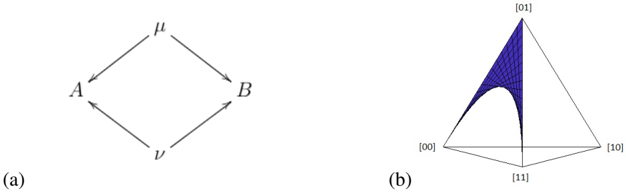
The image contains two distinct technical diagrams labeled (a) and (b). Diagram (a) is an abstract directed graph showing relationships between four symbolic elements. Diagram (b) is a three-dimensional geometric plot featuring a tetrahedron with binary-labeled vertices and an internal curved mesh surface. The image appears to be from a technical or scientific publication, likely in mathematics, theoretical computer science, or quantum information.
### Components/Axes
**Diagram (a) - Directed Graph:**
* **Nodes/Vertices:** Four nodes labeled with symbols:
* `A` (left)
* `B` (right)
* `μ` (mu, top center)
* `ν` (nu, bottom center)
* **Edges/Arrows:** Four directed arrows indicating relationships:
* `μ → A` (arrow from μ to A)
* `μ → B` (arrow from μ to B)
* `A → ν` (arrow from A to ν)
* `B → ν` (arrow from B to ν)
* **Spatial Layout:** The nodes form a diamond or square shape rotated 45 degrees. `μ` is positioned at the top vertex, `ν` at the bottom vertex, `A` at the left vertex, and `B` at the right vertex.
**Diagram (b) - 3D Tetrahedron Plot:**
* **Geometric Shape:** A wireframe tetrahedron (a pyramid with a triangular base).
* **Vertex Labels:** The four vertices are labeled with two-bit binary strings:
* `[01]` (top vertex)
* `[00]` (bottom-left vertex of the base)
* `[10]` (bottom-right vertex of the base)
* `[11]` (front/center vertex of the base)
* **Internal Feature:** A dark blue, mesh-like curved surface is plotted inside the tetrahedron. This surface appears to be a smooth manifold that connects or is bounded by the edges of the tetrahedron. It is most prominent between the `[01]` vertex and the base edge connecting `[00]` and `[10]`, curving inward towards the `[11]` vertex.
* **Spatial Layout:** The tetrahedron is presented in a standard 3D perspective view. The `[01]` vertex is at the top. The base triangle is formed by `[00]`, `[10]`, and `[11]`, with `[11]` appearing closest to the viewer.
### Detailed Analysis
**Diagram (a) Analysis:**
* **Structure:** This is a classic commutative diagram shape often used in category theory, algebra, or formal methods. It depicts two parallel paths from `μ` to `ν`: one via `A` (`μ → A → ν`) and one via `B` (`μ → B → ν`).
* **Flow Direction:** The flow is strictly top-to-bottom, originating at `μ` and terminating at `ν`, with `A` and `B` as intermediate nodes.
**Diagram (b) Analysis:**
* **Geometric Context:** The tetrahedron with binary labels is a common representation for the state space of a two-qubit quantum system. The four vertices correspond to the four computational basis states: |00⟩, |01⟩, |10⟩, |11⟩.
* **Surface Interpretation:** The blue mesh surface likely represents a specific subset or function within this state space. Given its shape, it could visualize:
1. The set of all pure states for a particular quantum system.
2. A specific manifold like the "Bloch sphere" generalization for two qubits (though the standard two-qubit Bloch sphere is more complex).
3. The support of a particular quantum state or operation.
* **Visual Trend:** The surface is not flat; it exhibits a smooth, concave curvature relative to the viewer, dipping down from the `[01]` vertex towards the center of the tetrahedron before rising to meet the edges connected to `[00]` and `[10]`.
### Key Observations
1. **Abstract vs. Concrete:** Diagram (a) is purely abstract and symbolic, defining relationships. Diagram (b) is a concrete geometric instantiation, possibly representing a mathematical object related to the concepts in (a).
2. **Binary Labeling:** The use of `[00]`, `[01]`, etc., in (b) strongly suggests a context of digital logic, coding theory, or quantum computing, where these represent bit strings or qubit states.
3. **Symmetry in (a):** The graph in (a) is symmetric with respect to a vertical axis through `μ` and `ν`. The roles of `A` and `B` are interchangeable.
4. **Complex Surface in (b):** The internal blue surface is a complex, non-linear feature. Its precise mathematical definition is not given, but its visualization is the central focus of diagram (b).
### Interpretation
The two diagrams are likely connected, illustrating an abstract concept and its geometric realization.
* **What the data suggests:** Diagram (a) defines a structure where two entities (`A` and `B`) mediate a relationship between a source (`μ`) and a sink (`ν`). This is a fundamental pattern in many fields: two functions composing to the same result, two processes leading to the same outcome, or two paths in a logical proof.
* **How elements relate:** Diagram (b) may be a visualization of the space of possibilities defined by the structure in (a). If `A` and `B` represent operations on a two-qubit system (as suggested by the vertex labels), then the tetrahedron represents the total state space. The blue surface could then represent the set of states reachable via the paths `μ → A → ν` and `μ → B → ν`, or perhaps the set of states where the two paths yield equivalent results (commutativity).
* **Notable Anomalies/Insights:** The key insight is the translation from an abstract relational diagram to a concrete, high-dimensional geometric object. The curved surface in (b) indicates that the relationship is non-trivial and linear in the state space. The choice of a tetrahedron specifically points towards a system with four discrete basis states, making quantum information a very strong candidate for the context. The diagrams together likely serve to build intuition about a mathematical property (like commutativity or equivalence) by showing its abstract form and its effect on a state space.