## Grid Layout: Symbolic Pattern Analysis
### Overview
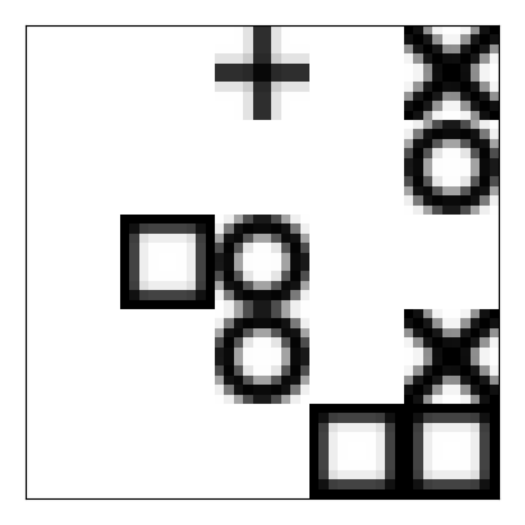
The image depicts a 3x3 grid with symbolic elements (plus signs, Xs, Os, and squares) arranged in specific positions. No textual labels, axis titles, or legends are present. The grid appears to represent a structured arrangement of symbols, potentially indicating a game board, code, or abstract pattern.
### Components/Axes
- **Grid Structure**:
- 3 rows (top, middle, bottom) and 3 columns (left, center, right).
- Each cell contains a single symbol or is empty.
- **Symbols**:
- **Plus sign (+)**: Located in the center of the top row.
- **Xs**: Present in the top-right corner and the bottom-right corner of the middle row.
- **Os**: Located in the bottom-right corner of the top row and the center of the middle row.
- **Squares**: Found in the top-left corner of the middle row, the bottom-left corner, and the bottom-right corner.
### Detailed Analysis
- **Top Row**:
- Top-left: Empty.
- Top-center: Plus sign (+).
- Top-right: Xs.
- **Middle Row**:
- Top-left: Square.
- Center: Os.
- Bottom-right: Xs.
- **Bottom Row**:
- Bottom-left: Square.
- Bottom-center: Empty.
- Bottom-right: Two squares.
### Key Observations
1. **Symbol Distribution**:
- Xs and Os are positioned in the rightmost columns of their respective rows.
- Squares occupy the leftmost and bottom-right cells, with the bottom-right cell containing two squares.
- The plus sign is isolated in the center of the top row, acting as a focal point.
2. **Pattern Ambiguity**:
- No clear numerical or categorical data is present.
- The arrangement resembles a game board (e.g., tic-tac-toe) but with non-standard symbols (e.g., plus sign).
3. **Missing Elements**:
- No axis labels, legends, or textual annotations are visible.
### Interpretation
The grid likely represents a symbolic or abstract system rather than a data-driven chart. The plus sign in the top-center may denote a central reference point, while the Xs, Os, and squares could symbolize different entities or states. The absence of textual labels suggests the image is either a placeholder, a conceptual diagram, or part of a larger system requiring external context. The repetition of squares in the bottom row might indicate a progression or emphasis on that area. Without additional context, the purpose remains speculative, but the structured layout implies intentional design for a specific function (e.g., game mechanics, code representation, or visual metaphor).