## Diagram: Cannon Firing Simulation
### Overview
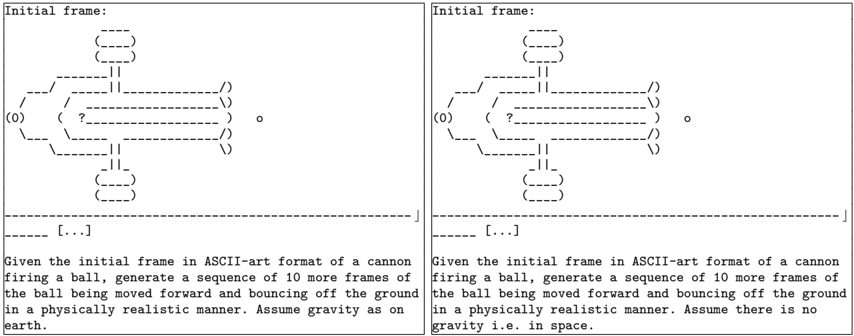
The image presents two scenarios of a cannon firing a ball, represented in ASCII art. The left side simulates the trajectory with gravity, while the right side simulates the trajectory without gravity. The image includes the initial frame of the cannon and ball, along with instructions to generate subsequent frames.
### Components/Axes
* **Title (Left):** Initial frame:
* **Title (Right):** Initial frame:
* **Cannon (ASCII Art):** A cannon is depicted using ASCII characters, consisting of a base, a barrel, and a firing mechanism. The barrel contains a question mark "?".
* **Ball (ASCII Art):** A small circle "o" represents the ball.
* **Ground (ASCII Art):** A dashed line represents the ground.
* **Ellipsis (ASCII Art):** `[...]` indicates that the simulation continues beyond the initial frame.
* **Text Description (Left):** "Given the initial frame in ASCII-art format of a cannon firing a ball, generate a sequence of 10 more frames of the ball being moved forward and bouncing off the ground in a physically realistic manner. Assume gravity as on earth."
* **Text Description (Right):** "Given the initial frame in ASCII-art format of a cannon firing a ball, generate a sequence of 10 more frames of the ball being moved forward and bouncing off the ground in a physically realistic manner. Assume there is no gravity i.e. in space."
### Detailed Analysis
The image shows two identical initial states of a cannon firing a ball. The key difference lies in the accompanying text, which specifies the simulation conditions:
* **Left Side (Gravity):** The simulation should account for gravity, implying a parabolic trajectory for the ball. The ball will move forward and bounce off the ground.
* **Right Side (No Gravity):** The simulation should disregard gravity, resulting in a straight-line trajectory for the ball. The ball will move forward without bouncing.
The ASCII art cannon is composed of the following elements:
* A base made of two stacked rounded rectangles.
* A barrel extending horizontally, with a question mark inside.
* A firing mechanism on the left side, represented by angled lines and parentheses.
* The ball is positioned to the right of the cannon's barrel.
### Key Observations
* The initial frame is identical in both scenarios.
* The only difference between the two scenarios is the presence or absence of gravity in the simulation.
* The ellipsis `[...]` suggests that the simulation continues for multiple frames beyond the initial state.
### Interpretation
The image sets up a comparative simulation of projectile motion. By contrasting the trajectory of a ball fired from a cannon with and without gravity, the image highlights the fundamental impact of gravity on projectile motion. The left side demonstrates a realistic scenario where gravity causes the ball to follow a curved path and bounce, while the right side illustrates a hypothetical scenario where the ball travels in a straight line due to the absence of gravity. The instructions prompt the user to generate a sequence of frames, implying an animation or visualization of the ball's movement over time.