\n
## Diagram: Cannonball Trajectory Generation Task
### Overview
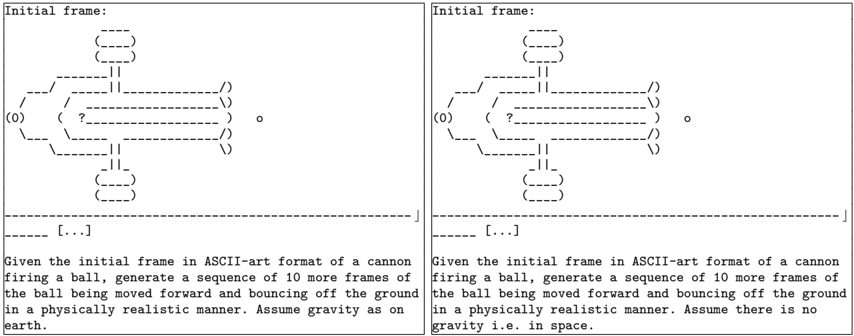
The image presents two side-by-side diagrams illustrating a task description for generating a sequence of frames depicting the trajectory of a cannonball. The task involves generating 10 additional frames based on an initial frame, with two distinct scenarios: one with gravity (as on Earth) and one without gravity (in space). The diagrams use ASCII art to represent the initial state of the cannon and the cannonball.
### Components/Axes
The diagrams consist of the following components:
* **Initial Frame:** ASCII art representation of a cannon and a cannonball in flight.
* **Text Description:** A textual description of the task, specifying the input (initial frame), the output (10 more frames), and the physical conditions (gravity or no gravity).
* **Cannon Representation:** The cannon is depicted using brackets and lines, with the barrel angled upwards. The origin (0) is marked.
* **Cannonball Representation:** The cannonball is represented by the character 'o'.
* **Trajectory Representation:** Dashed lines indicate the initial trajectory of the cannonball.
* **Placeholder:** "[...]" indicates where the generated frames would be placed.
### Detailed Analysis or Content Details
**Left Diagram (With Gravity):**
* **Text:** "Given the initial frame in ASCII-art format of a cannon firing a ball, generate a sequence of 10 more frames of the ball being moved forward and bouncing off the ground in a physically realistic manner. Assume gravity as on earth."
* **Initial Frame:** The cannon is positioned at (0). The cannonball 'o' is located approximately 5 units to the right and 2 units above the cannon. The initial trajectory is shown with dashed lines, indicating a parabolic path.
* **Placeholder:** "[...]" is present below the initial frame, indicating the space for the 10 generated frames.
**Right Diagram (Without Gravity):**
* **Text:** "Given the initial frame in ASCII-art format of a cannon firing a ball, generate a sequence of 10 more frames of the ball being moved forward and bouncing off the ground in a physically realistic manner. Assume there is no gravity i.e. in space."
* **Initial Frame:** Identical to the left diagram in terms of cannon and cannonball positioning. The initial trajectory is also shown with dashed lines.
* **Placeholder:** "[...]" is present below the initial frame, indicating the space for the 10 generated frames.
### Key Observations
* The two diagrams are nearly identical except for the accompanying text description, which specifies the presence or absence of gravity.
* The initial frames are the same, providing a consistent starting point for the frame generation task.
* The task requires generating frames that adhere to the laws of physics, either with or without gravity.
* The use of ASCII art provides a simple and abstract representation of the physical scenario.
### Interpretation
The diagrams outline a computational task focused on simulating projectile motion. The core challenge lies in generating a sequence of frames that realistically depict the cannonball's trajectory under different gravitational conditions. The task requires an understanding of physics principles (gravity, projectile motion, bouncing) and the ability to translate these principles into a visual representation using ASCII art. The two scenarios (with and without gravity) highlight the importance of gravity in shaping the trajectory. The "[...]" placeholders suggest that the expected output is a series of ASCII art frames demonstrating the cannonball's movement over time. The task is essentially a test of a system's ability to model and visualize physical phenomena.