TECHNICAL ASSET FINGERPRINT
a5ff51ea29020c16dd0d2552
Click to view fullscreen
Press ESC or click to close
FOUND IN PAPERS
EXPERT: nemotron-free VERSION 1
RUNTIME: free/nvidia/nemotron-nano-12b-v2-vl:free
INTEL_VERIFIED
# Technical Document Extraction: Image Analysis
## Overview
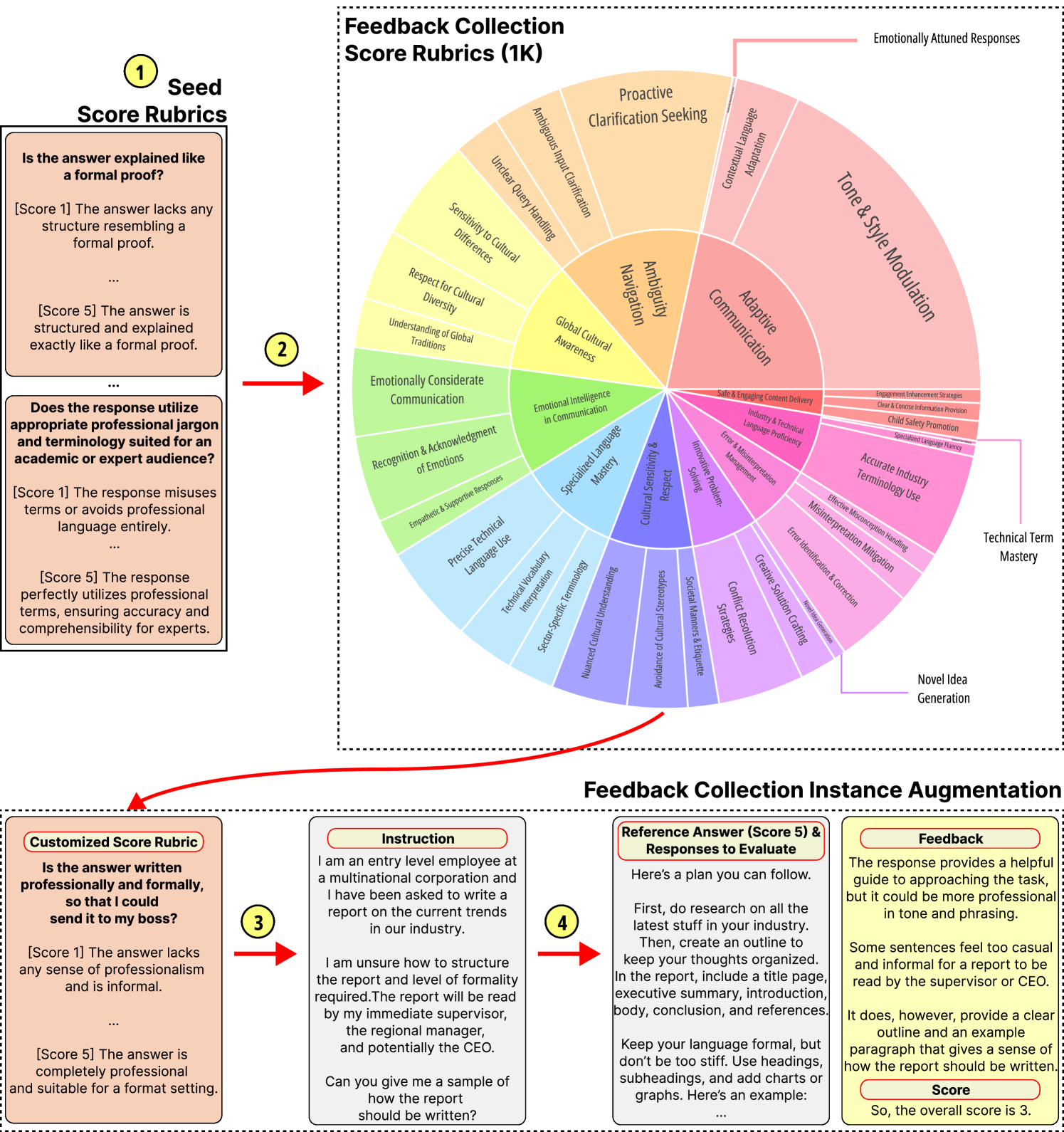
The image is a **flowchart** depicting a structured process for evaluating and refining responses using **score rubrics** and **feedback mechanisms**. It includes textual descriptions, hierarchical categories, and directional arrows indicating workflow. Below is a detailed breakdown of all textual components, diagrams, and data points.
---
## 1. Seed Score Rubrics
### Labels and Text
- **Question 1**:
*"Is the answer explained like a formal proof?"*
- Score 1: The answer lacks any structure resembling a formal proof.
- Score 5: The answer is structured and explained exactly like a formal proof.
- **Question 2**:
*"Does the response utilize appropriate professional jargon and terminology suited for an academic or expert audience?"*
- Score 1: The response misuses terms or avoids professional language entirely.
- Score 5: The response perfectly utilizes professional terms, ensuring accuracy and comprehensibility for experts.
---
## 2. Feedback Collection Score Rubrics (1K)
### Circular Diagram Structure
The central diagram is a **radial chart** with hierarchical categories and subcategories. Key components include:
#### Main Categories (Colored Segments)
1. **Tone & Style Modulation** (Pink)
- Emotionally Attuned Responses
- Contextual Language Adaptation
2. **Adaptive Communication** (Light Pink)
- Tone & Style Modulation
- Contextual Language Adaptation
3. **Ambiguity Navigation** (Orange)
- Proactive Clarification Seeking
- Ambiguous Input Clarification
- Unclear Query Handling
4. **Global Cultural Awareness** (Yellow)
- Sensitivity to Cultural Differences
- Respect for Cultural Diversity
- Understanding of Global Traditions
5. **Emotional Intelligence in Communication** (Green)
- Emotionally Considerate Communication
- Recognition & Acknowledgment of Emotions
- Empathetic & Supportive Responses
6. **Specialized Language Mastery** (Blue)
- Precise Technical Language Use
- Technical Vocabulary Interpretation
- Sector-Specific Terminology
7. **Cultural Sensitivity & Respect** (Purple)
- Nuanced Cultural Understanding
- Avoidance of Cultural Stereotypes
- Societal Manners & Etiquette
8. **Problem Solving** (Light Purple)
- Innovative Problem Solving
- Error & Misinterpretation Management
9. **Industry & Technical Language Proficiency** (Red)
- Accurate Industry Terminology Use
- Effective Misconception Handling
- Misinterpretation Mitigation
10. **Technical Term Mastery** (Dark Red)
- Novel Idea Generation
- Specialized Language Fluency
11. **Child Safety Promotion** (Light Orange)
- Engagement Enhancement Strategies
- Clear & Concise Information Provision
#### Arrows and Connections
- Red arrows indicate **feedback flow** between components (e.g., from Seed Score Rubrics to Feedback Collection Instance Augmentation).
- Dotted lines separate distinct sections (e.g., Seed Score Rubrics, Feedback Collection Score Rubrics, Feedback Collection Instance Augmentation).
---
## 3. Feedback Collection Instance Augmentation
### Textual Components
#### Instruction Block
- **Task**:
*"I am an entry-level employee at a multinational corporation and have been asked to write a report on the current trends in our industry."*
- **Uncertainty**:
*"I am unsure how to structure the report and level of formality required. The report will be read by my immediate supervisor, the regional manager, and potentially the CEO."*
- **Request**:
*"Can you give me a sample of how the report should be written?"*
#### Reference Answer (Score 5)
- **Guidelines**:
1. Research all the latest stuff in your industry.
2. Create an outline organized with thoughts.
3. Include a title page, executive summary, introduction, body, conclusion, and references.
4. Use formal language but avoid stiffness.
5. Add charts or graphs (example provided).
#### Feedback Block
- **Positive Feedback**:
*"The response provides a helpful guide to approaching the task but could be more professional in tone and phrasing."*
- **Constructive Criticism**:
*"Some sentences feel too casual and informal for a report to be read by the supervisor or CEO."*
- **Suggestions**:
*"Keep your language formal, use headings, subheadings, and add charts or graphs. Here’s an example: [example text]."*
#### Score
- **Overall Score**: 3
---
## 4. Customized Score Rubric
### Labels and Text
- **Question**:
*"Is the answer written professionally and formally, so that I could send it to my boss?"*
- Score 1: The answer lacks any sense of professionalism and is informal.
- Score 5: The answer is completely professional and suitable for a formal setting.
---
## Diagram Components and Flow
1. **Seed Score Rubrics** (Left) → **Feedback Collection Score Rubrics (1K)** (Center) → **Feedback Collection Instance Augmentation** (Right) → **Customized Score Rubric** (Bottom Left).
2. Arrows indicate **evaluation progression** and **feedback integration**.
3. Dotted lines separate distinct evaluation phases.
---
## Key Trends and Data Points
- **Hierarchical Evaluation**:
- Feedback Collection Score Rubrics (1K) is the most detailed, with 11 main categories and 25+ subcategories.
- Seed and Customized Score Rubrics focus on **formality** and **professionalism**.
- **Feedback Loop**:
- The process emphasizes iterative refinement (e.g., from Seed to Customized Rubrics).
- **Cultural and Technical Focus**:
- Categories like *Global Cultural Awareness* and *Technical Term Mastery* highlight cross-cultural and domain-specific requirements.
---
## Notes
- **No Data Tables**: The image uses textual descriptions and hierarchical diagrams instead of numerical data.
- **Language**: All text is in **English**.
- **Spatial Grounding**:
- Seed Score Rubrics: Top-left quadrant.
- Feedback Collection Score Rubrics: Central circular diagram.
- Feedback Collection Instance Augmentation: Right side.
- Customized Score Rubric: Bottom-left quadrant.
---
## Final Output
This flowchart outlines a **multi-stage evaluation process** for technical documents, emphasizing **formality**, **professionalism**, and **cultural/technical adaptability**. The Feedback Collection Score Rubrics (1K) serves as the core evaluation framework, while the Customized Score Rubric tailors criteria for specific audiences (e.g., executives).
DECODING INTELLIGENCE...