## Bar Chart: BatchNorm Noise Augmentation Test Accuracy Comparison
### Overview
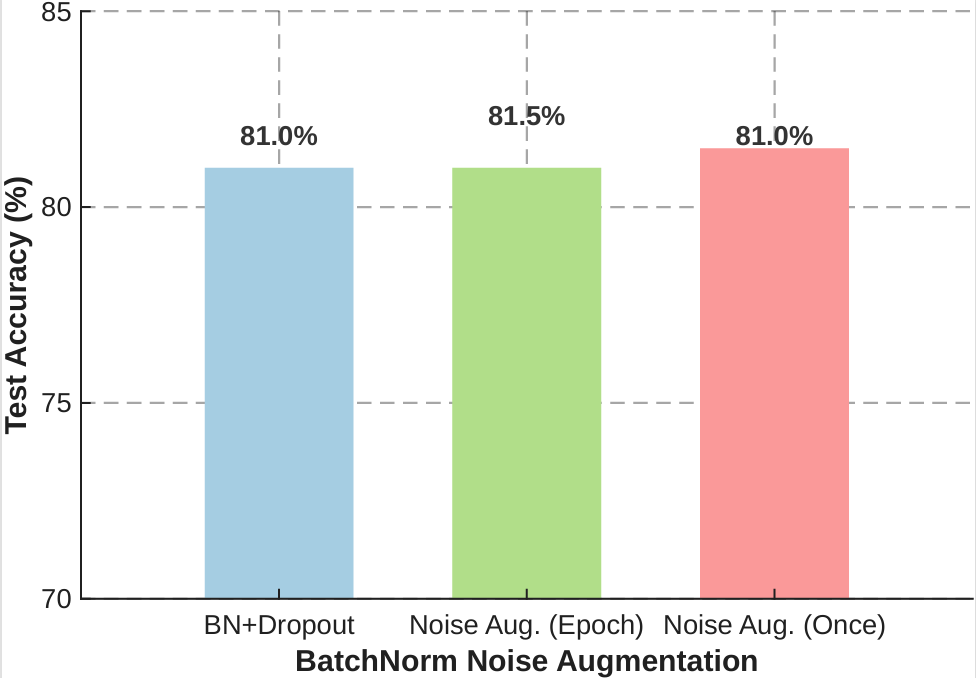
The chart compares test accuracy percentages for three BatchNorm noise augmentation techniques: "BN+Dropout," "Noise Aug. (Epoch)," and "Noise Aug. (Once)." All methods achieve similar performance, with "Noise Aug. (Epoch)" showing marginally higher accuracy.
### Components/Axes
- **X-axis**: Labeled "BatchNorm Noise Augmentation," listing three categories:
1. BN+Dropout (blue)
2. Noise Aug. (Epoch) (green)
3. Noise Aug. (Once) (red)
- **Y-axis**: Labeled "Test Accuracy (%)" with a scale from 70% to 85%, marked in 1% increments.
- **Legend**: Not explicitly visible in the image, but colors are directly mapped to categories in the x-axis labels.
### Detailed Analysis
1. **BN+Dropout (Blue)**:
- Test Accuracy: 81.0%
- Bar height aligns with the 81% mark on the y-axis.
2. **Noise Aug. (Epoch) (Green)**:
- Test Accuracy: 81.5%
- Bar height is the tallest, slightly exceeding 81%.
3. **Noise Aug. (Once) (Red)**:
- Test Accuracy: 81.0%
- Bar height matches BN+Dropout at 81%.
### Key Observations
- **Noise Aug. (Epoch)** achieves the highest test accuracy (81.5%), outperforming the other two methods by 0.5%.
- **BN+Dropout** and **Noise Aug. (Once)** have identical test accuracies (81.0%), suggesting equivalent performance.
- All methods fall within a narrow range (81.0–81.5%), indicating minimal variation in effectiveness.
### Interpretation
The data suggests that applying noise augmentation at the epoch level ("Noise Aug. (Epoch)") yields marginally better results than combining BatchNorm with dropout or applying noise augmentation once. However, the differences are small (≤0.5%), implying that all three techniques are broadly comparable in practical scenarios. The consistency between BN+Dropout and Noise Aug. (Once) might indicate that the timing of noise application (once vs. per epoch) has negligible impact compared to the augmentation method itself. This could guide optimization efforts toward simpler implementations without significant performance trade-offs.