\n
## Diagram: Federated Learning Process
### Overview
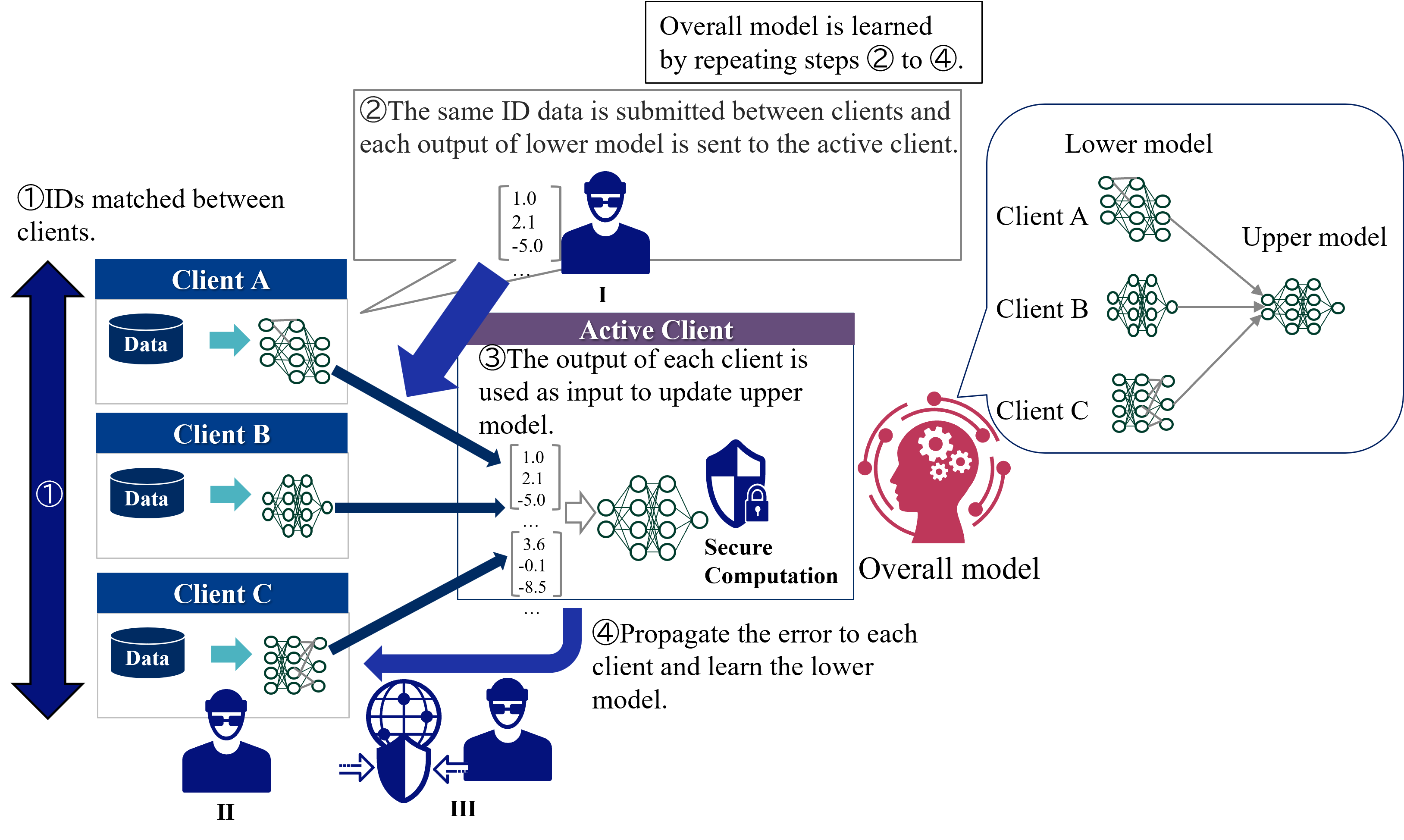
This diagram illustrates a federated learning process involving multiple clients (A, B, and C) and a central server. The process involves iterative steps of data sharing, model updating, and error propagation to learn an overall model without directly exchanging data. The diagram is segmented into three main areas: Client Side (left), Active Client & Secure Computation (center), and Model Architecture (right).
### Components/Axes
The diagram features the following components:
* **Clients (A, B, C):** Represent individual devices or entities holding local data.
* **Data:** Input data residing on each client.
* **Lower Model:** A model trained locally on each client's data.
* **Upper Model:** A global model aggregated from the lower models.
* **Active Client:** The client selected for model aggregation in a given iteration.
* **Secure Computation:** A secure environment for aggregating model updates.
* **Overall Model:** The final, globally learned model.
* **IDs Matched Between Clients:** Indicates the synchronization of client identifiers.
* **Arrows:** Represent the flow of data and model updates.
* **Numbered Steps:** Describe the sequence of operations.
### Detailed Analysis or Content Details
The diagram outlines a four-step process:
**Step 1: IDs Matched Between Clients**
* A large purple arrow indicates the synchronization of client identifiers between Clients A, B, and C.
**Step 2: The same ID data is submitted between clients and each output of lower model is sent to the active client.**
* Grey arrows connect Clients A, B, and C to a box labeled "I".
* Box "I" contains the following values:
* 1.0
* 2.1
* -5.0
* The text "The same ID data is submitted between clients and each output of lower model is sent to the active client." accompanies this step.
**Step 3: The output of each client is used as input to update upper model.**
* Grey arrows connect Clients A, B, and C to a central component labeled "Active Client".
* The "Active Client" contains a box labeled with the following values:
* 3.6
* -0.1
* -8.5
* 1.0
* 2.1
* -5.0
* The "Active Client" is connected to a "Secure Computation" component (represented by a building with a lock).
* The text "The output of each client is used as input to update upper model." accompanies this step.
**Step 4: Propagate the error to each client and learn the lower model.**
* An arrow connects the "Secure Computation" component to Clients A, B, and C.
* The text "Propagate the error to each client and learn the lower model." accompanies this step.
**Model Architecture (Right Side)**
* Clients A, B, and C each have a "Lower Model" (represented by a network of nodes).
* Each client also has an "Upper Model" (also represented by a network of nodes) connected to its "Lower Model".
* A gear icon connects the "Secure Computation" component to the "Overall Model".
* The text "Overall model is learned by repeating steps ② to ④." is positioned at the top-right of the diagram.
**Additional Elements:**
* "II" represents a person/user.
* "III" represents a globe/network.
* Arrows between "II" and "III" indicate data transfer.
### Key Observations
* The process is iterative, as indicated by the statement "Overall model is learned by repeating steps ② to ④."
* Secure computation is used to aggregate model updates, suggesting a focus on privacy.
* The values within boxes "I" and the "Active Client" box appear to be model parameters or gradients.
* The diagram highlights the decentralized nature of federated learning, where data remains on the clients.
### Interpretation
This diagram depicts a federated learning system designed to train a global model collaboratively without directly sharing sensitive data. The process begins with synchronizing client IDs. Each client trains a local model ("Lower Model") on its own data. The outputs of these local models are then sent to an "Active Client," which aggregates them using "Secure Computation" to update a global model ("Upper Model"). The error from the global model is then propagated back to the clients, allowing them to refine their local models. This iterative process continues until the overall model converges.
The use of "Secure Computation" suggests a commitment to preserving data privacy during the aggregation process. The diagram emphasizes the decentralized nature of the learning process, where data remains on the clients, and only model updates are exchanged. The values within the boxes likely represent model parameters or gradients used in the training process. The inclusion of "II" and "III" suggests that the clients are connected through a network and that users are involved in the process. The diagram effectively illustrates the core principles of federated learning and its potential for privacy-preserving machine learning.