## Bar Chart: Overall Accuracy Comparison
### Overview
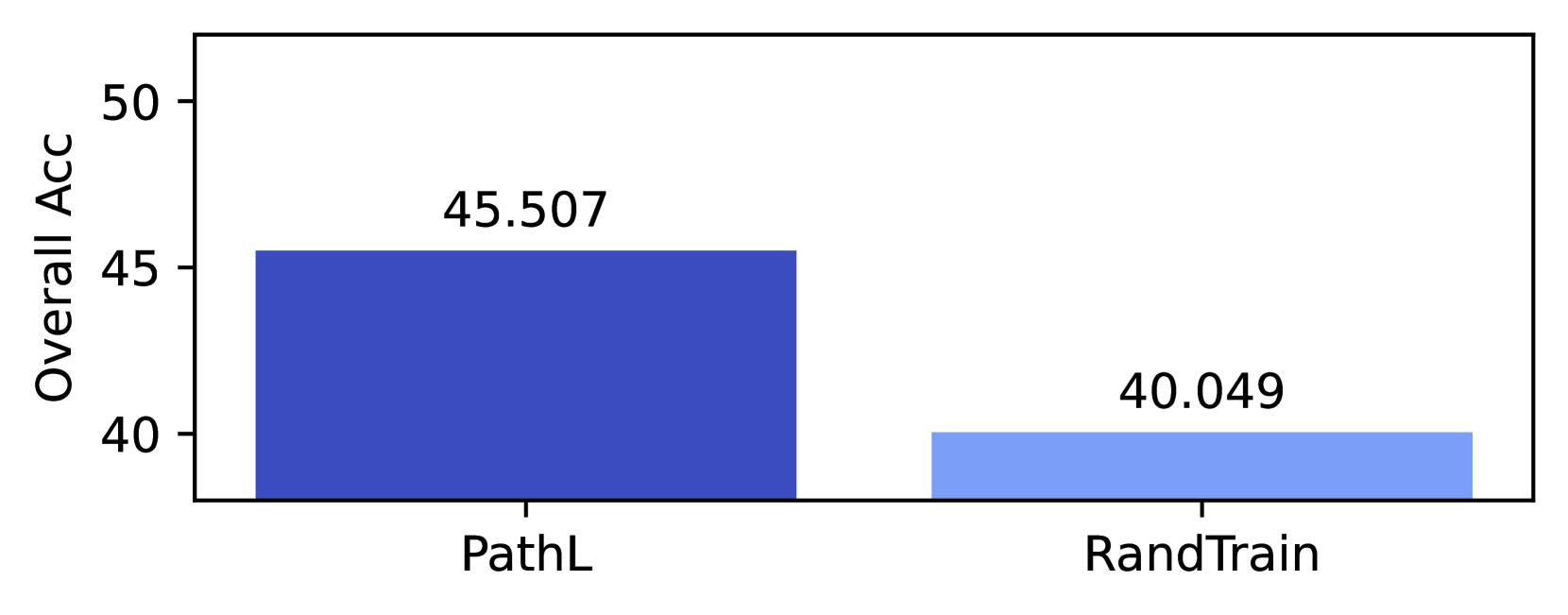
The image is a bar chart comparing the overall accuracy of two methods: PathL and RandTrain. The y-axis represents "Overall Acc" and ranges from approximately 38 to 52. The x-axis represents the two methods being compared. PathL has a higher overall accuracy than RandTrain.
### Components/Axes
* **Y-axis:** "Overall Acc" with tick marks at 40, 45, and 50.
* **X-axis:** Categorical axis with two categories: "PathL" and "RandTrain".
* **Bars:** Two bars representing the overall accuracy for each method. PathL is represented by a dark blue bar, and RandTrain is represented by a light blue bar.
* **Values:** Numerical values are displayed above each bar, indicating the exact overall accuracy.
### Detailed Analysis
* **PathL:** The dark blue bar for PathL reaches an overall accuracy of 45.507.
* **RandTrain:** The light blue bar for RandTrain reaches an overall accuracy of 40.049.
### Key Observations
* PathL has a significantly higher overall accuracy compared to RandTrain.
* The difference in overall accuracy between PathL and RandTrain is approximately 5.458 (45.507 - 40.049).
### Interpretation
The bar chart demonstrates that the PathL method achieves a higher overall accuracy than the RandTrain method. This suggests that PathL is a more effective approach for the task being evaluated. The difference in accuracy is substantial, indicating a potentially significant advantage of using PathL over RandTrain.