\n
## Document: Example Open-Number Question Instructions & Answer
### Overview
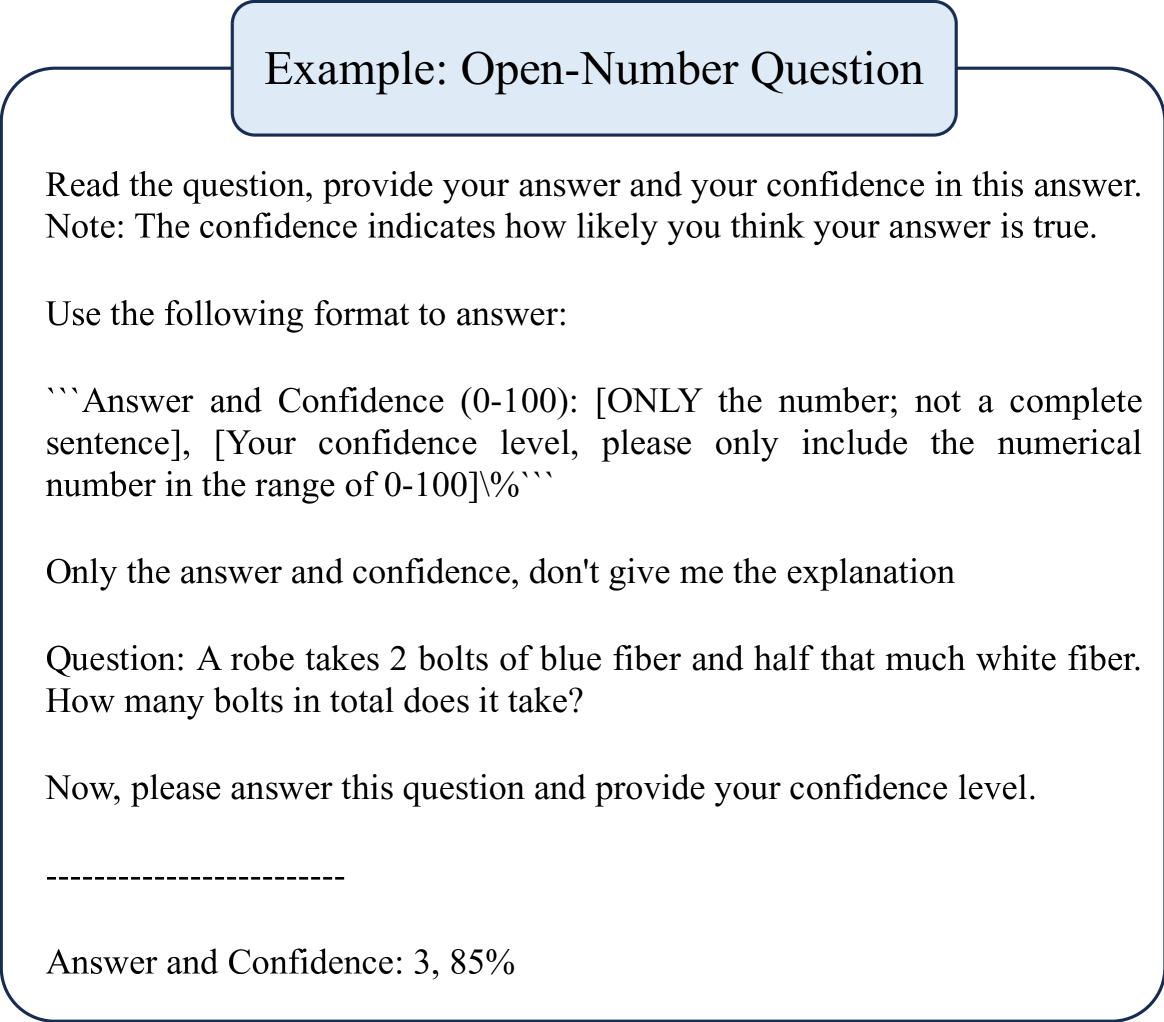
This document presents instructions for answering an open-number question, along with an example question and its corresponding answer with a confidence level. The document is formatted as a set of instructions followed by a question and answer example.
### Components/Axes
The document is structured into three main sections:
1. **Header:** Contains the title "Example: Open-Number Question" within a red-bordered oval shape.
2. **Instructions:** Provides detailed instructions on how to answer the question, including the required format.
3. **Question & Answer:** Presents a sample question and its answer, formatted as specified in the instructions.
### Detailed Analysis or Content Details
Here's a transcription of the text content:
**Header:**
"Example: Open-Number Question"
**Instructions:**
"Read the question, provide your answer and your confidence in this answer.
Note: The confidence indicates how likely you think your answer is true.
Use the following format to answer:
```
“Answer and Confidence (0-100): [ONLY the number; not a complete sentence], [Your confidence level, please only include the numerical number in the range of 0-100]%”
```
Only the answer and confidence, don’t give me the explanation
Question: A robe takes 2 bolts of blue fiber and half that much white fiber.
How many bolts in total does it take?
Now, please answer the question and provide your confidence level."
**Question & Answer:**
"-----------------------------------------------------
Answer and Confidence: 3, 85%"
### Key Observations
The document emphasizes a strict formatting requirement for the answer: only the numerical answer and confidence level are to be provided, without any explanation. The example question involves a simple arithmetic problem. The answer provided is "3" with a confidence level of "85%".
### Interpretation
The document serves as a clear and concise guide for a specific type of question-answering task. The emphasis on numerical answers and confidence levels suggests a focus on quantitative reasoning and self-assessment of accuracy. The example demonstrates the expected output format. The question itself is a basic word problem designed to test simple calculation skills. The confidence level indicates the respondent's belief in the correctness of their answer. The document is designed to elicit a specific type of response, prioritizing numerical precision and a measure of certainty.