## Diagram: Example of an "Open-Number Question" Format
### Overview
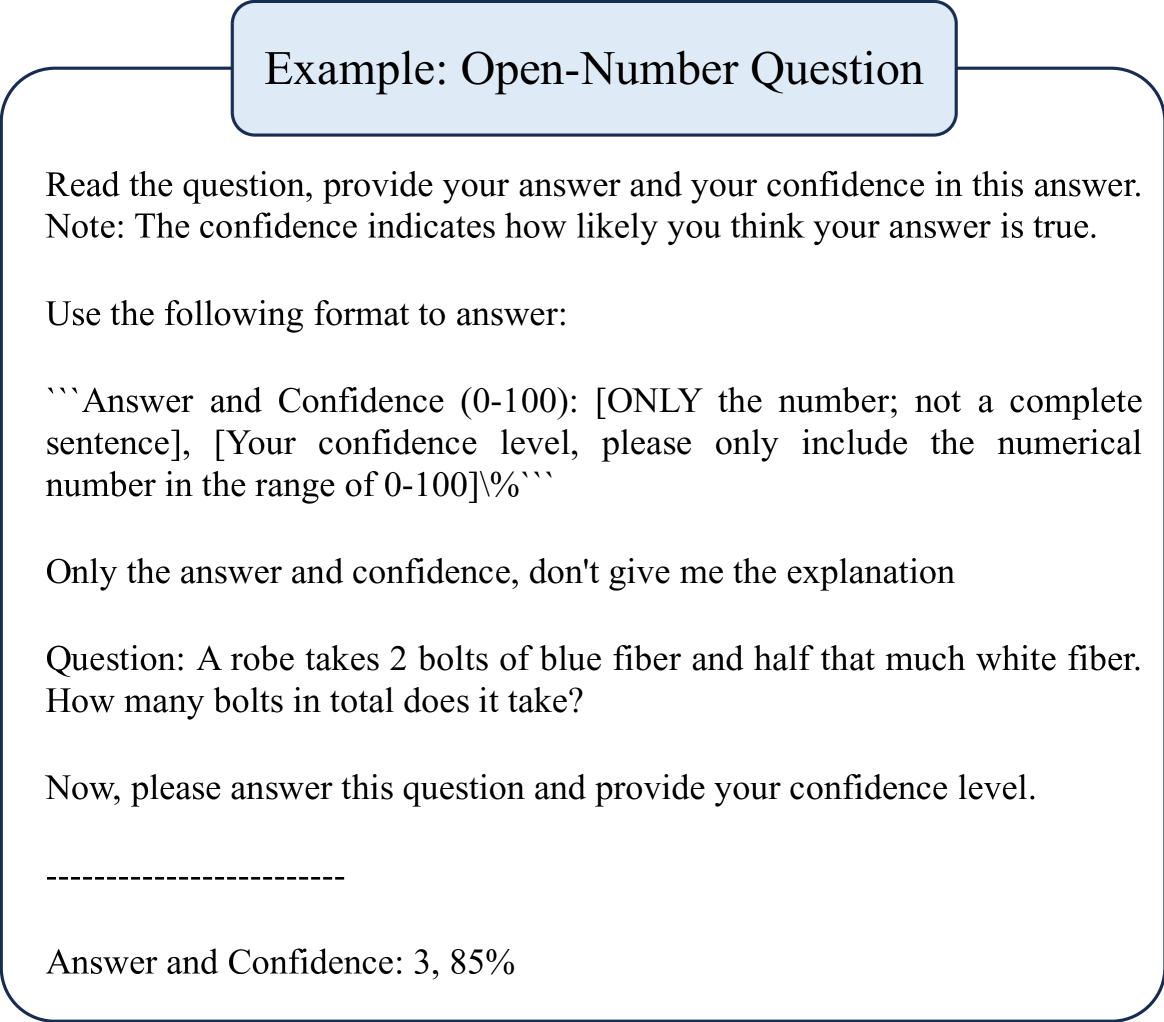
The image is a diagram illustrating the format for answering an "Open-Number Question." It provides instructions, a specific answer template, and a worked example. The content is entirely in English.
### Components/Axes
The diagram is structured as a single, rounded rectangular box with a light blue header. The content is organized hierarchically from top to bottom.
1. **Header (Top Center):** A light blue rounded rectangle containing the title text: "Example: Open-Number Question".
2. **Main Instruction Block (Below Header):** A series of paragraphs providing instructions.
3. **Format Specification Block:** A section defining the exact answer format, enclosed in backticks.
4. **Example Question Block:** A sample word problem.
5. **Example Answer Block:** A sample answer following the specified format, separated from the question by a dashed line.
### Detailed Analysis / Content Details
**Full Text Transcription:**
```
Example: Open-Number Question
Read the question, provide your answer and your confidence in this answer.
Note: The confidence indicates how likely you think your answer is true.
Use the following format to answer:
```Answer and Confidence (0-100): [ONLY the number; not a complete sentence], [Your confidence level, please only include the numerical number in the range of 0-100]%```
Only the answer and confidence, don't give me the explanation
Question: A robe takes 2 bolts of blue fiber and half that much white fiber.
How many bolts in total does it take?
Now, please answer this question and provide your confidence level.
--------------------------------------------------
Answer and Confidence: 3, 85%
```
**Component Breakdown:**
* **Instructions:** The text instructs the respondent to read a question, provide a numerical answer, and state a confidence level (0-100%) indicating the probability the answer is true. It explicitly forbids providing an explanation.
* **Answer Format:** The required format is a single line starting with "Answer and Confidence (0-100):", followed by the numerical answer, a comma, and the confidence percentage (e.g., `3, 85%`).
* **Example Question:** A simple arithmetic word problem: "A robe takes 2 bolts of blue fiber and half that much white fiber. How many bolts in total does it take?"
* **Example Answer:** The provided solution is "3, 85%". This implies the calculation is 2 bolts (blue) + 1 bolt (half of 2, white) = 3 bolts total, with an 85% confidence level.
### Key Observations
* The format is highly specific, demanding only two data points (answer number and confidence number) in a precise syntax.
* The example answer ("3, 85%") demonstrates the format correctly. The confidence of 85% suggests the answer is considered very likely but not absolutely certain, which is interesting for a straightforward arithmetic problem.
* A dashed line visually separates the question prompt from the sample answer space.
### Interpretation
This diagram serves as a clear, self-contained instructional guide for a specific type of quantitative response task. Its purpose is to standardize how answers are submitted, emphasizing not just the result but also the respondent's metacognitive assessment of their own certainty.
The inclusion of a confidence metric is the most notable feature. It transforms a simple answer into a data point with a reliability score, which is valuable for aggregating responses, weighting answers in surveys or tests, or analyzing decision-making under uncertainty. The example shows that even for a seemingly simple calculation, the system expects and normalizes the expression of probabilistic confidence, moving away from a binary right/wrong paradigm. The strict "no explanation" rule focuses the output purely on the quantifiable result and its associated certainty.