## Screenshot: Open-Number Question Example
### Overview
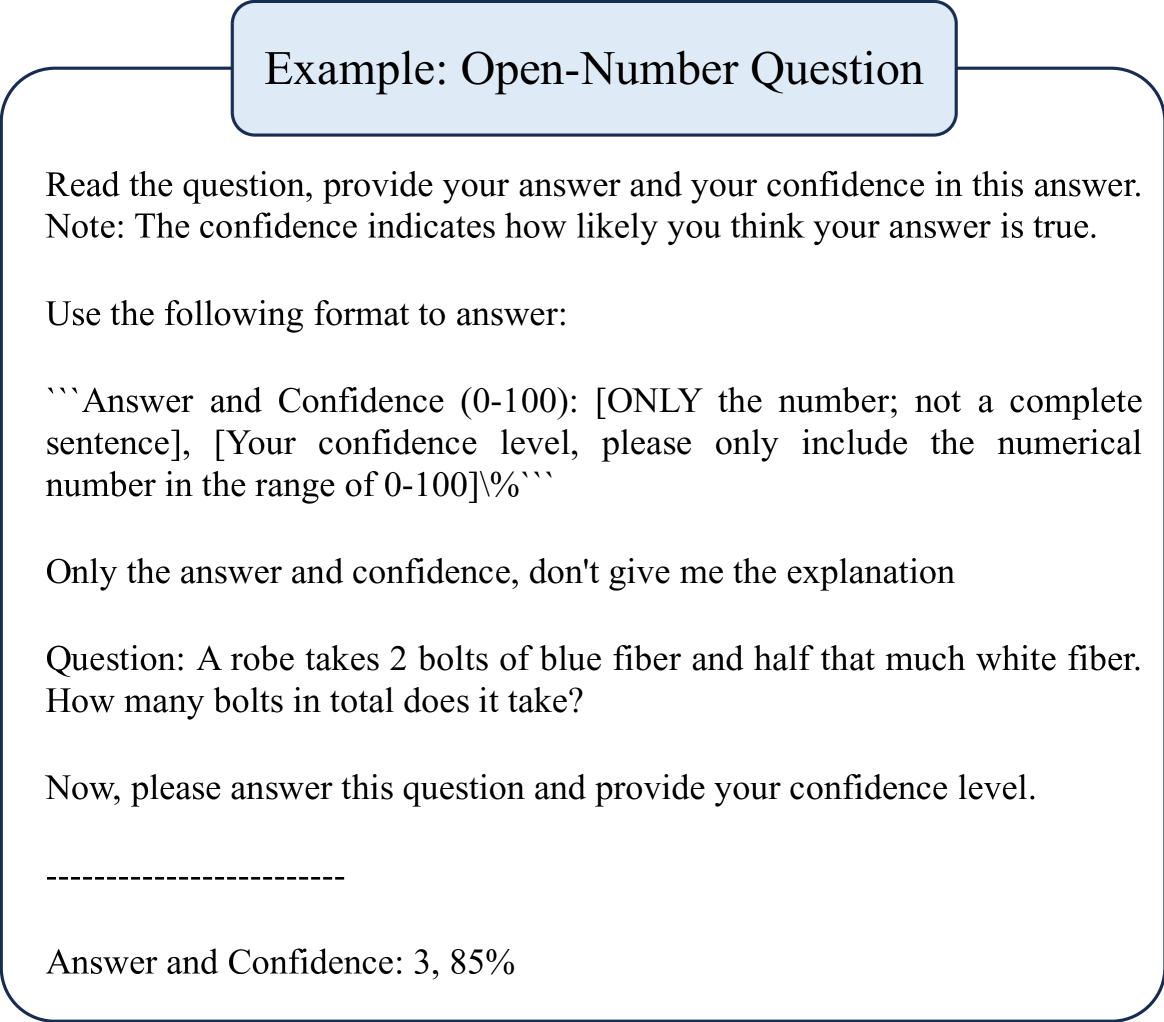
The image displays a structured example of an "Open-Number Question" format, including instructions, a sample question, and a formatted answer with confidence level. The layout emphasizes precision in numerical answers and confidence scoring.
### Components/Axes
- **Header**:
- Title: "Example: Open-Number Question" (centered, bold, light blue background).
- **Instructions**:
- Text: "Read the question, provide your answer and your confidence in this answer. Note: The confidence indicates how likely you think your answer is true. Use the following format to answer: [format example]."
- **Format Example**:
- Template: `""[Answer and Confidence (0-100): [ONLY the number; not a complete sentence], [Your confidence level, please only include the numerical number in the range of 0-100]%""`.
- **Question**:
- Text: "A robe takes 2 bolts of blue fiber and half that much white fiber. How many bolts in total does it take?"
- **Answer Section**:
- Placeholder: A horizontal line for manual input.
- Sample Answer: "Answer and Confidence: 3, 85%" (below the placeholder).
### Detailed Analysis
- **Title**: Clearly labeled as an example, with a light blue header box.
- **Instructions**: Explicitly directs users to provide a numerical answer and confidence score (0-100).
- **Format Example**: Strictly enforces a specific syntax for answers, emphasizing brevity and numerical-only responses.
- **Question**: A word problem requiring arithmetic (2 bolts blue fiber + 1 bolt white fiber = 3 total bolts).
- **Answer**: The sample answer "3, 85%" adheres to the format, with confidence expressed as a percentage.
### Key Observations
- The format prioritizes minimalism, avoiding explanations and focusing on numerical precision.
- Confidence scoring is decoupled from the answer, requiring separate input.
- The example uses a simple arithmetic problem to demonstrate the format.
### Interpretation
This example illustrates a structured approach to open-ended numerical questions, likely designed for educational or assessment tools. The confidence metric introduces subjectivity into objective answers, potentially to evaluate reasoning certainty. The strict formatting rules suggest automated grading or parsing requirements, where deviations could invalidate responses. The use of a basic math problem ensures clarity in demonstrating the format’s application.