## Optical System Diagram: Three Configurations for Light Modulation and Coupling
### Overview
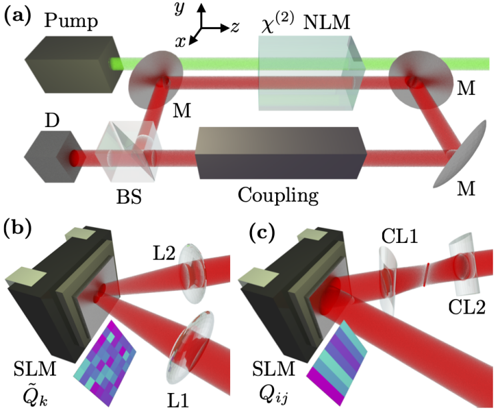
The image displays three distinct schematic diagrams, labeled (a), (b), and (c), illustrating different configurations of an optical system. The diagrams use a 3D-rendered style with color-coded light beams (green and red) and labeled components. The primary focus appears to be on setups involving a Pump laser, a nonlinear medium (NLM), spatial light modulators (SLMs), and various lenses and mirrors for beam steering and shaping.
### Components/Axes
**Common Elements:**
* **Light Beams:** Two distinct colors are used: a green beam and a red beam.
* **Coordinate System:** A 3D Cartesian coordinate system is shown in the top center of panel (a), with axes labeled `x`, `y`, and `z`.
* **Mirrors (M):** Multiple circular, reflective components labeled `M` are used to redirect the red beam path.
* **Spatial Light Modulator (SLM):** A device shown in panels (b) and (c), depicted as a dark rectangular block with a patterned active surface.
**Panel (a) Specific Components:**
* **Pump:** A dark gray rectangular block, source of the green beam.
* **χ⁽²⁾ NLM:** A light green translucent block labeled `χ⁽²⁾ NLM` (Nonlinear Medium with second-order susceptibility). The green beam passes through it.
* **Coupling:** A dark gray rectangular block positioned in the lower beam path.
* **BS:** A translucent cube labeled `BS` (Beam Splitter).
* **D:** A dark gray hexagonal component labeled `D` (likely a Detector).
* **Beam Path:** The green beam travels from the Pump, through the NLM. The red beam follows a more complex path, reflected by mirrors (`M`), passing through the `Coupling` block, and interacting with the `BS` before reaching detector `D`.
**Panel (b) Specific Components:**
* **SLM with Q̂_k:** The spatial light modulator displays a pattern labeled `Q̂_k`. The pattern is a grid of blue and purple squares.
* **L1, L2:** Two circular lenses labeled `L1` and `L2`.
* **Beam Path:** A single red beam originates from the SLM, splits into two diverging paths that pass through lenses `L1` and `L2` respectively, forming a V-shape.
**Panel (c) Specific Components:**
* **SLM with Q_ij:** The spatial light modulator displays a pattern labeled `Q_ij`. The pattern consists of vertical stripes in blue, purple, and cyan.
* **CL1, CL2:** Two cylindrical lenses labeled `CL1` and `CL2`.
* **Beam Path:** A single red beam originates from the SLM, passes through the cylindrical lenses `CL1` and `CL2`, and remains as a single, shaped beam.
### Detailed Analysis
**Panel (a) - Main Optical Setup:**
* **Spatial Layout:** The `Pump` and `NLM` are aligned along the z-axis at the top. The `Coupling` block is parallel to them but offset in the negative y-direction. The `BS` and `D` are positioned to the left (negative x-direction) of the main loop.
* **Beam Interaction:** The diagram suggests a process where a pump beam (green) interacts within a nonlinear medium (`χ⁽²⁾ NLM`). A secondary red beam is routed via mirrors through a `Coupling` element and is then analyzed or detected using a beam splitter (`BS`) and detector (`D`). This is characteristic of setups for nonlinear optics experiments, such as sum-frequency generation or parametric processes, where one beam (pump) influences another.
**Panel (b) - Diverging Beam Setup with Spherical Lenses:**
* **SLM Pattern (`Q̂_k`):** The pattern is a discrete, pixelated grid, suggesting a phase or amplitude mask designed to create a specific diffraction pattern or to address multiple spatial modes.
* **Optical Function:** The use of two separate spherical lenses (`L1`, `L2`) on diverging paths implies the system is designed to image or transform the SLM pattern into two distinct output channels or to perform a specific optical operation like a Fourier transform on separate parts of the beam.
**Panel (c) - Shaped Beam Setup with Cylindrical Lenses:**
* **SLM Pattern (`Q_ij`):** The pattern is composed of continuous vertical stripes, indicating a modulation that varies primarily along one spatial dimension (the horizontal axis in the pattern's local coordinates).
* **Optical Function:** Cylindrical lenses (`CL1`, `CL2`) affect focusing or divergence in only one axis. This setup is likely used to shape the beam's profile anisotropically—for example, to correct astigmatism, to create a line focus, or to perform a one-dimensional Fourier transform of the SLM pattern.
### Key Observations
1. **Progressive Complexity:** The panels show a progression from a complete system loop (a) to two specific subsystems or alternative configurations (b and c) that focus on beam modulation and shaping using an SLM.
2. **SLM Pattern Specificity:** The patterns on the SLMs are not generic; they are specifically labeled (`Q̂_k`, `Q_ij`) and visually distinct (pixelated grid vs. vertical stripes), indicating they are designed for different mathematical or optical functions.
3. **Lens Type Correlation:** The choice of lens is directly correlated to the SLM pattern. The discrete, 2D pattern in (b) uses spherical lenses, while the 1D-varying pattern in (c) uses cylindrical lenses.
4. **Color Consistency:** The red beam color is consistent across all three panels, suggesting it represents the same "signal" or "probe" beam being manipulated in different ways. The green beam is exclusive to panel (a), identifying it as the "pump."
### Interpretation
This diagram illustrates components of an advanced optical experiment, likely in the field of quantum optics, photonics, or laser physics. Panel (a) shows the core experimental apparatus where a nonlinear process is driven by a pump beam and probed by a red beam. Panels (b) and (c) detail two methods for preparing or analyzing the spatial profile of the red probe beam using a Spatial Light Modulator.
* **Purpose of SLMs:** The SLMs are used to impose programmable spatial patterns (`Q̂_k`, `Q_ij`) onto the beam's wavefront. This is a common technique for mode selection, beam shaping, wavefront correction, or implementing specific optical transformations.
* **Relationship Between Panels:** Panels (b) and (c) could represent two different modes of operation for the "Coupling" or detection arm shown in (a). For instance, the SLM and lens system might be placed where the detector `D` is, or within the `Coupling` block, to condition the beam before or after its interaction in the NLM.
* **Underlying Concept:** The labels `Q̂_k` and `Q_ij` suggest a mathematical formalism. `Q̂_k` might represent a set of discrete modes or operators (indexed by `k`), while `Q_ij` could represent a continuous transformation or a matrix element. The setups are physical implementations to realize these mathematical operations optically.
* **Technical Implication:** The system is designed for precise spatial control of light. The difference between (b) and (c) highlights how the optical elements (spherical vs. cylindrical lenses) must be matched to the dimensionality of the desired spatial modulation (2D vs. 1D) to achieve the correct output beam profile. This is crucial for applications like optical computing, quantum state preparation, or high-resolution imaging.