## Diagram: Two Major Pain Points in KG-LLM Reasoning
### Overview
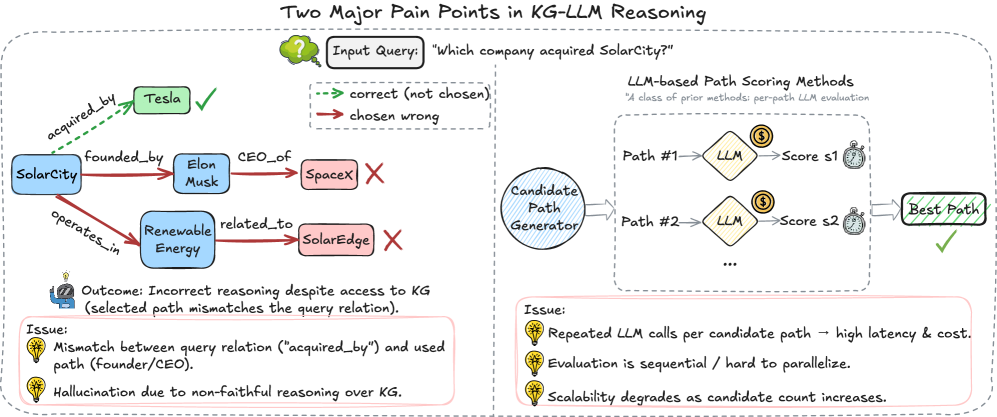
The diagram illustrates two critical challenges in knowledge graph (KG)-based large language model (LLM) reasoning. It contrasts a KG structure with an LLM-based path evaluation system, highlighting mismatches in reasoning and scalability issues. The left side shows a KG with entities and relationships, while the right side demonstrates how an LLM evaluates candidate reasoning paths.
### Components/Axes
#### Left Side (Knowledge Graph)
- **Entities**:
- SolarCity (blue box)
- Tesla (green box)
- Elon Musk (blue box)
- SpaceX (pink box)
- Renewable Energy (blue box)
- SolarEdge (pink box)
- **Relationships**:
- `acquired_by` (dashed green arrow: Tesla → SolarCity)
- `founded_by` (solid red arrow: SolarCity → Elon Musk)
- `CEO_of` (solid red arrow: Elon Musk → SpaceX)
- `operates_in` (solid red arrow: SolarCity → Renewable Energy)
- `related_to` (solid red arrow: Renewable Energy → SolarEdge)
- **Annotations**:
- Green checkmark next to Tesla (correct answer)
- Red X next to SpaceX (incorrectly chosen by LLM)
- Text box: "Outcome: Incorrect reasoning despite access to KG (selected path mismatches the query relation)."
#### Right Side (LLM-Based Path Scoring)
- **Components**:
- **Candidate Path Generator**: Circular node generating multiple paths.
- **LLM Evaluation**: Diamond-shaped nodes labeled "LLM" with associated scores (s1, s2, ...).
- **Best Path Selection**: Final node with green checkmark.
- **Annotations**:
- Text box: "Issue: Repeated LLM calls per candidate path → high latency & cost."
- Text box: "Issue: Evaluation is sequential / hard to parallelize."
- Text box: "Issue: Scalability degrades as candidate count increases."
### Detailed Analysis
#### Left Side (KG Structure)
1. **Correct Path**:
- SolarCity was acquired by Tesla (dashed green arrow).
- Confirmed by green checkmark.
2. **Incorrect Path**:
- LLM selected SpaceX via the `CEO_of` relationship (Elon Musk → SpaceX).
- Red X indicates error.
3. **Mismatched Relationships**:
- Query asks for "acquired_by," but LLM used "founded_by" and "CEO_of" paths.
- Hallucination due to non-faithful reasoning over KG.
#### Right Side (Path Scoring)
1. **Path Evaluation**:
- Multiple candidate paths (e.g., Path #1, Path #2) are scored by LLM.
- Scores (s1, s2) are assigned, but the process is sequential.
2. **Scalability Issues**:
- Repeated LLM calls increase latency and cost.
- Evaluation cannot be parallelized, limiting efficiency.
- Scalability degrades as candidate paths grow.
### Key Observations
1. **Incorrect Reasoning**: Despite access to the KG, the LLM failed to identify Tesla as the acquirer of SolarCity, instead selecting SpaceX via unrelated relationships.
2. **Path Evaluation Inefficiencies**: The sequential LLM evaluation process introduces high computational overhead and poor scalability.
3. **Hallucination**: The LLM generated a reasoning path (Elon Musk → SpaceX) that does not align with the query's required relationship ("acquired_by").
### Interpretation
The diagram highlights two systemic issues in KG-LLM integration:
1. **KG-LLM Mismatch**: The LLM's reasoning diverges from the KG's factual structure, leading to hallucinations. This suggests a need for tighter alignment between query intent and KG relationship semantics.
2. **Path Scoring Bottlenecks**: The sequential LLM evaluation creates scalability challenges, making the system impractical for large-scale applications. Parallelization or heuristic-based pruning of candidate paths could mitigate this.
3. **Trust in KG Data**: The failure to leverage the KG correctly implies either insufficient KG curation (e.g., missing "acquired_by" relationships) or inadequate LLM prompting to constrain reasoning to valid KG paths.
The diagram underscores the need for hybrid systems that combine KG constraints with LLM flexibility while addressing computational inefficiencies in path evaluation.