\n
## Mathematical Diagram: Commutative Stability Mapping
### Overview
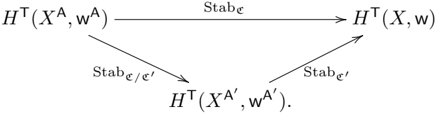
The image displays a commutative diagram from mathematical optimization or machine learning theory, illustrating relationships between different problem formulations and their stability properties. The diagram consists of three nodes connected by directed arrows, each labeled with a stability mapping.
### Components/Axes
The diagram is structured as a triangle with three nodes and three connecting arrows:
**Nodes (Mathematical Expressions):**
1. **Top-Left Node:** \( H^{\top}(X^A, \mathbf{w}^A) \)
2. **Top-Right Node:** \( H^{\top}(X, \mathbf{w}) \)
3. **Bottom Node:** \( H^{\top}(X^{A'}, \mathbf{w}^{A'}) \)
**Arrows (Mappings):**
1. **Horizontal Arrow (Top-Left to Top-Right):** Labeled "Stab\(_\epsilon\)".
2. **Diagonal Arrow (Top-Left to Bottom):** Labeled "Stab\(_{\epsilon/\epsilon'}\)".
3. **Diagonal Arrow (Bottom to Top-Right):** Labeled "Stab\(_{\epsilon'}\)".
**Spatial Grounding:**
* The diagram is centered on a white background.
* The three nodes form an inverted triangle: two nodes are aligned horizontally at the top, and the third node is centered below them.
* The arrows are straight lines with arrowheads pointing to the target node. The labels are placed approximately at the midpoint of each arrow.
### Detailed Analysis
The diagram defines a relationship between three instances of a function or set \( H^{\top} \), each parameterized by a pair \((X, \mathbf{w})\). The superscripts \(A\) and \(A'\) denote different variants or approximations of the primary parameters \((X, \mathbf{w})\).
The arrows represent "Stab" (stability) mappings, parameterized by values \(\epsilon\) and \(\epsilon'\). The structure implies that applying the stability mapping Stab\(_\epsilon\) directly from the top-left to the top-right node is equivalent to following the path through the bottom node: first applying Stab\(_{\epsilon/\epsilon'}\) and then Stab\(_{\epsilon'}\). This is the defining property of a commutative diagram.
### Key Observations
1. **Notation:** The use of bold \(\mathbf{w}\) typically denotes a vector, while \(X\) may represent a dataset, design matrix, or another structured input. \(H^{\top}\) could represent a hypothesis class, a loss function, or a set of optimal solutions.
2. **Hierarchy of Approximations:** The diagram suggests a hierarchy where \((X^A, \mathbf{w}^A)\) is an approximation of \((X^{A'}, \mathbf{w}^{A'})\), which in turn is an approximation of the original \((X, \mathbf{w})\). The stability mappings quantify how properties (like solutions or generalization bounds) are preserved under these approximations.
3. **Parameterized Stability:** The stability mappings are not generic but are controlled by specific parameters (\(\epsilon\), \(\epsilon'\), and their ratio \(\epsilon/\epsilon'\)). This indicates a precise, quantifiable relationship between the approximation errors.
### Interpretation
This diagram is a formal representation of a **stability-based approximation guarantee**. It visually encodes a theorem stating that if a problem defined by \((X^A, \mathbf{w}^A)\) is stable under the mapping Stab\(_{\epsilon/\epsilon'}\) to an intermediate approximation \((X^{A'}, \mathbf{w}^{A'})\), and that intermediate form is stable under Stab\(_{\epsilon'}\) to the final form \((X, \mathbf{w})\), then the original problem is stable under the composed mapping Stab\(_\epsilon\).
**What it means:** In practical terms, this could be used to prove that an efficient algorithm solving an approximate problem (top-left) will produce a solution that is close (within \(\epsilon\)) to the solution of the true, harder problem (top-right). The path through the bottom node provides a way to decompose and analyze the total error \(\epsilon\) into two controllable components, \(\epsilon'\) and \(\epsilon/\epsilon'\). This is a common technique in theoretical computer science and statistical learning theory to establish robustness and generalization bounds for algorithms.