## Diagram: Commutative Diagram of Homotopy Groups
### Overview
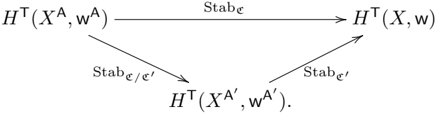
The image presents a commutative diagram illustrating relationships between homotopy groups. It shows how the homotopy group of a space (X^A, w^A) transforms into the homotopy group of another space (X, w) through different stabilization maps.
### Components/Axes
* **Nodes:**
* Top-left: H^T(X^A, w^A)
* Top-right: H^T(X, w)
* Bottom-center: H^T(X^A', w^A')
* **Arrows (Maps):**
* Top arrow: Stabe (from H^T(X^A, w^A) to H^T(X, w))
* Left arrow: Stab_{e/e'} (from H^T(X^A, w^A) to H^T(X^A', w^A'))
* Right arrow: Stab_{e'} (from H^T(X^A', w^A') to H^T(X, w))
### Detailed Analysis
The diagram depicts a commutative relationship between different homotopy groups and stabilization maps.
* **H^T(X^A, w^A):** This represents the T-equivariant homotopy group of the space X^A with a basepoint w^A. It is located at the top-left of the diagram.
* **H^T(X, w):** This represents the T-equivariant homotopy group of the space X with a basepoint w. It is located at the top-right of the diagram.
* **H^T(X^A', w^A'):** This represents the T-equivariant homotopy group of the space X^A' with a basepoint w^A'. It is located at the bottom-center of the diagram.
* **Stab_e:** This is a stabilization map from H^T(X^A, w^A) to H^T(X, w). It is represented by the arrow going from the top-left node to the top-right node.
* **Stab_{e/e'}:** This is a stabilization map from H^T(X^A, w^A) to H^T(X^A', w^A'). It is represented by the arrow going from the top-left node to the bottom-center node.
* **Stab_{e'}:** This is a stabilization map from H^T(X^A', w^A') to H^T(X, w). It is represented by the arrow going from the bottom-center node to the top-right node.
### Key Observations
The diagram shows that starting from H^T(X^A, w^A), one can reach H^T(X, w) either directly via Stab_e or indirectly via Stab_{e/e'} followed by Stab_{e'}. The commutativity of the diagram implies that these two paths are equivalent.
### Interpretation
The diagram illustrates a fundamental relationship in equivariant homotopy theory. It demonstrates how stabilization maps connect different homotopy groups, and the commutativity of the diagram highlights the consistency of these connections. The diagram suggests that the stabilization process can be decomposed into multiple steps, and the overall result is independent of the specific path taken. This type of diagram is crucial for understanding the structure and properties of equivariant homotopy groups and their relationships.