## Diagram: State Transition Model with Stabilization Functions
### Overview
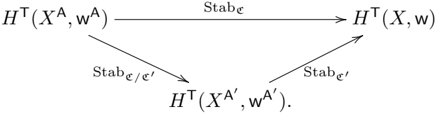
The diagram illustrates a state transition model involving three primary states connected by labeled transitions. It uses mathematical notation to represent transformations between states, with stabilization functions governing the transitions. The structure suggests a hierarchical or conditional relationship between the states.
### Components/Axes
- **Nodes (States):**
1. $ H^T(X^A, w^A) $: Initial state with parameters $ X^A $ and $ w^A $.
2. $ H^T(X, w) $: Intermediate state with parameters $ X $ and $ w $.
3. $ H^T(X^{A'}, w^{A'}) $: Final state with modified parameters $ X^{A'} $ and $ w^{A'} $.
- **Transitions (Arrows):**
1. $ \text{Stab}_\epsilon $: Transition from $ H^T(X^A, w^A) $ to $ H^T(X, w) $.
2. $ \text{Stab}_{\epsilon/\epsilon'} $: Transition from $ H^T(X^A, w^A) $ to $ H^T(X^{A'}, w^{A'}) $.
3. $ \text{Stab}_{\epsilon'} $: Transition from $ H^T(X, w) $ to $ H^T(X^{A'}, w^{A'}) $.
### Detailed Analysis
- **Node Labels**: All nodes use the notation $ H^T(\cdot) $, where the arguments vary:
- $ X^A, w^A $: Likely represent initial inputs or variables.
- $ X, w $: Simplified or transformed inputs.
- $ X^{A'}, w^{A'} $: Modified or derived inputs (denoted by primes).
- **Transition Labels**: Stabilization functions ($ \text{Stab} $) with subscripts indicating conditions:
- $ \epsilon $: A parameter or condition governing the first transition.
- $ \epsilon/\epsilon' $: A ratio or comparison between $ \epsilon $ and $ \epsilon' $.
- $ \epsilon' $: A modified or secondary condition.
### Key Observations
1. **Flow Direction**: The diagram shows a unidirectional flow from $ H^T(X^A, w^A) $ to $ H^T(X^{A'}, w^{A'}) $, with two possible paths:
- Direct path via $ \text{Stab}_{\epsilon/\epsilon'} $.
- Indirect path via $ \text{Stab}_\epsilon \rightarrow \text{Stab}_{\epsilon'} $.
2. **Parameter Evolution**: The primes in $ X^{A'} $ and $ w^{A'} $ suggest iterative or conditional updates to the initial parameters.
3. **Stabilization Logic**: The use of $ \text{Stab} $ implies constraints or adjustments to ensure stability during transitions.
### Interpretation
This diagram likely models a process where an initial state ($ H^T(X^A, w^A) $) evolves through stabilization mechanisms to reach a refined state ($ H^T(X^{A'}, w^{A'}) $). The two transition paths suggest conditional behavior:
- The direct path ($ \text{Stab}_{\epsilon/\epsilon'} $) may represent a shortcut under specific conditions.
- The indirect path ($ \text{Stab}_\epsilon \rightarrow \text{Stab}_{\epsilon'} $) could involve intermediate adjustments.
The use of stabilization functions ($ \text{Stab} $) implies that the transitions are not arbitrary but governed by constraints (e.g., error correction, optimization). The primes in the final state’s parameters ($ X^{A'}, w^{A'} $) indicate that the process introduces modifications to the original inputs, possibly through feedback or iterative refinement.
This structure is common in control systems, optimization algorithms, or machine learning pipelines where states represent model iterations or data transformations. The diagram abstracts the relationships between these stages, emphasizing the role of stabilization in ensuring valid transitions.