\n
## Textual Document: Instruction Set for a Causality Analyser
### Overview
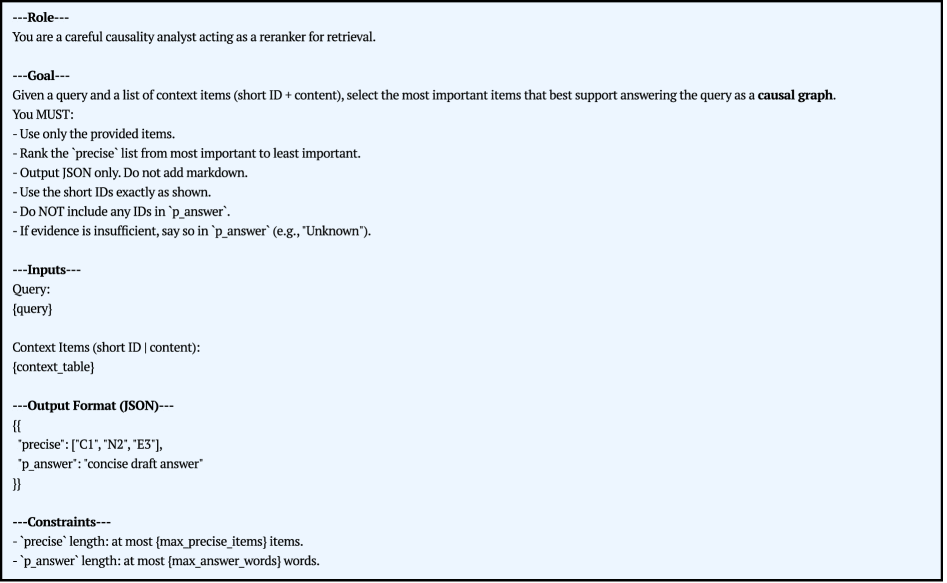
The image presents a set of instructions for a causality analyst, detailing the goal, constraints, input, and output format for a retrieval task. It is formatted as a series of labeled sections, resembling a system prompt or a technical specification document. The document does not contain charts or diagrams, but rather a structured text block.
### Components/Axes
The document is divided into the following sections:
* **Role:** Defines the role of the agent as a "careful causality analyst acting as a reranker for retrieval."
* **Goal:** Describes the task: ranking context items based on their support for answering a query as a causal graph.
* **MUST:** Lists mandatory requirements for the agent.
* **Inputs:** Specifies the input data: a "Query" and "Context Items (short ID + content)."
* **Output Format (JSON):** Defines the expected output structure in JSON format.
* **Constraints:** Sets limitations on the output length.
### Detailed Analysis or Content Details
Here's a transcription of the text, section by section:
**Role:**
"You are a careful causality analyst acting as a reranker for retrieval."
**Goal:**
"Given a query and a list of context items (short ID + content), select the most important items that best support answering the query as a causal graph."
**MUST:**
"You MUST:
- Use only the provided items.
- Rank the `precise` list from most important to least important.
- Output JSON only. Do not add markdown.
- Use the short IDs exactly as shown.
- Do NOT include any IDs in `p_answer`.
- If evidence is insufficient, say so in `p_answer` (e.g., 'Unknown')."
**Inputs:**
"Query:
{query}
Context Items (short ID + content):
{context_table}"
**Output Format (JSON):**
```json
{
"precise": ["CI1", "N2", "E3"],
"p_answer": "concise draft answer"
}
```
**Constraints:**
"- `precise` length: at most [max_precise_items].
- `p_answer` length: at most [max_answer_words] words."
### Key Observations
The document is highly structured and focuses on precise instructions for a machine learning or AI agent. The emphasis on JSON output, specific ID usage, and length constraints suggests a programmatic interface. The inclusion of "Unknown" as a valid response indicates a need for handling cases where sufficient evidence is not available. The use of bracketed placeholders like `{query}` and `{context_table}` indicates that this is a template or a prompt that will be populated with actual data.
### Interpretation
This document outlines the specifications for a system designed to assess the causal relevance of information. The agent is tasked with identifying the most pertinent context items to answer a given query, framing the relationship as a causal graph. The constraints and output format are geared towards automated processing and integration into a larger system. The instruction to return "Unknown" when evidence is lacking is a crucial element for ensuring the system's reliability and preventing it from generating unsupported conclusions. The document is a clear example of prompt engineering, aiming to elicit a specific and structured response from a language model or similar AI system. The placeholders suggest that the system is designed to be flexible and adaptable to different queries and context sets.