## Diagram: Retrieval-Augmented Generation vs. Iterative Retrieval-Augmented Generation
### Overview
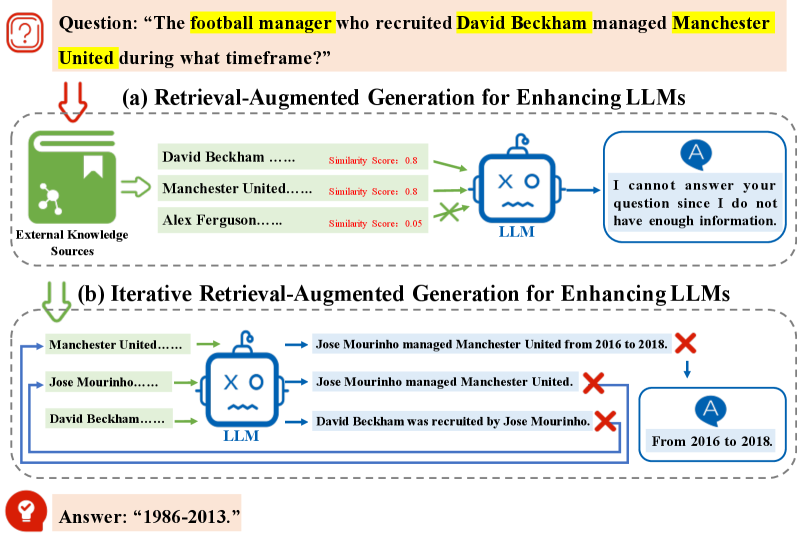
The image presents two diagrams illustrating different approaches to enhancing Large Language Models (LLMs) using retrieval-augmented generation. The first diagram (a) shows a basic retrieval-augmented generation, while the second (b) depicts an iterative approach. The diagrams demonstrate how external knowledge sources are used to provide context to the LLM for answering a specific question.
### Components/Axes
**Overall Structure:**
* The image is divided into two main sections, (a) and (b), each representing a different method.
* Each section includes:
* External Knowledge Sources
* LLM (Large Language Model)
* Output/Answer
**Section (a): Retrieval-Augmented Generation**
* **Title:** (a) Retrieval-Augmented Generation for Enhancing LLMs
* **External Knowledge Sources:** Represented by a green book icon.
* Entries:
* David Beckham ...... Similarity Score: 0.8
* Manchester United ...... Similarity Score: 0.8
* Alex Ferguson ...... Similarity Score: 0.05
* **LLM:** Represented by a blue robot-like icon with "X" and "O" on its face.
* **Output:** "I cannot answer your question since I do not have enough information."
**Section (b): Iterative Retrieval-Augmented Generation**
* **Title:** (b) Iterative Retrieval-Augmented Generation for Enhancing LLMs
* **External Knowledge Sources:**
* Entries:
* Manchester United ......
* Jose Mourinho ......
* David Beckham ......
* **LLM:** Represented by a blue robot-like icon with "X" and "O" on its face.
* **Outputs:**
* Jose Mourinho managed Manchester United from 2016 to 2018. (Marked with a red "X")
* Jose Mourinho managed Manchester United. (Marked with a red "X")
* David Beckham was recruited by Jose Mourinho. (Marked with a red "X")
* **Final Answer:** "From 2016 to 2018."
**Question and Answer:**
* **Question:** "The football manager who recruited David Beckham managed Manchester United during what timeframe?"
* **Answer:** "1986-2013."
### Detailed Analysis or Content Details
**Section (a):**
1. The LLM receives information about David Beckham, Manchester United, and Alex Ferguson from the external knowledge sources.
2. The similarity scores indicate the relevance of each entry to the question.
3. Despite the information, the LLM fails to provide a correct answer, stating it doesn't have enough information.
**Section (b):**
1. The LLM iteratively retrieves information about Manchester United, Jose Mourinho, and David Beckham.
2. The LLM generates several incorrect statements.
3. Finally, the LLM provides a timeframe "From 2016 to 2018" based on the retrieved information. However, this is still not the correct answer.
4. The correct answer is provided separately as "1986-2013."
### Key Observations
* The iterative approach (b) attempts to refine the answer through multiple retrievals and generations.
* Both approaches initially fail to provide the correct answer directly.
* The similarity scores in (a) do not guarantee a correct answer.
### Interpretation
The diagrams illustrate the challenges of using retrieval-augmented generation to answer complex questions. While providing external knowledge can improve the LLM's performance, it doesn't always guarantee accurate or complete answers. The iterative approach attempts to address this by refining the answer through multiple steps, but it can still lead to incorrect conclusions. The example highlights the need for more sophisticated methods to ensure the reliability and accuracy of LLMs when using external knowledge sources. The correct answer is provided separately, implying that neither method was successful in deriving the correct timeframe.