## Diagram: LLM Math Problem Solving Workflow
### Overview
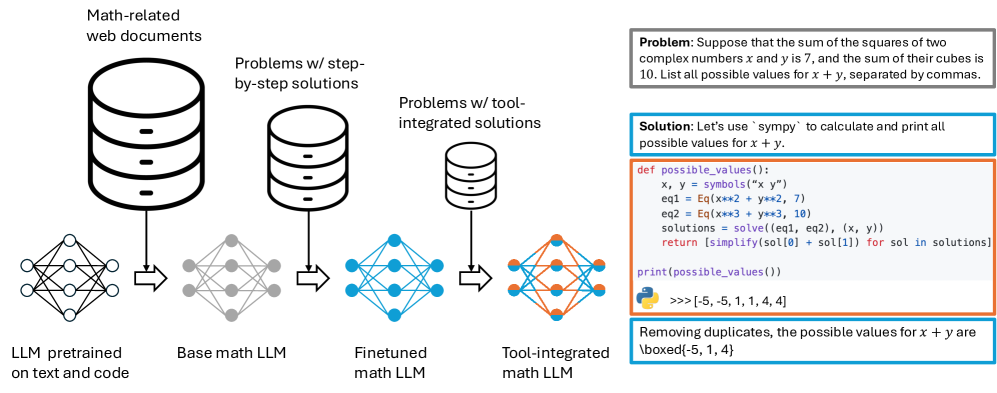
The image illustrates a workflow for solving math problems using different types of Language Learning Models (LLMs). It shows the progression from a general LLM pretrained on text and code to a tool-integrated math LLM, highlighting the data sources and processing steps involved. The diagram also includes a specific math problem, a Python code solution using the 'sympy' library, and the resulting possible values.
### Components/Axes
* **Data Sources (Top Row):**
* Math-related web documents
* Problems w/ step-by-step solutions
* Problems w/ tool-integrated solutions
* **LLM Types (Bottom Row):**
* LLM pretrained on text and code
* Base math LLM
* Finetuned math LLM
* Tool-integrated math LLM
* **Problem Statement (Top Right):**
* Problem: Suppose that the sum of the squares of two complex numbers x and y is 7, and the sum of their cubes is 10. List all possible values for x + y, separated by commas.
* **Solution (Middle Right):**
* Solution: Let's use 'sympy' to calculate and print all possible values for x + y.
* Python code block (see detailed analysis)
* Output: `>>> [-5, -5, 1, 1, 4, 4]`
* **Final Result (Bottom Right):**
* Removing duplicates, the possible values for x + y are \boxed{-5, 1, 4}
### Detailed Analysis
1. **Data Sources:** The diagram starts with three data sources, each represented by a stack of disks.
* "Math-related web documents" feeds into the "LLM pretrained on text and code."
* "Problems w/ step-by-step solutions" feeds into the "Base math LLM."
* "Problems w/ tool-integrated solutions" feeds into the "Tool-integrated math LLM."
2. **LLM Progression:** The diagram shows a progression of LLMs, each building upon the previous one.
* "LLM pretrained on text and code" is a general-purpose LLM. The nodes in the network are white.
* "Base math LLM" is a math-specific LLM, likely fine-tuned from the general LLM. The nodes in the network are gray.
* "Finetuned math LLM" is a further refined math LLM. The nodes in the network are blue.
* "Tool-integrated math LLM" is a math LLM that can use external tools. The nodes in the network are blue and orange.
3. **Problem and Solution:** The right side of the diagram presents a specific math problem and its solution.
* **Problem Statement:** The problem involves finding the possible values of x + y, given that x^2 + y^2 = 7 and x^3 + y^3 = 10, where x and y are complex numbers.
* **Python Code:** The solution uses the 'sympy' library to solve the equations.
```python
def possible_values():
x, y = symbols("x y")
eq1 = Eq(x**2 + y**2, 7)
eq2 = Eq(x**3 + y**3, 10)
solutions = solve((eq1, eq2), (x, y))
return [simplify(sol[0] + sol[1]) for sol in solutions]
print(possible_values())
```
* **Output:** The Python code outputs the list `[-5, -5, 1, 1, 4, 4]`.
* **Final Result:** After removing duplicates, the possible values for x + y are `[-5, 1, 4]`.
### Key Observations
* The diagram illustrates a pipeline for developing specialized LLMs for math problem-solving.
* The progression from general to specialized LLMs involves fine-tuning on specific data sources.
* The use of external tools (like 'sympy') enhances the capabilities of math LLMs.
* The example problem demonstrates how these LLMs can be used to solve complex mathematical problems.
### Interpretation
The diagram demonstrates the process of creating and utilizing specialized LLMs for mathematical problem-solving. It highlights the importance of curated datasets (step-by-step solutions, tool-integrated solutions) in fine-tuning general LLMs into powerful math-solving tools. The inclusion of a specific problem and its code-based solution provides a concrete example of how these LLMs can be applied. The progression from a general LLM to a tool-integrated LLM suggests a trend towards more sophisticated and capable AI systems that can leverage external resources to solve complex problems. The final result, `[-5, 1, 4]`, represents the successful application of this workflow to a challenging mathematical problem.