## Diagram: Math Problem Solving Pipeline with LLM Stages
### Overview
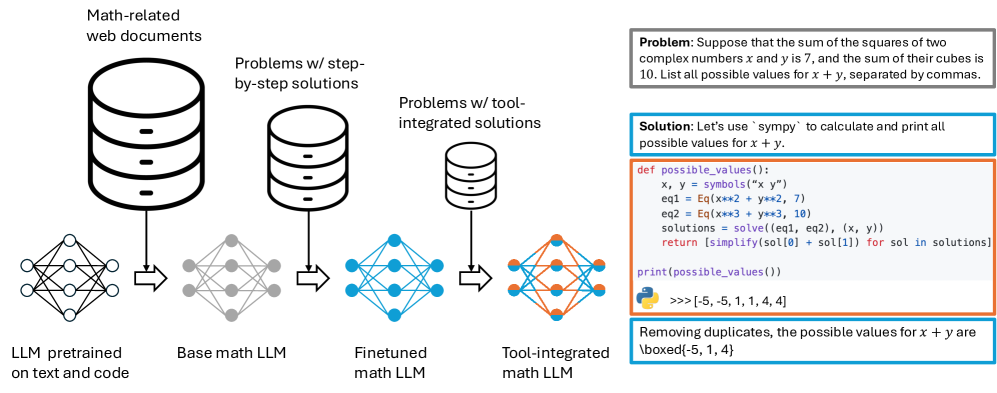
This technical diagram illustrates a multi-stage process for solving mathematical problems using large language models (LLMs). It shows three progressive stages of LLM refinement (Base, Finetuned, Tool-integrated) and demonstrates their application through a complex number problem example. The diagram combines conceptual flow diagrams with code implementation and results.
### Components/Axes
1. **Left Section (Conceptual Flow):**
- Three vertically stacked cylinders labeled:
- "Math-related web documents" (top)
- "Problems w/ step-by-step solutions" (middle)
- "Problems w/ tool-integrated solutions" (bottom)
- Three neural network diagrams connected by arrows:
- **Base math LLM**: Gray nodes with black connections
- **Finetuned math LLM**: Blue nodes with blue connections
- **Tool-integrated math LLM**: Orange nodes with orange connections
- Spatial grounding:
- Base LLM (leftmost) → Finetuned LLM (center) → Tool-integrated LLM (rightmost)
2. **Right Section (Problem/Solution):**
- Gray box containing:
- **Problem statement**: "Suppose that the sum of the squares of two complex numbers x and y is 7, and the sum of their cubes is 10. List all possible values for x + y, separated by commas."
- Orange box containing:
- **Solution code**: Python implementation using sympy library
- **Output**: `>>> [-5, -5, 1, 1, 4, 4]`
- Blue box containing:
- **Post-processing result**: "Removing duplicates, the possible values for x + y are \boxed{-5, 1, 4}"
### Detailed Analysis
1. **Conceptual Flow Components:**
- **Math-related web documents**: Raw data source (top cylinder)
- **Problems w/ step-by-step solutions**: Intermediate processing stage (middle cylinder)
- **Problems w/ tool-integrated solutions**: Advanced processing with external tools (bottom cylinder)
- Neural network progression shows increasing complexity:
- Base LLM: 4x4 grid (16 nodes)
- Finetuned LLM: 3x3 grid (9 nodes)
- Tool-integrated LLM: 2x2 grid (4 nodes) with orange coloration
2. **Problem/Solution Details:**
- **Problem constraints**:
- x² + y² = 7
- x³ + y³ = 10
- **Solution approach**:
- Symbolic computation using sympy
- Defined equations:
- eq1: x² + y² = 7
- eq2: x³ + y³ = 10
- Solved system for (x, y)
- Simplified solutions for x + y
- **Final output**:
- Raw solutions: [-5, -5, 1, 1, 4, 4]
- Deduplicated values: {-5, 1, 4}
### Key Observations
1. **LLM Progression**:
- Tool-integrated LLM shows most complex architecture despite fewer nodes, suggesting specialized capabilities
- Color coding (gray → blue → orange) visually represents increasing sophistication
2. **Problem Complexity**:
- Combines algebraic constraints with complex number theory
- Requires symbolic computation rather than numerical approximation
3. **Output Processing**:
- Explicit demonstration of post-processing (duplicate removal)
- Final answer presented in boxed mathematical notation
### Interpretation
This diagram demonstrates a systematic approach to mathematical problem-solving using progressively enhanced LLMs. The pipeline suggests:
1. **Knowledge Base**: Starts with raw web documents
2. **Training Progression**:
- Base LLM learns general patterns
- Finetuned LLM specializes in mathematical reasoning
- Tool-integrated LLM incorporates external computational tools
3. **Problem-Solving Capability**:
- The example problem requires solving a system of nonlinear equations
- The solution shows how symbolic computation (sympy) handles complex number constraints
- Final answer demonstrates both mathematical rigor (multiple solutions) and practical processing (duplicate removal)
The progression from raw data to tool-integrated solutions mirrors real-world AI development trajectories, where general models are refined through specialization and tool integration to handle increasingly complex tasks. The specific problem chosen (complex numbers with sum constraints) tests both algebraic manipulation and numerical stability in symbolic computation systems.