## Flow Diagram: Ethical Decision-Making Process
### Overview
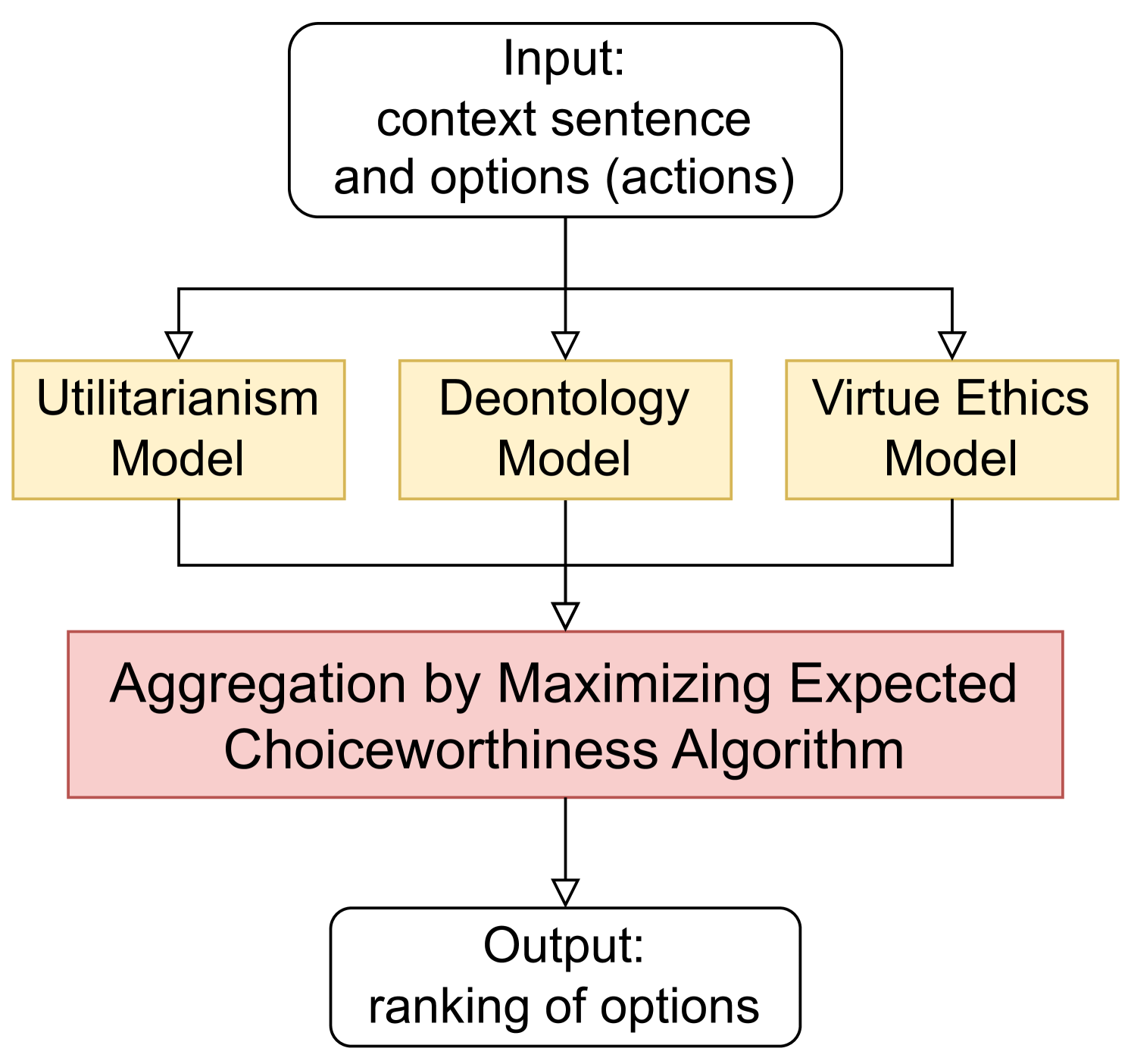
The image is a flow diagram illustrating an ethical decision-making process. It starts with an input of a context sentence and options (actions), feeds into three ethical models (Utilitarianism, Deontology, and Virtue Ethics), aggregates the results using a "Maximizing Expected Choiceworthiness Algorithm," and outputs a ranking of options.
### Components/Axes
* **Input:** A rounded rectangle at the top of the diagram labeled "Input: context sentence and options (actions)".
* **Ethical Models:** Three rectangular boxes, colored light yellow, arranged horizontally below the input. They are labeled "Utilitarianism Model", "Deontology Model", and "Virtue Ethics Model".
* **Aggregation Algorithm:** A rectangular box, colored light red, positioned below the ethical models. It is labeled "Aggregation by Maximizing Expected Choiceworthiness Algorithm".
* **Output:** A rounded rectangle at the bottom of the diagram labeled "Output: ranking of options".
* **Flow Arrows:** Downward-pointing arrows indicate the flow of information from the input to the ethical models, from the ethical models to the aggregation algorithm, and from the aggregation algorithm to the output.
### Detailed Analysis or ### Content Details
1. **Input:** The process begins with a "context sentence" and a set of "options (actions)". This suggests a scenario or situation requiring an ethical decision.
2. **Ethical Models:**
* **Utilitarianism Model:** This model likely evaluates options based on their overall utility or happiness generated.
* **Deontology Model:** This model likely evaluates options based on adherence to moral rules or duties.
* **Virtue Ethics Model:** This model likely evaluates options based on their alignment with virtuous character traits.
3. **Aggregation Algorithm:** The outputs of the three ethical models are fed into an "Aggregation by Maximizing Expected Choiceworthiness Algorithm." This algorithm combines the results from the different ethical perspectives to produce a single, aggregated score for each option.
4. **Output:** The final output is a "ranking of options," presumably ordered from most ethically desirable to least ethically desirable based on the algorithm's calculations.
### Key Observations
* The diagram presents a structured approach to ethical decision-making.
* It incorporates multiple ethical frameworks to provide a more comprehensive evaluation.
* The "Maximizing Expected Choiceworthiness Algorithm" serves as a central component for integrating the different ethical perspectives.
### Interpretation
The diagram illustrates a system for making ethical decisions by combining the outputs of three distinct ethical frameworks: Utilitarianism, Deontology, and Virtue Ethics. The system takes a context sentence and a set of possible actions as input. Each ethical model evaluates the options based on its specific principles. The results are then aggregated by an algorithm that aims to maximize "choiceworthiness," suggesting a weighted combination of the ethical perspectives. The final output is a ranked list of options, providing a structured and theoretically grounded approach to ethical decision-making. The diagram suggests that by considering multiple ethical viewpoints and using a formal aggregation method, one can arrive at a more robust and defensible ethical decision.