\n
## Diagram: Ethical Decision-Making Process
### Overview
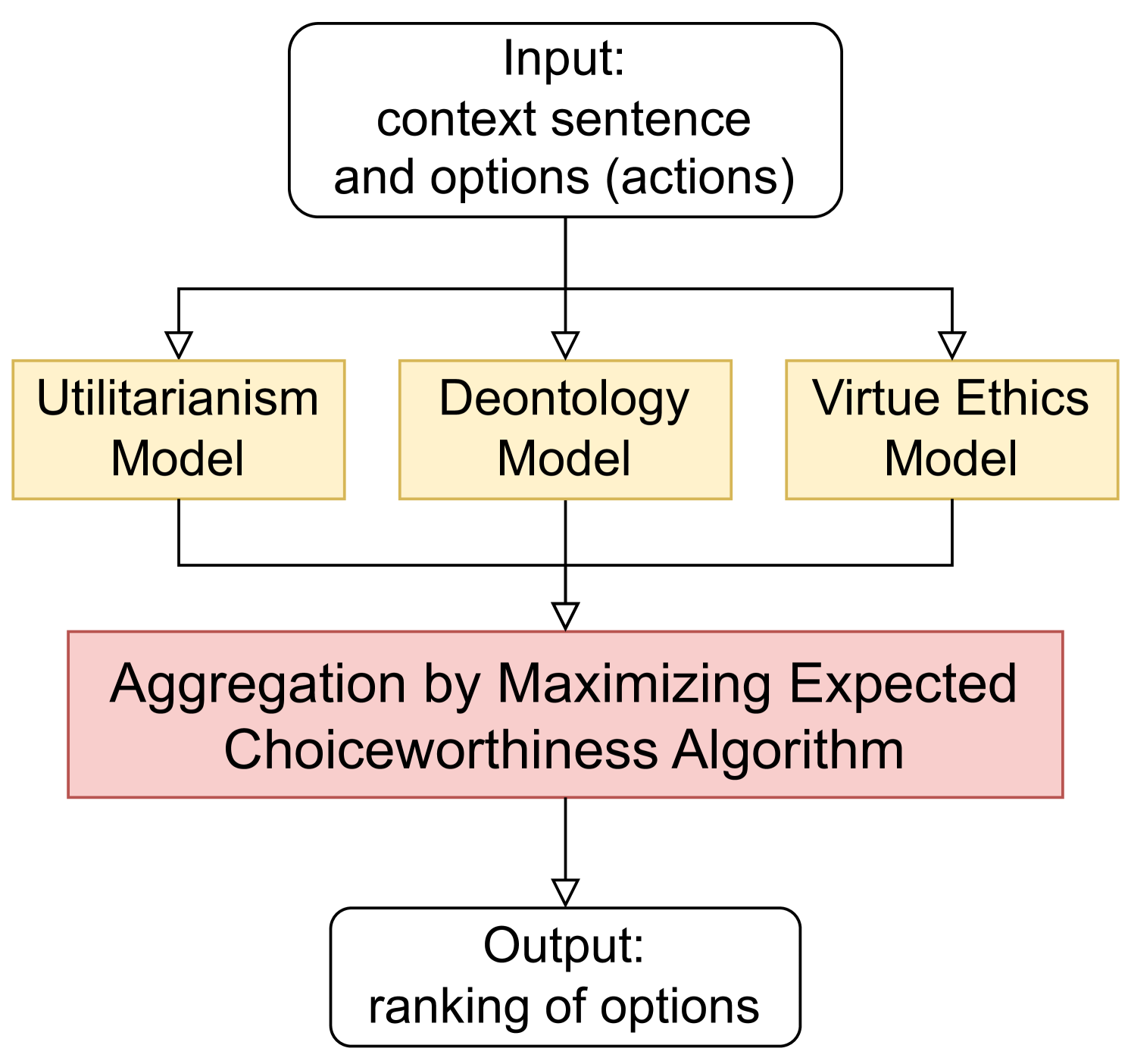
The image depicts a flowchart illustrating a process for ethical decision-making. The process takes an input of a "context sentence and options (actions)" and outputs a "ranking of options" after processing through three ethical models and an aggregation algorithm.
### Components/Axes
The diagram consists of the following components:
* **Input:** A rounded rectangle at the top, labeled "Input: context sentence and options (actions)".
* **Ethical Models:** Three yellow rectangles branching from the input, labeled "Utilitarianism Model", "Deontology Model", and "Virtue Ethics Model".
* **Aggregation:** A large pink rectangle below the ethical models, labeled "Aggregation by Maximizing Expected ChoiceWorthiness Algorithm".
* **Output:** A rounded rectangle at the bottom, labeled "Output: ranking of options".
* **Arrows:** White arrows indicating the flow of information from input to models, from models to aggregation, and from aggregation to output.
### Detailed Analysis or Content Details
The diagram shows a sequential process:
1. The process begins with an "Input" consisting of a "context sentence and options (actions)".
2. This input is fed into three separate "Ethical Models" simultaneously: "Utilitarianism Model", "Deontology Model", and "Virtue Ethics Model".
3. The outputs of these three models are then fed into an "Aggregation by Maximizing Expected ChoiceWorthiness Algorithm".
4. Finally, the output of the aggregation algorithm is a "ranking of options".
The diagram does not contain any numerical data or scales. It is a conceptual representation of a process.
### Key Observations
The diagram highlights the integration of multiple ethical frameworks (Utilitarianism, Deontology, and Virtue Ethics) into a single decision-making process. The "Aggregation by Maximizing Expected ChoiceWorthiness Algorithm" appears to be the core component that combines the insights from these different models.
### Interpretation
This diagram illustrates a sophisticated approach to ethical decision-making that moves beyond relying on a single ethical theory. By incorporating multiple perspectives, the process aims to provide a more comprehensive and nuanced evaluation of available options. The "Maximizing Expected ChoiceWorthiness Algorithm" suggests a quantitative or computational approach to combining these perspectives, potentially assigning weights or scores to different ethical considerations. The diagram implies that the output is not simply a "yes" or "no" answer, but rather a prioritized ranking of options, allowing for a more informed and flexible decision-making process. The diagram does not specify the details of the algorithm or how the ethical models generate their outputs, but it provides a high-level overview of the process flow.