## Diagram: Ethical Decision-Making Aggregation Flowchart
### Overview
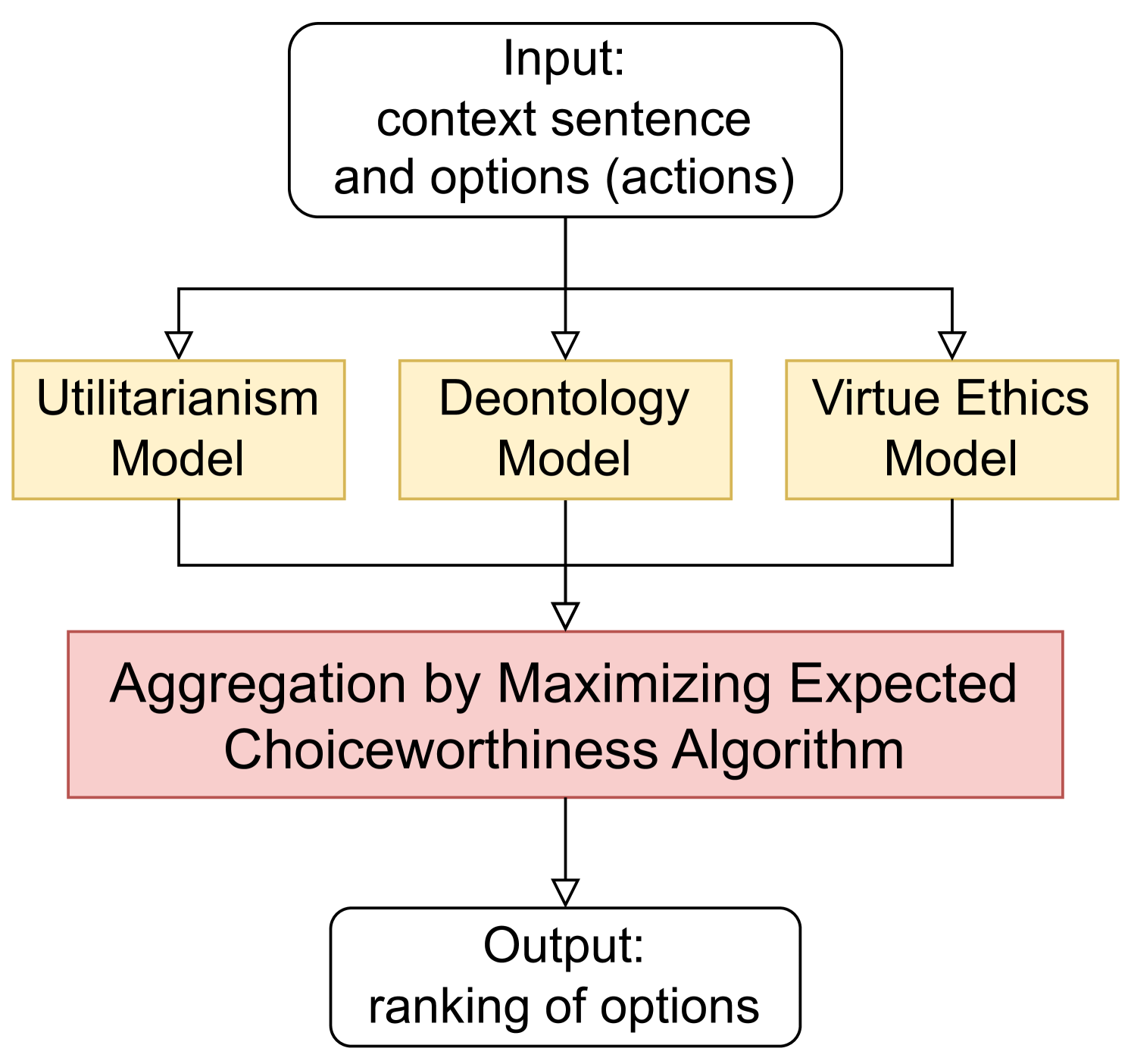
This image is a flowchart diagram illustrating a multi-model ethical decision-making system. The process begins with an input, which is then processed in parallel by three distinct ethical models. The outputs from these models are aggregated by a central algorithm, which produces a final ranked output. The diagram uses a top-down flow with clear directional arrows.
### Components/Axes
The diagram consists of five main rectangular boxes connected by directional arrows. The boxes are arranged in four distinct horizontal layers.
1. **Top Layer (Input):** A single white box with a black border.
* **Text Content:**
```
Input:
context sentence
and options (actions)
```
* **Position:** Centered at the top of the diagram.
2. **Middle Layer (Parallel Models):** Three light-yellow boxes with gold borders, arranged horizontally and centered below the input box.
* **Left Box Text:** `Utilitarianism Model`
* **Center Box Text:** `Deontology Model`
* **Right Box Text:** `Virtue Ethics Model`
* **Position:** These three boxes are in a row, directly below the input box. Arrows from the input box point down to each of these three boxes.
3. **Aggregation Layer:** A single light-red box with a dark red border.
* **Text Content:**
```
Aggregation by Maximizing Expected
Choiceworthiness Algorithm
```
* **Position:** Centered below the three model boxes. Arrows from all three model boxes converge and point down into this box.
4. **Bottom Layer (Output):** A single white box with a black border.
* **Text Content:**
```
Output:
ranking of options
```
* **Position:** Centered at the bottom of the diagram. An arrow from the aggregation box points down into this box.
**Flow Direction:** The arrows indicate a strict top-down, parallel-then-convergent flow: Input → [Utilitarianism Model, Deontology Model, Virtue Ethics Model] (in parallel) → Aggregation Algorithm → Output.
### Detailed Analysis
* **Component Isolation & Spatial Grounding:**
* **Header Region:** Contains only the "Input" box.
* **Main Processing Region:** Contains the three parallel ethical model boxes and the aggregation algorithm box. The three models are positioned equidistantly in a horizontal line.
* **Footer Region:** Contains only the "Output" box.
* **Text Transcription:** All text within the boxes has been transcribed exactly as it appears, preserving line breaks.
* **Relationships:** The diagram explicitly shows that the single input is fed simultaneously into three separate ethical frameworks. The outputs of these frameworks are not shown individually but are implied to be inputs to the aggregation algorithm. The aggregation algorithm then produces a single, final output.
### Key Observations
1. **Parallel Processing:** The core of the system is the parallel application of three major ethical theories (Utilitarianism, Deontology, Virtue Ethics) to the same problem.
2. **Centralized Aggregation:** A specific algorithm ("Maximizing Expected Choiceworthiness") is used to combine the potentially conflicting recommendations from the three ethical models.
3. **Unidirectional Flow:** The process is strictly feed-forward with no feedback loops or iterative steps shown.
4. **Abstraction:** The diagram is a high-level architectural view. It does not detail the internal workings of the individual ethical models or the aggregation algorithm.
### Interpretation
This flowchart represents a structured, computational approach to ethical reasoning. It suggests a system designed to make moral decisions by synthesizing multiple ethical perspectives rather than relying on a single doctrine.
* **What it demonstrates:** The system acknowledges that different ethical frameworks (consequence-based, duty-based, character-based) can lead to different conclusions. Instead of choosing one, it uses a meta-algorithm to find a consensus or optimal choice based on "expected choiceworthiness," which likely involves weighing the outputs from each model.
* **How elements relate:** The input provides the moral dilemma. The three models act as specialized "ethical sensors," each analyzing the dilemma through its own lens. The aggregation algorithm functions as a "moral integrator," resolving the analyses into a single actionable ranking.
* **Notable implications:** The design implies that a robust ethical decision can be achieved through the systematic combination of established moral philosophies. The final output is a "ranking of options," indicating the system is designed for scenarios with multiple possible actions, providing a prioritized list rather than a single binary choice. The absence of a "human-in-the-loop" component in the diagram suggests a fully automated decision-support or decision-making system.