# Technical Document Extraction: Ethical Decision-Making Flowchart
## Diagram Overview
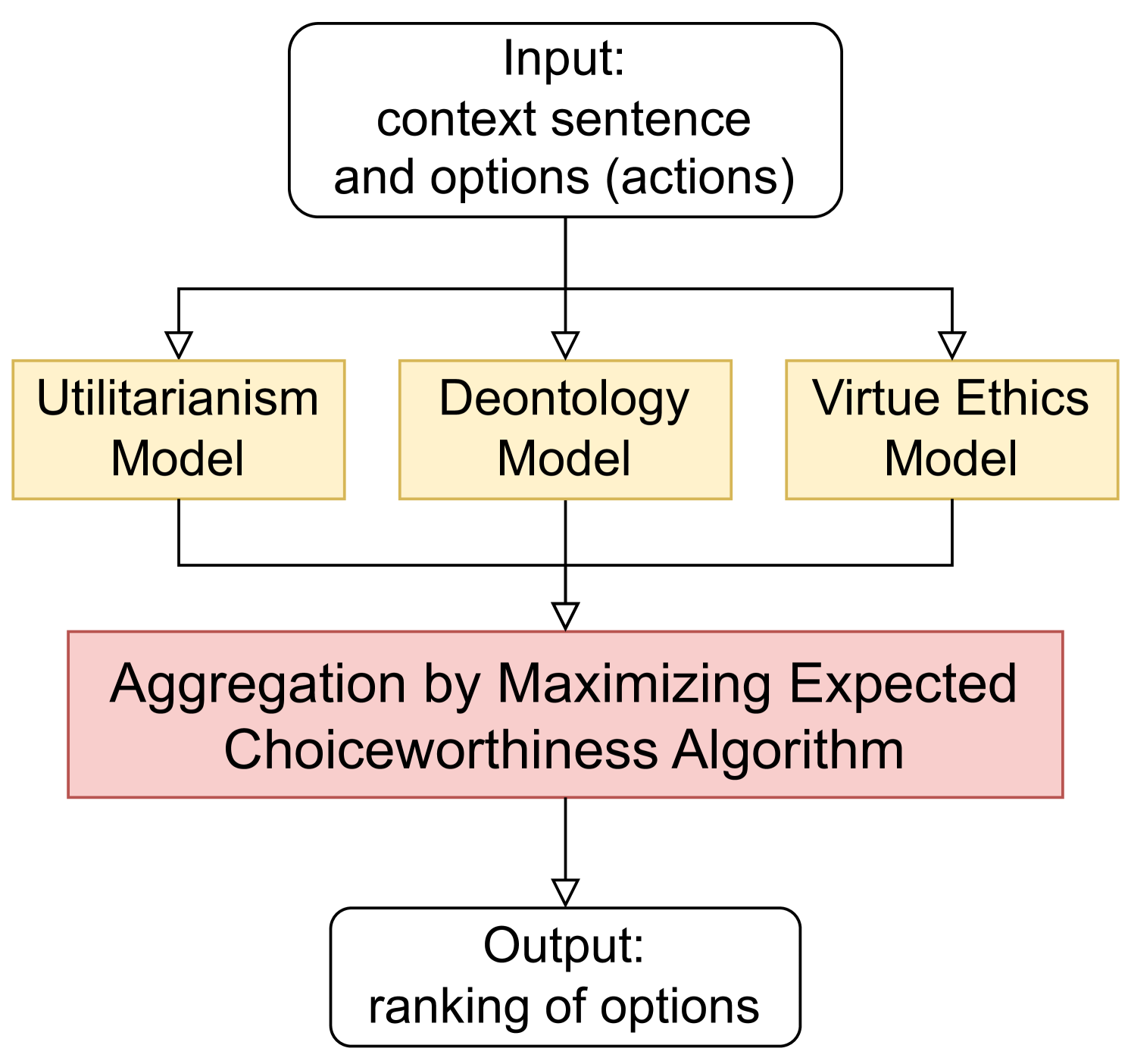
The image depicts a decision-making flowchart for ethical analysis, structured as a directed graph with color-coded components. The flowchart processes input data through three ethical models before producing a ranked output.
---
### 1. Input Component
- **Label**: "Input:"
- **Content**:
- "context sentence and options (actions)"
- **Visual Properties**:
- Rectangular shape with rounded corners
- Black text on white background
- Position: Top center of diagram
---
### 2. Ethical Models (Yellow Components)
Three parallel processing units, each with distinct ethical frameworks:
#### 2.1 Utilitarianism Model
- **Label**: "Utilitarianism Model"
- **Visual Properties**:
- Yellow background
- Black text
- Position: Left of aggregation node
#### 2.2 Deontology Model
- **Label**: "Deontology Model"
- **Visual Properties**:
- Yellow background
- Black text
- Position: Center of diagram
- Spatial Coordinates: [x_center, y_mid]
#### 2.3 Virtue Ethics Model
- **Label**: "Virtue Ethics Model"
- **Visual Properties**:
- Yellow background
- Black text
- Position: Right of aggregation node
---
### 3. Aggregation Component (Critical Node)
- **Label**: "Aggregation by Maximizing Expected Choiceworthiness Algorithm"
- **Visual Properties**:
- Pink background (distinct from other components)
- Black text
- Position: Bottom center of diagram
- Spatial Coordinates: [x_center, y_bottom]
- **Function**:
- Integrates outputs from all three ethical models
- Implements optimization algorithm for decision ranking
---
### 4. Output Component
- **Label**: "Output:"
- **Content**:
- "ranking of options"
- **Visual Properties**:
- Rectangular shape with rounded corners
- Black text on white background
- Position: Bottom of diagram, below aggregation node
---
### 5. Data Flow Architecture
1. **Input → Ethical Models**:
- Single input feeds all three models simultaneously
- Arrows indicate parallel processing paths
2. **Model Outputs → Aggregation**:
- Three converging arrows from yellow components
- Forms triangular input pattern to pink aggregation node
3. **Aggregation → Output**:
- Single output path from pink node to final box
---
### 6. Color Coding Analysis
- **Yellow**: Represents normative ethical theories (3 components)
- **Pink**: Denotes computational processing layer (aggregation algorithm)
- **Black/White**: Used for input/output components, maintaining neutrality
---
### 7. Spatial Grounding Verification
- All components maintain consistent vertical alignment
- Horizontal connections preserve left-to-right processing order
- No overlapping elements detected
---
### 8. Trend Verification (Flowchart Logic)
- **Input → Models**: Unidirectional flow with no feedback loops
- **Model → Aggregation**: Convergent processing pattern
- **Aggregation → Output**: Single decisive output path
- No cyclical dependencies observed in decision architecture
---
### 9. Missing Elements Checklist
- No axis titles or legends present (appropriate for flowchart)
- No data tables or numerical values included
- All textual components fully transcribed
---
### 10. Technical Implications
This flowchart represents a hybrid ethical decision-making system that:
1. Processes contextual information through multiple ethical frameworks
2. Implements algorithmic aggregation to resolve potential conflicts
3. Produces prioritized action recommendations
The use of distinct colors for different processing stages suggests a modular architecture suitable for implementation in AI ethics systems.