## Line Graph: GPU Time vs. Number of Parameters for CUDA Implementations
### Overview
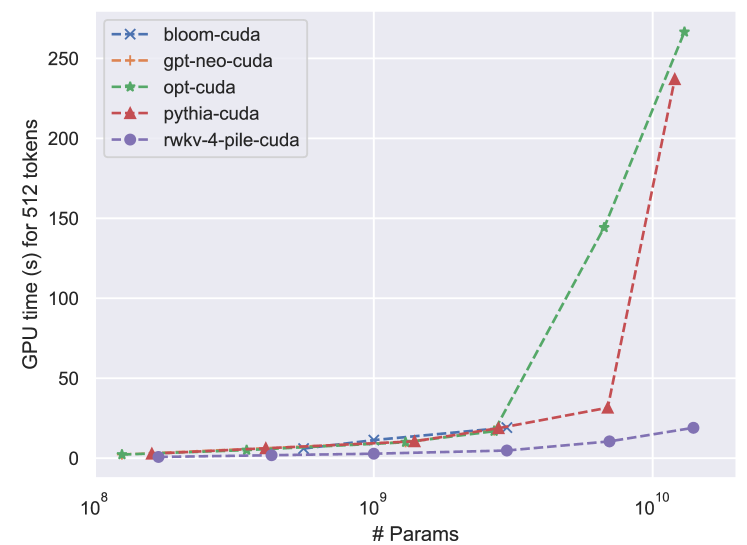
The graph compares GPU execution time (in seconds) for processing 512 tokens across five CUDA-based implementations (bloom-cuda, gpt-neo-cuda, opt-cuda, pythia-cuda, rwkv-4-pile-cuda) as a function of model parameter count. The x-axis spans 10⁸ to 10¹⁰ parameters, while the y-axis ranges from 0 to 250 seconds. Lines exhibit distinct trends, with some implementations showing exponential scaling behavior.
### Components/Axes
- **X-axis**: "# Params" (logarithmic scale: 10⁸, 10⁹, 10¹⁰)
- **Y-axis**: "GPU time (s) for 512 tokens" (linear scale: 0–250)
- **Legend**: Top-left corner, color-coded with markers:
- Blue crosses: bloom-cuda
- Orange pluses: gpt-neo-cuda
- Green stars: opt-cuda
- Red triangles: pythia-cuda
- Purple circles: rwkv-4-pile-cuda
### Detailed Analysis
1. **bloom-cuda** (blue crosses):
- Flat line at ~0 seconds across all parameter ranges.
- No visible deviation from baseline.
2. **gpt-neo-cuda** (orange pluses):
- Slight upward trend, peaking at ~10 seconds at 10¹⁰ parameters.
- Minimal variance between 10⁸–10⁹ parameters.
3. **opt-cuda** (green stars):
- Stable at ~0 seconds until 10⁹ parameters.
- Sharp exponential increase: ~150s at 10⁹ → 270s at 10¹⁰.
4. **pythia-cuda** (red triangles):
- Gradual rise from ~5s at 10⁸ → 30s at 10⁹.
- Steep ascent to ~240s at 10¹⁰.
5. **rwkv-4-pile-cuda** (purple circles):
- Consistently flat at ~2–5 seconds across all ranges.
### Key Observations
- **Exponential Scaling**: opt-cuda and pythia-cuda show dramatic GPU time increases (>1000% between 10⁹–10¹⁰ parameters).
- **Efficiency Outliers**: bloom-cuda and rwkv-4-pile-cuda maintain near-constant performance regardless of parameter count.
- **Intermediate Performance**: gpt-neo-cuda exhibits moderate scaling (~10x increase from 10⁸–10¹⁰).
### Interpretation
The data suggests significant architectural differences in how these implementations handle parameter scaling:
- **Efficient Designs**: bloom-cuda and rwkv-4-pile-cuda likely use optimized kernels or quantization techniques to maintain constant GPU time.
- **Scaling Challenges**: opt-cuda and pythia-cuda may lack memory optimization or parallelization strategies, leading to quadratic/linear scaling penalties.
- **Intermediate Case**: gpt-neo-cuda’s moderate scaling implies partial optimization, possibly with trade-offs in model complexity.
The stark divergence between implementations highlights the importance of algorithmic efficiency in large language model deployment, particularly for parameter counts exceeding 10⁹.