\n
## Diagram: Monster Hunter Attack Action Flow
### Overview
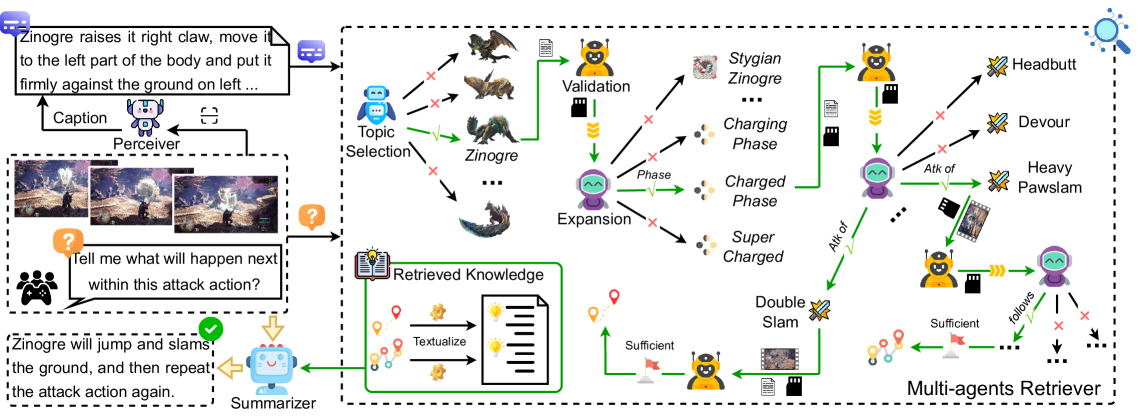
The image depicts a diagram illustrating the process of understanding and predicting attack actions of a monster, specifically the "Stygian Zinogre" from the Monster Hunter series. The diagram shows a flow of information from perceiving a monster's action, retrieving knowledge, and predicting the next steps in the attack sequence. It appears to be a conceptual model for an AI or multi-agent system designed to analyze monster behavior.
### Components/Axes
The diagram is divided into four main sections, arranged horizontally from left to right:
1. **Perceiver:** Handles initial perception of the monster's action.
2. **Knowledge Retrieval & Expansion:** Processes the perceived action to retrieve and expand relevant knowledge.
3. **Attack Phase Prediction:** Identifies the current attack phase and predicts subsequent actions.
4. **Multi-agents Retriever:** Utilizes multiple agents to validate and refine the prediction.
Key labels include: "Caption", "Topic Selection", "Validation", "Expansion", "Textualize", "Sufficient", "Phase", "Attk of", "Follows".
The monster is labeled "Zinogre" and "Stygian Zinogre".
Attack actions include: "Headbutt", "Devour", "Heavy Pawslam", "Double Slam", "Charging Phase", "Charged Phase", "Super Charged".
### Detailed Analysis or Content Details
**1. Perceiver (Leftmost Section):**
* An image of the Stygian Zinogre is present, with a dashed outline.
* A speech bubble contains the text: "Zinogre raises it right claw, move it to the left part of the body and put it firmly against the ground on left..."
* A controller icon with a question mark and the text: "Tell me what will happen next within this attack action?"
* A summarizer icon with the text: "Zinogre will jump and slams the ground, and then repeat the attack action again."
**2. Knowledge Retrieval & Expansion (Center-Left Section):**
* "Topic Selection" is labeled above a selection process.
* "Zinogre" is shown with a selection indicator.
* "Validation" and "Expansion" are labeled as processes.
* "Retrieved Knowledge" is represented by a block of vertical lines.
* "Textualize" is labeled, leading to a location marker icon.
* "Sufficient" is labeled, connecting to the next section.
**3. Attack Phase Prediction (Center-Right Section):**
* "Stygian Zinogre" is labeled.
* "Charging Phase" leads to "Charged Phase" which leads to "Super Charged".
* "Attk of" (Attack of) is labeled, connecting "Charged Phase" and "Super Charged" to "Double Slam".
* "Phase" is labeled, connecting "Charging Phase" to "Charged Phase".
**4. Multi-agents Retriever (Rightmost Section):**
* "Headbutt", "Devour", and "Heavy Pawslam" are labeled as potential attack actions.
* "Attk of" (Attack of) is labeled, connecting "Headbutt" and "Devour" to the next stage.
* "Sufficient" is labeled, connecting the attack actions to a flow diagram with location marker icons and arrows labeled "Follows".
### Key Observations
* The diagram illustrates a sequential process, starting with perception and culminating in attack prediction.
* The "Sufficient" label suggests a threshold or confidence level is reached before proceeding to the next stage.
* The multi-agent retriever section indicates that multiple potential attack actions are considered and evaluated.
* The diagram focuses on the Stygian Zinogre, suggesting it's a specific case study or example.
* The flow is largely linear, with feedback loops implied by the "Validation" and "Expansion" processes.
### Interpretation
This diagram represents a system designed to understand and predict the attack patterns of a monster in a game context. The system takes visual input (the monster's action), retrieves relevant knowledge about the monster and its attacks, and then predicts the next steps in the attack sequence. The multi-agent retriever component suggests a probabilistic approach, where multiple possible attacks are considered and ranked based on their likelihood. The "Sufficient" label implies a confidence threshold that must be met before a prediction is considered reliable.
The diagram highlights the complexity of monster behavior and the need for a sophisticated system to accurately predict attacks. It suggests a combination of visual perception, knowledge retrieval, and probabilistic reasoning is required to achieve this goal. The diagram is likely a conceptual model for an AI system or a component within a larger game AI framework. The use of terms like "Validation" and "Expansion" suggests a learning component, where the system can refine its knowledge and improve its prediction accuracy over time. The diagram is a high-level overview and does not provide details on the specific algorithms or techniques used in each stage.